
About This Book
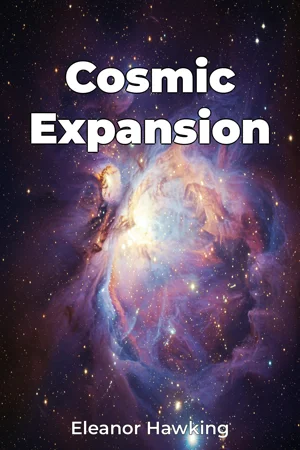
What if the very fabric of the universe is stretching, carrying galaxies away from each other at an ever-increasing pace, shaping the ultimate destiny of existence? This book, "Cosmic Expansion," delves into one of the most profound and awe-inspiring discoveries of modern cosmology: the accelerating expansion of the universe. We will explore the evidence for this expansion, the mysterious force driving it, and its implications for the future of everything. The first key concept is the expansion itself, its measurement, and the history of its discovery. We'll examine the work of Edwin Hubble and others who first observed the redshift of distant galaxies, providing evidence that the universe is not static but expanding. This section is crucial because it lays the foundation for understanding the subsequent developments and challenges to existing cosmological models. Second, we will investigate dark energy, the enigmatic entity believed to be responsible for the accelerated expansion. We delve into the theoretical models of dark energy, from the cosmological constant to more complex quintessence models, while acknowledging what we do not yet know. Understanding the fundamental nature of dark energy is critical because it dominates the energy density of the universe and dictates its long-term evolution. Third, we will explore the consequences of cosmic expansion for the fate of the universe. Will the expansion continue forever, leading to a "heat death" where all energy is evenly distributed? Or will dark energy weaken, leading to eventual contraction? These possible outcomes are explored in detail, highlighting the far-reaching implications of current cosmological research. "Cosmic Expansion" argues that the accelerating expansion of the universe represents not just a cosmological curiosity but a fundamental challenge to our understanding of physics. The book will show how the standard model of particle physics fails to explain the observed amount of dark energy, indicating the need for new theoretical frameworks. The book is divided into three sections. The first section introduces the basic concepts of cosmology, including the Big Bang theory, cosmic microwave background radiation, and the large-scale structure of the universe. The second part delves into the evidence for the accelerated expansion, including supernova observations, baryon acoustic oscillations, and gravitational lensing. This section rigorously presents the data supporting the expansion. The third section discusses the implications of cosmic expansion for the future of the universe: the "Big Rip," "Big Freeze," and "Big Crunch" scenarios. We will present data from multiple sources, including the Hubble Space Telescope, the Wilkinson Microwave Anisotropy Probe (WMAP), and the Planck satellite. These data, coupled with theoretical models, provide a robust and compelling argument for the accelerating expansion of the universe. This book connects to various other fields, including particle physics, astrophysics, and general relativity. The study of dark energy requires insights from both cosmology and particle physics, while the expansion of the universe is fundamentally governed by general relativity. These interdisciplinary connections emphasize the interconnectedness of modern science. "Cosmic Expansion" offers a comprehensive overview of the expansion of the universe, focusing specifically on the physics. The book also addresses the limits of current understanding, discussing the challenges and uncertainties associated with dark energy research. This book is intended for students, researchers, and anyone interested in cosmology and astrophysics. A basic understanding of physics and mathematics will be helpful, but the book is written in a clear and accessible style. It offers a valuable resource for anyone seeking to understand this important area of modern science. As a work of non-fiction, "Cosmic Expansion" adheres to the highest standards of accuracy. All claims are supported by evidence, and the book is designed to be informative and educational. The book focuses on the observable universe and its expansion, but does not address topics such as the multiverse or speculative theories beyond the realm of testable physics. This focused scope allows for a detailed examination of the primary topic. The implications of cosmic expansion extend beyond theoretical physics. Understanding the nature of dark energy may lead to new insights into the fundamental laws of nature and potentially to new technologies. The book acknowledges the ongoing debates about the nature of dark energy and alternative explanations for the accelerated expansion, such as modifications to general relativity. The book explores these options without speculation.
What if the very fabric of the universe is stretching, carrying galaxies away from each other at an ever-increasing pace, shaping the ultimate destiny of existence? This book, "Cosmic Expansion," delves into one of the most profound and awe-inspiring discoveries of modern cosmology: the accelerating expansion of the universe. We will explore the evidence for this expansion, the mysterious force driving it, and its implications for the future of everything. The first key concept is the expansion itself, its measurement, and the history of its discovery. We'll examine the work of Edwin Hubble and others who first observed the redshift of distant galaxies, providing evidence that the universe is not static but expanding. This section is crucial because it lays the foundation for understanding the subsequent developments and challenges to existing cosmological models. Second, we will investigate dark energy, the enigmatic entity believed to be responsible for the accelerated expansion. We delve into the theoretical models of dark energy, from the cosmological constant to more complex quintessence models, while acknowledging what we do not yet know. Understanding the fundamental nature of dark energy is critical because it dominates the energy density of the universe and dictates its long-term evolution. Third, we will explore the consequences of cosmic expansion for the fate of the universe. Will the expansion continue forever, leading to a "heat death" where all energy is evenly distributed? Or will dark energy weaken, leading to eventual contraction? These possible outcomes are explored in detail, highlighting the far-reaching implications of current cosmological research. "Cosmic Expansion" argues that the accelerating expansion of the universe represents not just a cosmological curiosity but a fundamental challenge to our understanding of physics. The book will show how the standard model of particle physics fails to explain the observed amount of dark energy, indicating the need for new theoretical frameworks. The book is divided into three sections. The first section introduces the basic concepts of cosmology, including the Big Bang theory, cosmic microwave background radiation, and the large-scale structure of the universe. The second part delves into the evidence for the accelerated expansion, including supernova observations, baryon acoustic oscillations, and gravitational lensing. This section rigorously presents the data supporting the expansion. The third section discusses the implications of cosmic expansion for the future of the universe: the "Big Rip," "Big Freeze," and "Big Crunch" scenarios. We will present data from multiple sources, including the Hubble Space Telescope, the Wilkinson Microwave Anisotropy Probe (WMAP), and the Planck satellite. These data, coupled with theoretical models, provide a robust and compelling argument for the accelerating expansion of the universe. This book connects to various other fields, including particle physics, astrophysics, and general relativity. The study of dark energy requires insights from both cosmology and particle physics, while the expansion of the universe is fundamentally governed by general relativity. These interdisciplinary connections emphasize the interconnectedness of modern science. "Cosmic Expansion" offers a comprehensive overview of the expansion of the universe, focusing specifically on the physics. The book also addresses the limits of current understanding, discussing the challenges and uncertainties associated with dark energy research. This book is intended for students, researchers, and anyone interested in cosmology and astrophysics. A basic understanding of physics and mathematics will be helpful, but the book is written in a clear and accessible style. It offers a valuable resource for anyone seeking to understand this important area of modern science. As a work of non-fiction, "Cosmic Expansion" adheres to the highest standards of accuracy. All claims are supported by evidence, and the book is designed to be informative and educational. The book focuses on the observable universe and its expansion, but does not address topics such as the multiverse or speculative theories beyond the realm of testable physics. This focused scope allows for a detailed examination of the primary topic. The implications of cosmic expansion extend beyond theoretical physics. Understanding the nature of dark energy may lead to new insights into the fundamental laws of nature and potentially to new technologies. The book acknowledges the ongoing debates about the nature of dark energy and alternative explanations for the accelerated expansion, such as modifications to general relativity. The book explores these options without speculation.
"Cosmic Expansion" explores the accelerating expansion of the universe, a groundbreaking discovery in cosmology. It examines evidence supporting this phenomenon, dark energy's role, and the implications for the universe's fate. One intriguing aspect discussed is how the expansion challenges our current understanding of physics, particularly the standard model of particle physics. The book also highlights observations from the Hubble Space Telescope, WMAP, and the Planck satellite, showcasing how data from these sources support the accelerating expansion. The book progresses by first introducing fundamental cosmology concepts like the Big Bang theory and the cosmic microwave background. It then presents evidence for accelerated expansion through supernova observations and baryon acoustic oscillations. Finally, it delves into potential future scenarios like the Big Rip, Big Freeze, and Big Crunch. "Cosmic Expansion" stands out by focusing specifically on the physics of cosmic expansion and dark energy, making it a valuable resource for students, researchers, and anyone interested in astrophysics.
Book Details
ISBN
9788233966126
Publisher
Publifye AS
Your Licenses
You don't own any licenses for this book
Purchase a license below to unlock this book and download the EPUB.
Purchase License
Select a tier to unlock this book
Need bulk licensing?
Contact us for enterprise agreements.