
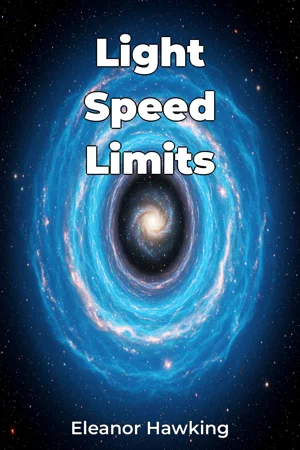
About This Book
Have you ever stopped to consider why there's a universal speed limit? This book, *Light Speed Limits*, explores the fascinating and fundamental principle that nothing can travel faster than light, delving into the physics that govern our universe and the implications of this cosmic speed restriction. We will unpack what transpires as objects approach light speed, and contemplate the theoretical possibilities, and significant hurdles, of achieving faster-than-light travel through concepts like warp drives. Understanding these concepts is paramount to appreciating the very fabric of spacetime and the limitations it imposes on our aspirations for interstellar travel. The book's central argument posits that while exceeding the speed of light remains firmly within the realm of theoretical physics, comprehending the established laws that prevent it is crucial for both advancing our scientific knowledge and grounding our technological ambitions. This understanding is not just about theoretical constraints; it shapes our approach to everything from particle physics experiments to the search for extraterrestrial life. *Light Speed Limits* begins by introducing the historical context of special relativity, explaining how Einstein's postulates revolutionized our understanding of space and time. We then explore the core tenets of relativity, including time dilation, length contraction, and the increase of mass with velocity. The book subsequently dedicates significant attention to the energy requirements for approaching light speed, illustrating the exponential increase in energy needed as an object accelerates. Through concrete examples and calculations, we elucidate why reaching the speed of light would necessitate infinite energy, effectively precluding any object with mass from attaining it. A later section of the book examines the consequences of near-light speed travel, covering topics such as relativistic momentum, the twin paradox, and the Doppler effect. This portion uses thought experiments and real-world applications, like particle accelerators, to solidify understanding. Finally, we delve into speculative physics, investigating the theoretical possibilities for circumventing the light speed barrier. This includes a thorough examination of warp drives based on solutions to Einstein's field equations, wormholes, and other hypothetical concepts. We rigorously assess the potential advantages and, critically, the immense challenges associated with each idea, from the exotic matter requirements to the potential paradoxes of time travel. To support its arguments, *Light Speed Limits* draws on a wide range of sources, including peer-reviewed scientific papers, experimental data from particle physics facilities, and theoretical models of spacetime. The book presents complex equations in an accessible manner, supplementing them with diagrams and visualizations. The primary methodology involves analyzing and synthesizing existing research to provide a cohesive and comprehensive overview of the topic. This book has interdisciplinary connections to cosmology, quantum mechanics, and engineering. The discussion of warp drives naturally links to the challenges in engineering such systems, while the quantum realm may present certain loopholes that future theories could possibly utilize. The book's examination of time dilation and its effects on cosmic distances ties directly into the larger field of cosmology. *Light Speed Limits* adopts a neutral, informative tone, aiming to present the science accurately. It avoids sensationalism and focuses on the established physics while acknowledging the speculative nature of faster-than-light travel. The intended audience includes science enthusiasts, students of physics, and anyone curious about the fundamental laws governing our universe. The book is valuable to those seeking a clear and comprehensive understanding of the speed of light as a cosmic limit and the potential pathways, however improbable, for overcoming it. The book is constrained to the realm of current theoretical and experimental physics. It does engage with theoretical constructs, but only through an analytical and fact-based lens. It does not delve into science fiction beyond referencing the origins of some theoretical concepts. While faster-than-light travel remains beyond our current capabilities, understanding the limitations and possibilities has practical implications. Research into advanced propulsion systems, motivated by the desire for faster space travel, could lead to breakthroughs in energy production and materials science. Moreover, a deep appreciation for the constraints of physics is essential for responsible scientific inquiry and technological development. The discussion of warp drives and wormholes inevitably touches upon ongoing debates within the scientific community. Are these concepts fundamentally flawed, or do they represent legitimate, albeit highly challenging, avenues for future research? *Light Speed Limits* acknowledges these debates, presenting different perspectives and critically evaluating the evidence for and against each viewpoint.
Have you ever stopped to consider why there's a universal speed limit? This book, *Light Speed Limits*, explores the fascinating and fundamental principle that nothing can travel faster than light, delving into the physics that govern our universe and the implications of this cosmic speed restriction. We will unpack what transpires as objects approach light speed, and contemplate the theoretical possibilities, and significant hurdles, of achieving faster-than-light travel through concepts like warp drives. Understanding these concepts is paramount to appreciating the very fabric of spacetime and the limitations it imposes on our aspirations for interstellar travel. The book's central argument posits that while exceeding the speed of light remains firmly within the realm of theoretical physics, comprehending the established laws that prevent it is crucial for both advancing our scientific knowledge and grounding our technological ambitions. This understanding is not just about theoretical constraints; it shapes our approach to everything from particle physics experiments to the search for extraterrestrial life. *Light Speed Limits* begins by introducing the historical context of special relativity, explaining how Einstein's postulates revolutionized our understanding of space and time. We then explore the core tenets of relativity, including time dilation, length contraction, and the increase of mass with velocity. The book subsequently dedicates significant attention to the energy requirements for approaching light speed, illustrating the exponential increase in energy needed as an object accelerates. Through concrete examples and calculations, we elucidate why reaching the speed of light would necessitate infinite energy, effectively precluding any object with mass from attaining it. A later section of the book examines the consequences of near-light speed travel, covering topics such as relativistic momentum, the twin paradox, and the Doppler effect. This portion uses thought experiments and real-world applications, like particle accelerators, to solidify understanding. Finally, we delve into speculative physics, investigating the theoretical possibilities for circumventing the light speed barrier. This includes a thorough examination of warp drives based on solutions to Einstein's field equations, wormholes, and other hypothetical concepts. We rigorously assess the potential advantages and, critically, the immense challenges associated with each idea, from the exotic matter requirements to the potential paradoxes of time travel. To support its arguments, *Light Speed Limits* draws on a wide range of sources, including peer-reviewed scientific papers, experimental data from particle physics facilities, and theoretical models of spacetime. The book presents complex equations in an accessible manner, supplementing them with diagrams and visualizations. The primary methodology involves analyzing and synthesizing existing research to provide a cohesive and comprehensive overview of the topic. This book has interdisciplinary connections to cosmology, quantum mechanics, and engineering. The discussion of warp drives naturally links to the challenges in engineering such systems, while the quantum realm may present certain loopholes that future theories could possibly utilize. The book's examination of time dilation and its effects on cosmic distances ties directly into the larger field of cosmology. *Light Speed Limits* adopts a neutral, informative tone, aiming to present the science accurately. It avoids sensationalism and focuses on the established physics while acknowledging the speculative nature of faster-than-light travel. The intended audience includes science enthusiasts, students of physics, and anyone curious about the fundamental laws governing our universe. The book is valuable to those seeking a clear and comprehensive understanding of the speed of light as a cosmic limit and the potential pathways, however improbable, for overcoming it. The book is constrained to the realm of current theoretical and experimental physics. It does engage with theoretical constructs, but only through an analytical and fact-based lens. It does not delve into science fiction beyond referencing the origins of some theoretical concepts. While faster-than-light travel remains beyond our current capabilities, understanding the limitations and possibilities has practical implications. Research into advanced propulsion systems, motivated by the desire for faster space travel, could lead to breakthroughs in energy production and materials science. Moreover, a deep appreciation for the constraints of physics is essential for responsible scientific inquiry and technological development. The discussion of warp drives and wormholes inevitably touches upon ongoing debates within the scientific community. Are these concepts fundamentally flawed, or do they represent legitimate, albeit highly challenging, avenues for future research? *Light Speed Limits* acknowledges these debates, presenting different perspectives and critically evaluating the evidence for and against each viewpoint.
*Light Speed Limits* explores the universal speed limit—the speed of light—and its profound implications for physics, interstellar travel, and our understanding of spacetime. The book delves into Einstein's theory of special relativity, explaining phenomena like time dilation and length contraction that occur as objects approach light speed. A key insight is the exponential energy increase required for acceleration, demonstrating why reaching light speed is impossible for massive objects, requiring infinite energy. The book progresses from the historical context of relativity to its core tenets, then examines the energy requirements and consequences of near-light-speed travel. It further investigates speculative physics, including warp drives and wormholes, while acknowledging the immense challenges and potential paradoxes. The book's approach is analytical, using peer-reviewed scientific papers and experimental data to present a clear and comprehensive overview of relativistic physics and cosmology. Ultimately, while faster-than-light travel remains theoretical, understanding these limitations and potential pathways is crucial. The book highlights the value of exploring these concepts to advance scientific knowledge and ground our technological ambitions, making it valuable for science enthusiasts and students seeking a deeper understanding of the universe's fundamental laws.
Book Details
ISBN
9788233966027
Publisher
Publifye AS
Your Licenses
You don't own any licenses for this book
Purchase a license below to unlock this book and download the EPUB.
Purchase License
Select a tier to unlock this book
Need bulk licensing?
Contact us for enterprise agreements.