
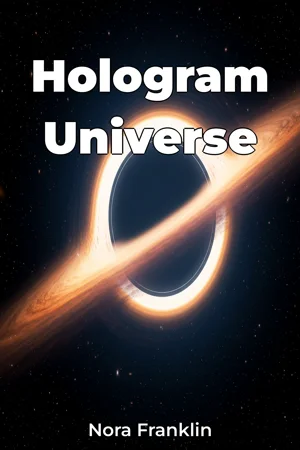
About This Book
What if everything we perceive as reality is merely a projection from a distant, two-dimensional surface? "Hologram Universe" embarks on a journey to explore this radical proposition, delving into the fascinating intersection of cosmology, quantum physics, and information theory. This book tackles three core concepts: the holographic principle, string theory, and the fundamental role of information in shaping our universe. These topics are significant because they challenge our conventional understanding of space, time, and the nature of reality itself, offering potential resolutions to some of physics’ deepest paradoxes. To understand these ideas, some background is helpful. We will touch upon classical physics, general relativity (Einstein's theory of gravity), and basic quantum mechanics. We will also explore the historical development of string theory as an attempt to unify all fundamental forces. This is essential to appreciating the current models of the universe, which the book then critically examines. The central argument of "Hologram Universe" is that the holographic principle offers a viable framework for reconciling general relativity and quantum mechanics, two theories that currently clash when applied to extreme conditions like those found in black holes or the early universe. This argument's importance lies in its potential to provide a unified description of reality, resolving long-standing inconsistencies in our understanding of the cosmos. The book is structured to progressively introduce and develop this concept. The initial chapters explain the holographic principle, demonstrating how the information describing a volume of space can be encoded on its boundary. We then explore the evidence for this principle, from theoretical arguments based on black hole thermodynamics to connections with quantum entanglement. Next, we investigate string theory, focusing on its role in providing a mathematical framework for the holographic principle and describing the fundamental building blocks of the universe. Finally, we explore the role of information as a fundamental constituent of reality, examining how it might underpin space-time itself. The evidence and research presented include theoretical models derived from string theory, thought experiments regarding black hole information loss, and cosmological observations that support inflationary models of the early universe. We will analyze data from gravitational wave detectors and cosmic microwave background experiments. The book connects to several other fields. First, information theory, which provides the mathematical basis for quantifying and manipulating information. Second, computer science: connections between the universe and computational processes are explored. Third, philosophy, where the nature of reality, perception, and consciousness are examined in light of these new perspectives. These interdisciplinary connections enrich the book's argument. The book's unique approach lies in its synthesis of theoretical and experimental insights, offering a comprehensive and accessible overview of the holographic universe concept. It is written in a clear and conversational style, making complex ideas understandable to a broad audience without sacrificing scientific accuracy. The target audience is anyone with an interest in cosmology, quantum physics, and the nature of reality. It would be valuable if you have a basic understanding of science but not necessarily an advanced knowledge of theoretical physics. The book falls within the non-fiction genre of popular science, aiming to educate and engage readers through clear explanations, compelling examples, and critical analysis of current scientific theories. The scope of the book is broad, covering a wide range of topics from black hole physics to string theory and cosmology. However, it is intentionally limited in its mathematical depth, focusing instead on conceptual understanding and the broader implications of these ideas. The information in the book can be applied to understand new technologies, such as quantum computing and information storage. Also, readers can use the concepts to better evaluate new findings and theories in the physical sciences. The book addresses ongoing debates within the scientific community, such as the black hole information paradox and the interpretation of quantum mechanics. It critically examines the strengths and weaknesses of both the holographic principle and string theory, acknowledging the speculative nature of some aspects while highlighting the significant progress that has been made in recent years.
What if everything we perceive as reality is merely a projection from a distant, two-dimensional surface? "Hologram Universe" embarks on a journey to explore this radical proposition, delving into the fascinating intersection of cosmology, quantum physics, and information theory. This book tackles three core concepts: the holographic principle, string theory, and the fundamental role of information in shaping our universe. These topics are significant because they challenge our conventional understanding of space, time, and the nature of reality itself, offering potential resolutions to some of physics’ deepest paradoxes. To understand these ideas, some background is helpful. We will touch upon classical physics, general relativity (Einstein's theory of gravity), and basic quantum mechanics. We will also explore the historical development of string theory as an attempt to unify all fundamental forces. This is essential to appreciating the current models of the universe, which the book then critically examines. The central argument of "Hologram Universe" is that the holographic principle offers a viable framework for reconciling general relativity and quantum mechanics, two theories that currently clash when applied to extreme conditions like those found in black holes or the early universe. This argument's importance lies in its potential to provide a unified description of reality, resolving long-standing inconsistencies in our understanding of the cosmos. The book is structured to progressively introduce and develop this concept. The initial chapters explain the holographic principle, demonstrating how the information describing a volume of space can be encoded on its boundary. We then explore the evidence for this principle, from theoretical arguments based on black hole thermodynamics to connections with quantum entanglement. Next, we investigate string theory, focusing on its role in providing a mathematical framework for the holographic principle and describing the fundamental building blocks of the universe. Finally, we explore the role of information as a fundamental constituent of reality, examining how it might underpin space-time itself. The evidence and research presented include theoretical models derived from string theory, thought experiments regarding black hole information loss, and cosmological observations that support inflationary models of the early universe. We will analyze data from gravitational wave detectors and cosmic microwave background experiments. The book connects to several other fields. First, information theory, which provides the mathematical basis for quantifying and manipulating information. Second, computer science: connections between the universe and computational processes are explored. Third, philosophy, where the nature of reality, perception, and consciousness are examined in light of these new perspectives. These interdisciplinary connections enrich the book's argument. The book's unique approach lies in its synthesis of theoretical and experimental insights, offering a comprehensive and accessible overview of the holographic universe concept. It is written in a clear and conversational style, making complex ideas understandable to a broad audience without sacrificing scientific accuracy. The target audience is anyone with an interest in cosmology, quantum physics, and the nature of reality. It would be valuable if you have a basic understanding of science but not necessarily an advanced knowledge of theoretical physics. The book falls within the non-fiction genre of popular science, aiming to educate and engage readers through clear explanations, compelling examples, and critical analysis of current scientific theories. The scope of the book is broad, covering a wide range of topics from black hole physics to string theory and cosmology. However, it is intentionally limited in its mathematical depth, focusing instead on conceptual understanding and the broader implications of these ideas. The information in the book can be applied to understand new technologies, such as quantum computing and information storage. Also, readers can use the concepts to better evaluate new findings and theories in the physical sciences. The book addresses ongoing debates within the scientific community, such as the black hole information paradox and the interpretation of quantum mechanics. It critically examines the strengths and weaknesses of both the holographic principle and string theory, acknowledging the speculative nature of some aspects while highlighting the significant progress that has been made in recent years.
"Hologram Universe" explores the groundbreaking idea that our perceived reality might be a projection from a distant, two-dimensional surface, delving into the holographic principle, string theory, and the role of information in shaping our cosmos. This concept suggests the universe operates like a giant hologram, where all the information needed to describe our three-dimensional world is encoded on a distant boundary. One intriguing aspect is how this framework attempts to reconcile general relativity and quantum mechanics, two theories that clash under extreme conditions, offering a potential unified description of reality. The book embarks on a journey through classical physics, general relativity, and basic quantum mechanics, progressing to explore the historical development of string theory. It explains the holographic principle by demonstrating how information describing space can be encoded on its boundary and explores evidence from black hole thermodynamics to quantum entanglement. By synthesizing theoretical and experimental insights, "Hologram Universe" offers a comprehensive yet accessible overview, making complex ideas understandable to a broad audience interested in cosmology, quantum physics, and the nature of reality.
Book Details
ISBN
9788233965976
Publisher
Publifye AS
Your Licenses
You don't own any licenses for this book
Purchase a license below to unlock this book and download the EPUB.
Purchase License
Select a tier to unlock this book
Need bulk licensing?
Contact us for enterprise agreements.