
About This Book
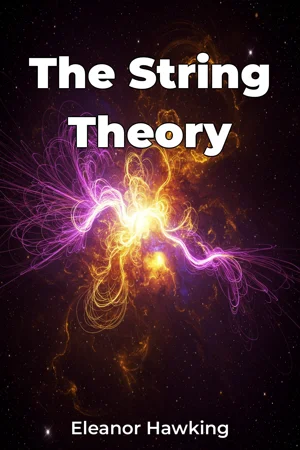
What if the universe we experience is merely a shadow, a projection from a reality far grander and more complex than we can perceive? "The String Theory" delves into this very question, exploring the revolutionary, yet still unproven, framework that attempts to unify all forces of nature and matter into a single, elegant theory. This book will guide you through the intricate landscape of string theory, a field that has captivated physicists for decades with its potential to unlock the deepest secrets of the cosmos. This book focuses on three key topics: the fundamental principles of string theory, the mathematical framework that underpins it, and its implications for understanding concepts such as quantum gravity, the nature of space-time, and the potential for extra dimensions. These topics are of paramount importance because they represent the cutting edge of theoretical physics, addressing the most fundamental questions about the universe's origin and composition. Understanding string theory requires some basic familiarity with quantum mechanics and general relativity. We will provide a brief overview of these concepts as they relate to the core arguments of the book, setting the stage for a deeper dive into the complexities of string theory. The central argument presented in "The String Theory" is that while string theory remains largely theoretical, its mathematical consistency and its ability to address fundamental problems in physics make it a vital area of research that could potentially lead to a unified understanding of the universe. We examine the strengths and weaknesses of this framework, acknowledging the challenges and uncertainties that remain. The book is structured in a way that gradually introduces the reader to the core concepts of string theory. It begins by exploring the historical context, tracing the evolution of physics from classical mechanics to quantum field theory and the emergence of string theory as a possible successor. We then delve into the basics of string theory, explaining how fundamental particles are not point-like but rather tiny, vibrating strings. The argument then progresses to examine the mathematical tools required to understand this theory, including advanced concepts such as supersymmetry and Calabi-Yau manifolds. The book culminates in a discussion of the potential applications of string theory to cosmology, black hole physics, and the search for a theory of everything. The arguments presented within "The String Theory" are supported by a wealth of theoretical research, including mathematical models, simulations, and conceptual frameworks developed by leading physicists. The book will cite original research papers, review articles, and textbooks that provide further details for interested readers. String theory naturally connects to several interdisciplinary fields, most notably mathematics, cosmology, and computer science. The sophisticated mathematical tools required for string theory research have led to advances in areas such as topology and geometry. Its implications for the early universe and the nature of dark matter and dark energy make it relevant to cosmology. Furthermore, computational methods are increasingly important for exploring the complex landscape of string theory solutions. This book offers a balanced perspective on string theory, presenting both its potential and its limitations. We explore alternative approaches to quantum gravity and critically evaluate the arguments for and against string theory as a viable framework for understanding the fundamental laws of nature. The writing style adopted in "The String Theory" is designed to be accessible to a broad audience with an interest in science, while maintaining the rigor and precision required for a technical subject. While aimed at readers with a background in physics or mathematics, we strive to explain complex concepts in a clear and concise manner, without sacrificing accuracy. The target audience for this book includes undergraduate and graduate students in physics, researchers in related fields, and anyone with a strong interest in cutting-edge science and the quest for a unified theory of everything. It provides them a comprehensive overview of string theory, its key concepts, and its ongoing challenges. As a work of scientific non-fiction, "The String Theory" adheres to the standards of accuracy, objectivity, and transparency. We make clear the distinction between established facts, theoretical models, and speculative ideas, and provide ample references to allow readers to further explore the subject. The scope of this book is limited to the fundamental principles and theoretical framework of string theory. We do not delve into the details of specific experimental searches for evidence of string theory, as these are beyond the current capabilities of experimental physics. While string theory is primarily a theoretical framework, it has potential real-world applications in areas such as materials science and information theory, where the mathematical tools developed for string theory can be used to solve problems in other fields. The book touches on these applications to demonstrate the broader relevance of string theory. Finally, this book acknowledges the controversies and debates surrounding string theory, including criticisms about its lack of experimental verification and the challenges of making testable predictions. We address these criticisms head-on, presenting the arguments from both sides of the debate.
What if the universe we experience is merely a shadow, a projection from a reality far grander and more complex than we can perceive? "The String Theory" delves into this very question, exploring the revolutionary, yet still unproven, framework that attempts to unify all forces of nature and matter into a single, elegant theory. This book will guide you through the intricate landscape of string theory, a field that has captivated physicists for decades with its potential to unlock the deepest secrets of the cosmos. This book focuses on three key topics: the fundamental principles of string theory, the mathematical framework that underpins it, and its implications for understanding concepts such as quantum gravity, the nature of space-time, and the potential for extra dimensions. These topics are of paramount importance because they represent the cutting edge of theoretical physics, addressing the most fundamental questions about the universe's origin and composition. Understanding string theory requires some basic familiarity with quantum mechanics and general relativity. We will provide a brief overview of these concepts as they relate to the core arguments of the book, setting the stage for a deeper dive into the complexities of string theory. The central argument presented in "The String Theory" is that while string theory remains largely theoretical, its mathematical consistency and its ability to address fundamental problems in physics make it a vital area of research that could potentially lead to a unified understanding of the universe. We examine the strengths and weaknesses of this framework, acknowledging the challenges and uncertainties that remain. The book is structured in a way that gradually introduces the reader to the core concepts of string theory. It begins by exploring the historical context, tracing the evolution of physics from classical mechanics to quantum field theory and the emergence of string theory as a possible successor. We then delve into the basics of string theory, explaining how fundamental particles are not point-like but rather tiny, vibrating strings. The argument then progresses to examine the mathematical tools required to understand this theory, including advanced concepts such as supersymmetry and Calabi-Yau manifolds. The book culminates in a discussion of the potential applications of string theory to cosmology, black hole physics, and the search for a theory of everything. The arguments presented within "The String Theory" are supported by a wealth of theoretical research, including mathematical models, simulations, and conceptual frameworks developed by leading physicists. The book will cite original research papers, review articles, and textbooks that provide further details for interested readers. String theory naturally connects to several interdisciplinary fields, most notably mathematics, cosmology, and computer science. The sophisticated mathematical tools required for string theory research have led to advances in areas such as topology and geometry. Its implications for the early universe and the nature of dark matter and dark energy make it relevant to cosmology. Furthermore, computational methods are increasingly important for exploring the complex landscape of string theory solutions. This book offers a balanced perspective on string theory, presenting both its potential and its limitations. We explore alternative approaches to quantum gravity and critically evaluate the arguments for and against string theory as a viable framework for understanding the fundamental laws of nature. The writing style adopted in "The String Theory" is designed to be accessible to a broad audience with an interest in science, while maintaining the rigor and precision required for a technical subject. While aimed at readers with a background in physics or mathematics, we strive to explain complex concepts in a clear and concise manner, without sacrificing accuracy. The target audience for this book includes undergraduate and graduate students in physics, researchers in related fields, and anyone with a strong interest in cutting-edge science and the quest for a unified theory of everything. It provides them a comprehensive overview of string theory, its key concepts, and its ongoing challenges. As a work of scientific non-fiction, "The String Theory" adheres to the standards of accuracy, objectivity, and transparency. We make clear the distinction between established facts, theoretical models, and speculative ideas, and provide ample references to allow readers to further explore the subject. The scope of this book is limited to the fundamental principles and theoretical framework of string theory. We do not delve into the details of specific experimental searches for evidence of string theory, as these are beyond the current capabilities of experimental physics. While string theory is primarily a theoretical framework, it has potential real-world applications in areas such as materials science and information theory, where the mathematical tools developed for string theory can be used to solve problems in other fields. The book touches on these applications to demonstrate the broader relevance of string theory. Finally, this book acknowledges the controversies and debates surrounding string theory, including criticisms about its lack of experimental verification and the challenges of making testable predictions. We address these criticisms head-on, presenting the arguments from both sides of the debate.
"The String Theory" explores a captivating yet unproven framework aiming to unify all forces and matter in a single theory. This book guides readers through string theory, a field proposing that fundamental particles are not point-like but tiny, vibrating strings existing in extra dimensions. It delves into the mathematical framework that underpins string theory, and implications for understanding quantum gravity, the nature of space-time, and the potential for extra dimensions. One intriguing aspect is its potential to reconcile quantum mechanics and general relativity, two pillars of modern physics that currently clash. The book starts by tracing physics' evolution to string theory, then examines the math, including supersymmetry and Calabi-Yau manifolds. It culminates by looking at applications to cosmology and black hole physics, addressing the search for a "theory of everything". While acknowledging the lack of experimental verification and ongoing debates, this work presents a balanced view of string theory's potential and limitations, making it valuable for anyone interested in cutting-edge theoretical physics.
Book Details
ISBN
9788233965853
Publisher
Publifye AS
Your Licenses
You don't own any licenses for this book
Purchase a license below to unlock this book and download the EPUB.
Purchase License
Select a tier to unlock this book
Need bulk licensing?
Contact us for enterprise agreements.