
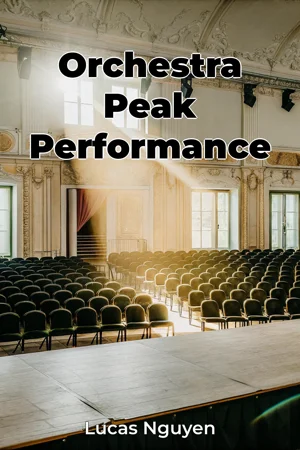
About This Book
Have you ever considered what a business can learn from a world-class orchestra? Orchestra Peak Performance explores the surprising parallels between orchestral performance and effective management, offering insights into leadership, collaboration, and achieving peak organizational performance. This book examines conductor methodologies and ensemble techniques to reveal how these principles can be applied in business contexts. The central argument of Orchestra Peak Performance is that the dynamics of a successful orchestra, with its intricate web of individual talents and unified artistic vision, provide a powerful model for fostering high-performance teams and achieving organizational excellence in any field. The book highlights key themes. First, it analyzes the conductor's role as a leader, exploring diverse leadership styles, communication strategies, and methods for inspiring collective commitment. Second, it examines the collaborative processes within the orchestra, focusing on communication workflows, conflict resolution, and the development of shared goals. Finally, the book reveals how an orchestra transforms individual contributions into a cohesive, high-quality product. The first section introduces the fundamental concepts of orchestral management, drawing parallels between musical and business structures. It examines historic and contemporary approaches to conducting, evaluating the strengths and weaknesses of different leadership styles. This section lays the groundwork for understanding the complexities of orchestral collaboration and the importance of effective communication. Chapter by chapter, the book develops these ideas by analyzing specific techniques used by conductors and musicians to create a unified performance. Case studies of renowned orchestras illustrate how different groups approach challenges such as managing diverse personalities, resolving conflicts, and adapting to changing circumstances. The book will explore how orchestras use methods to maximize their collective potential, enhance coordination, and foster innovation. The analysis will be supported by research drawn from organizational psychology, management theory, and musicology. Interviews with conductors, musicians, and orchestra administrators offer inside perspectives on the challenges and rewards of orchestral work. This is supplemented by data from performance reviews, audience surveys, and financial reports, providing a comprehensive view of orchestral performance. These sources will provide a detailed look at the specific interactions and strategies that contribute to success. Orchestra Peak Performance bridges the gap between the arts and business, demonstrating how principles of musical performance can inform leadership and management practices in diverse fields. It highlights the importance of mindful communication, shared vision, and collaborative problem-solving, offering practical guidance for improving team dynamics and organizational performance. This book is written for managers, leaders, and anyone interested in improving organizational performance. It will also appeal to musicians, music educators, and those who want to understand the inner workings of an orchestra. The accessible style ensures that the concepts are easily understood, even by those with limited musical background. While the book focuses primarily on Western classical orchestras, the principles discussed are applicable to a wide range of organizational settings and musical genres. It will not be a comprehensive history of orchestras but focuses on the practical application of management and leadership principles within the orchestral context. Orchestra Peak Performance offers a fresh perspective on leadership and collaboration, revealing how the principles of musical performance can transform any organization into a high-performing ensemble.
Have you ever considered what a business can learn from a world-class orchestra? Orchestra Peak Performance explores the surprising parallels between orchestral performance and effective management, offering insights into leadership, collaboration, and achieving peak organizational performance. This book examines conductor methodologies and ensemble techniques to reveal how these principles can be applied in business contexts. The central argument of Orchestra Peak Performance is that the dynamics of a successful orchestra, with its intricate web of individual talents and unified artistic vision, provide a powerful model for fostering high-performance teams and achieving organizational excellence in any field. The book highlights key themes. First, it analyzes the conductor's role as a leader, exploring diverse leadership styles, communication strategies, and methods for inspiring collective commitment. Second, it examines the collaborative processes within the orchestra, focusing on communication workflows, conflict resolution, and the development of shared goals. Finally, the book reveals how an orchestra transforms individual contributions into a cohesive, high-quality product. The first section introduces the fundamental concepts of orchestral management, drawing parallels between musical and business structures. It examines historic and contemporary approaches to conducting, evaluating the strengths and weaknesses of different leadership styles. This section lays the groundwork for understanding the complexities of orchestral collaboration and the importance of effective communication. Chapter by chapter, the book develops these ideas by analyzing specific techniques used by conductors and musicians to create a unified performance. Case studies of renowned orchestras illustrate how different groups approach challenges such as managing diverse personalities, resolving conflicts, and adapting to changing circumstances. The book will explore how orchestras use methods to maximize their collective potential, enhance coordination, and foster innovation. The analysis will be supported by research drawn from organizational psychology, management theory, and musicology. Interviews with conductors, musicians, and orchestra administrators offer inside perspectives on the challenges and rewards of orchestral work. This is supplemented by data from performance reviews, audience surveys, and financial reports, providing a comprehensive view of orchestral performance. These sources will provide a detailed look at the specific interactions and strategies that contribute to success. Orchestra Peak Performance bridges the gap between the arts and business, demonstrating how principles of musical performance can inform leadership and management practices in diverse fields. It highlights the importance of mindful communication, shared vision, and collaborative problem-solving, offering practical guidance for improving team dynamics and organizational performance. This book is written for managers, leaders, and anyone interested in improving organizational performance. It will also appeal to musicians, music educators, and those who want to understand the inner workings of an orchestra. The accessible style ensures that the concepts are easily understood, even by those with limited musical background. While the book focuses primarily on Western classical orchestras, the principles discussed are applicable to a wide range of organizational settings and musical genres. It will not be a comprehensive history of orchestras but focuses on the practical application of management and leadership principles within the orchestral context. Orchestra Peak Performance offers a fresh perspective on leadership and collaboration, revealing how the principles of musical performance can transform any organization into a high-performing ensemble.
"Orchestra Peak Performance" explores the surprising parallels between orchestral performance and effective business management. It reveals how the dynamics of an orchestra, with its blend of individual talents and unified artistic vision, serve as a powerful model for fostering high-performance teams. Did you know that the role of a conductor mirrors that of a CEO, requiring similar skills in leadership, communication, and inspiring collective commitment? The book emphasizes themes such as the conductor's leadership styles, communication strategies, and the significance of teamwork. The book progresses by introducing fundamental concepts of orchestral management and drawing parallels between musical and business structures. Case studies of renowned orchestras are analyzed, and research from organizational psychology, management theory, and musicology support the analysis. The book reveals how orchestras use ensemble techniques to maximize their collective potential, enhance coordination, and foster innovation. It highlights the importance of mindful communication, shared vision, and collaborative problem-solving, offering practical guidance for improving team dynamics and organizational performance.
Book Details
ISBN
9788233965358
Publisher
Publifye AS
Your Licenses
You don't own any licenses for this book
Purchase a license below to unlock this book and download the EPUB.
Purchase License
Select a tier to unlock this book
Need bulk licensing?
Contact us for enterprise agreements.