
About This Book
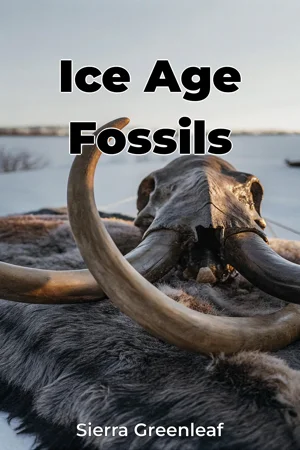
What can the bones of long-dead giants tell us about our planet’s past and, perhaps, its future? ‘Ice Age Fossils’ explores the fascinating world of the Pleistocene epoch, a period of dramatic climate shifts and the rise and fall of megafauna like mammoths, saber-toothed cats, and giant sloths. This book is vital because understanding the Ice Age provides critical insights into how ecosystems respond to environmental change, knowledge that is increasingly relevant in our current era of rapid global warming. We will delve into the primary factors that defined the Ice Age: the cyclical advances and retreats of massive ice sheets, fluctuating sea levels, and the profound impact these changes had on plant and animal life. This exploration requires an understanding of basic geological principles, climate science, and evolutionary biology, which will be presented in an accessible manner for a general audience. The central argument of ‘Ice Age Fossils’ is that the fossil record provides a detailed, though fragmented, picture of past environmental conditions and biotic responses, allowing us to reconstruct Ice Age ecosystems and understand the processes that led to the extinction of many iconic species. Understanding these extinction events is crucial for informing modern conservation efforts and predicting the potential consequences of current climate trends. The book will progress systematically. First, it will introduce the concept of the Ice Age, its chronology, and the key geological markers that define it. Second, it will examine the major players of this period, focusing on well-preserved fossil finds and the stories they tell about the lives of these creatures, their diets, their interactions, and the environments they inhabited. This section will include in-depth analyses of mammoth remains from Siberia, saber-toothed cat fossils from the La Brea Tar Pits, and giant sloth skeletons from South America. Third, the book will address the causes of the megafaunal extinctions, exploring various hypotheses related to climate change, human hunting pressure, and disease, and evaluating the evidence supporting each. Finally, it will consider the lessons the Ice Age can teach us about present-day environmental challenges, such as biodiversity loss and the effects of climate change on ecosystems. The evidence presented in this book will draw from a wide range of sources, including paleontological excavations, geological surveys, climate reconstructions based on ice core data, and genetic analyses of ancient DNA. The book will synthesize findings from disparate fields to offer a comprehensive perspective on the Ice Age. ‘Ice Age Fossils’ connects to several fields including climate science, archaeology, and conservation biology. Paleoclimate data from Ice Age fossils helps refine climate models. Archaeological finds in association with fossils provide evidence of early human-animal interactions. Finally, understanding the causes of past extinctions informs current biodiversity conservation strategies. This book takes a holistic approach, integrating paleontological data with broader environmental and ecological contexts. It aims to present a balanced view of the complex interplay of factors that shaped Ice Age ecosystems, moving beyond simplistic explanations of extinction events. The book is written in a clear and engaging style, aimed at a general audience interested in natural history, paleontology, and environmental science. It avoids technical jargon, opting instead for accessible explanations and vivid descriptions. The target audience includes students, amateur paleontologists, nature enthusiasts, and anyone curious about the history of life on Earth. It would be valuable to anyone seeking to understand the long-term impacts of climate change and the importance of preserving biodiversity. As a work of non-fiction earth sciences and biology, the book prioritizes factual accuracy and evidence-based conclusions. The scope of the book is limited to the Pleistocene epoch, with a focus on megafaunal fossils and their environmental context. It does not delve deeply into the evolutionary history of individual species beyond the scope of the Ice Age or address microscopic fossil evidence. The information in this book can be applied to understanding modern ecosystems and predicting their responses to climate change. By studying the past, we can gain insights into the future of our planet. The book addresses ongoing debates about the relative importance of climate change and human hunting in driving megafaunal extinctions. It presents different perspectives and evaluates the evidence supporting each, encouraging readers to critically assess the available data.
What can the bones of long-dead giants tell us about our planet’s past and, perhaps, its future? ‘Ice Age Fossils’ explores the fascinating world of the Pleistocene epoch, a period of dramatic climate shifts and the rise and fall of megafauna like mammoths, saber-toothed cats, and giant sloths. This book is vital because understanding the Ice Age provides critical insights into how ecosystems respond to environmental change, knowledge that is increasingly relevant in our current era of rapid global warming. We will delve into the primary factors that defined the Ice Age: the cyclical advances and retreats of massive ice sheets, fluctuating sea levels, and the profound impact these changes had on plant and animal life. This exploration requires an understanding of basic geological principles, climate science, and evolutionary biology, which will be presented in an accessible manner for a general audience. The central argument of ‘Ice Age Fossils’ is that the fossil record provides a detailed, though fragmented, picture of past environmental conditions and biotic responses, allowing us to reconstruct Ice Age ecosystems and understand the processes that led to the extinction of many iconic species. Understanding these extinction events is crucial for informing modern conservation efforts and predicting the potential consequences of current climate trends. The book will progress systematically. First, it will introduce the concept of the Ice Age, its chronology, and the key geological markers that define it. Second, it will examine the major players of this period, focusing on well-preserved fossil finds and the stories they tell about the lives of these creatures, their diets, their interactions, and the environments they inhabited. This section will include in-depth analyses of mammoth remains from Siberia, saber-toothed cat fossils from the La Brea Tar Pits, and giant sloth skeletons from South America. Third, the book will address the causes of the megafaunal extinctions, exploring various hypotheses related to climate change, human hunting pressure, and disease, and evaluating the evidence supporting each. Finally, it will consider the lessons the Ice Age can teach us about present-day environmental challenges, such as biodiversity loss and the effects of climate change on ecosystems. The evidence presented in this book will draw from a wide range of sources, including paleontological excavations, geological surveys, climate reconstructions based on ice core data, and genetic analyses of ancient DNA. The book will synthesize findings from disparate fields to offer a comprehensive perspective on the Ice Age. ‘Ice Age Fossils’ connects to several fields including climate science, archaeology, and conservation biology. Paleoclimate data from Ice Age fossils helps refine climate models. Archaeological finds in association with fossils provide evidence of early human-animal interactions. Finally, understanding the causes of past extinctions informs current biodiversity conservation strategies. This book takes a holistic approach, integrating paleontological data with broader environmental and ecological contexts. It aims to present a balanced view of the complex interplay of factors that shaped Ice Age ecosystems, moving beyond simplistic explanations of extinction events. The book is written in a clear and engaging style, aimed at a general audience interested in natural history, paleontology, and environmental science. It avoids technical jargon, opting instead for accessible explanations and vivid descriptions. The target audience includes students, amateur paleontologists, nature enthusiasts, and anyone curious about the history of life on Earth. It would be valuable to anyone seeking to understand the long-term impacts of climate change and the importance of preserving biodiversity. As a work of non-fiction earth sciences and biology, the book prioritizes factual accuracy and evidence-based conclusions. The scope of the book is limited to the Pleistocene epoch, with a focus on megafaunal fossils and their environmental context. It does not delve deeply into the evolutionary history of individual species beyond the scope of the Ice Age or address microscopic fossil evidence. The information in this book can be applied to understanding modern ecosystems and predicting their responses to climate change. By studying the past, we can gain insights into the future of our planet. The book addresses ongoing debates about the relative importance of climate change and human hunting in driving megafaunal extinctions. It presents different perspectives and evaluates the evidence supporting each, encouraging readers to critically assess the available data.
"Ice Age Fossils" unravels the mysteries of the Pleistocene epoch, exploring the dramatic climate shifts and the lives of megafauna such as mammoths and saber-toothed cats. This period is crucial for understanding how ecosystems respond to environmental changes, offering insights relevant to today's global warming crisis. Notably, the book highlights how fossil records provide detailed snapshots of past environments, helping us reconstruct Ice Age ecosystems and understand the extinction events that befell many iconic species. The book systematically progresses, starting with an introduction to the Ice Age's chronology and geological markers. It then delves into the well-preserved fossil finds, narrating the lives, diets, and interactions of Ice Age creatures. Finally, it addresses the causes of megafaunal extinctions, examining climate change, human hunting, and disease, and it considers the lessons the Ice Age can teach us about present-day environmental challenges. By synthesizing paleontological data with broader environmental contexts, "Ice Age Fossils" offers a holistic view of the complex interplay of factors that shaped Ice Age ecosystems.
Book Details
ISBN
9788233964436
Publisher
Publifye AS
Your Licenses
You don't own any licenses for this book
Purchase a license below to unlock this book and download the EPUB.
Purchase License
Select a tier to unlock this book
Need bulk licensing?
Contact us for enterprise agreements.