
About This Book
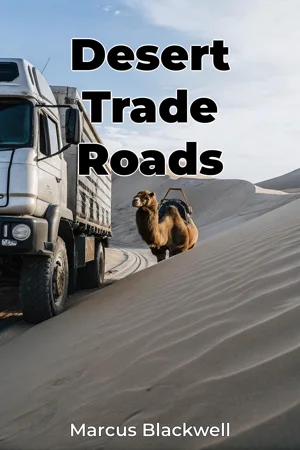
What propelled civilizations to traverse the seemingly impassable expanses of the world’s great deserts? This book, "Desert Trade Roads," unearths the intricate networks of exchange that flourished across arid landscapes, shaping economies, cultures, and the very course of history. We will delve into the historical significance of desert trade, investigating how these routes acted as conduits not only for goods but also for ideas, technologies, and religious beliefs. Our exploration will touch upon the ecological impact of trade and human adaptation to challenging environments. "Desert Trade Roads" argues that these often-overlooked routes were as vital to global interconnectedness as their maritime counterparts. The story of desert trade is a testament to human ingenuity, resilience, and the enduring drive for connection and commerce. Understanding these historical networks provides valuable insights into contemporary globalization, cultural exchange, and the challenges of sustainable development in arid regions. The book begins by establishing the environmental and historical context of major desert regions, including the Sahara, the Gobi, the Arabian Desert, and the deserts of the American Southwest. We examine the geographical features that shaped trade routes, the resources that attracted merchants, and the indigenous populations who facilitated and profited from this exchange. The core of "Desert Trade Roads" focuses on specific trade routes and the commodities that defined them. Chapters will explore the trans-Saharan trade in gold, salt, and slaves; the Silk Road's passage through the Gobi Desert, carrying silk, spices, and precious stones; the incense routes of Arabia, transporting frankincense and myrrh; and the turquoise and agricultural trade among the pre-Columbian peoples of the American Southwest. Each chapter will detail the challenges faced by traders, the technologies they employed (such as camels, saddles, and navigation techniques), and the social and political structures that governed trade. The book builds upon archaeological discoveries, historical texts, and ethnographic studies to reconstruct the lifeways of desert traders and the communities they connected. We analyze trade agreements, caravan organization, and the role of oases and trading posts as centers of cultural exchange. Unique primary source material, including merchant diaries, diplomatic correspondence, and archaeological reports, will be presented to support our analysis. Furthermore, "Desert Trade Roads" draws connections between history, geography, anthropology, and economics. We examine how desert trade influenced the development of urban centers, the spread of religions (such as Islam and Buddhism), and the evolution of economic systems. The book also considers the environmental consequences of trade, including deforestation, overgrazing, and the introduction of invasive species. A unique aspect of this book is its comparative approach, analyzing the similarities and differences between desert trade networks across different continents and time periods. We challenge conventional narratives that focus solely on maritime trade and demonstrate the critical role of deserts in shaping global history. Written in a clear and accessible style, "Desert Trade Roads" is intended for a broad audience, including students, history enthusiasts, travelers, and anyone interested in the interconnectedness of human societies. The book's exploration of ancient trade routes provides valuable context for understanding contemporary challenges, such as globalization, migration, and sustainable development. While "Desert Trade Roads" offers broad coverage of major desert trade routes, it does not attempt an exhaustive analysis of every minor route or regional variation. The focus remains on the most significant and well-documented examples, providing a comprehensive overview of the key themes and patterns. The information presented can be applied to contemporary discussions about international trade, cultural exchange, and the importance of preserving historical landscapes. The book acknowledges ongoing scholarly debates about the impact of trade on indigenous populations and the environment, presenting diverse perspectives and encouraging critical thinking.
What propelled civilizations to traverse the seemingly impassable expanses of the world’s great deserts? This book, "Desert Trade Roads," unearths the intricate networks of exchange that flourished across arid landscapes, shaping economies, cultures, and the very course of history. We will delve into the historical significance of desert trade, investigating how these routes acted as conduits not only for goods but also for ideas, technologies, and religious beliefs. Our exploration will touch upon the ecological impact of trade and human adaptation to challenging environments. "Desert Trade Roads" argues that these often-overlooked routes were as vital to global interconnectedness as their maritime counterparts. The story of desert trade is a testament to human ingenuity, resilience, and the enduring drive for connection and commerce. Understanding these historical networks provides valuable insights into contemporary globalization, cultural exchange, and the challenges of sustainable development in arid regions. The book begins by establishing the environmental and historical context of major desert regions, including the Sahara, the Gobi, the Arabian Desert, and the deserts of the American Southwest. We examine the geographical features that shaped trade routes, the resources that attracted merchants, and the indigenous populations who facilitated and profited from this exchange. The core of "Desert Trade Roads" focuses on specific trade routes and the commodities that defined them. Chapters will explore the trans-Saharan trade in gold, salt, and slaves; the Silk Road's passage through the Gobi Desert, carrying silk, spices, and precious stones; the incense routes of Arabia, transporting frankincense and myrrh; and the turquoise and agricultural trade among the pre-Columbian peoples of the American Southwest. Each chapter will detail the challenges faced by traders, the technologies they employed (such as camels, saddles, and navigation techniques), and the social and political structures that governed trade. The book builds upon archaeological discoveries, historical texts, and ethnographic studies to reconstruct the lifeways of desert traders and the communities they connected. We analyze trade agreements, caravan organization, and the role of oases and trading posts as centers of cultural exchange. Unique primary source material, including merchant diaries, diplomatic correspondence, and archaeological reports, will be presented to support our analysis. Furthermore, "Desert Trade Roads" draws connections between history, geography, anthropology, and economics. We examine how desert trade influenced the development of urban centers, the spread of religions (such as Islam and Buddhism), and the evolution of economic systems. The book also considers the environmental consequences of trade, including deforestation, overgrazing, and the introduction of invasive species. A unique aspect of this book is its comparative approach, analyzing the similarities and differences between desert trade networks across different continents and time periods. We challenge conventional narratives that focus solely on maritime trade and demonstrate the critical role of deserts in shaping global history. Written in a clear and accessible style, "Desert Trade Roads" is intended for a broad audience, including students, history enthusiasts, travelers, and anyone interested in the interconnectedness of human societies. The book's exploration of ancient trade routes provides valuable context for understanding contemporary challenges, such as globalization, migration, and sustainable development. While "Desert Trade Roads" offers broad coverage of major desert trade routes, it does not attempt an exhaustive analysis of every minor route or regional variation. The focus remains on the most significant and well-documented examples, providing a comprehensive overview of the key themes and patterns. The information presented can be applied to contemporary discussions about international trade, cultural exchange, and the importance of preserving historical landscapes. The book acknowledges ongoing scholarly debates about the impact of trade on indigenous populations and the environment, presenting diverse perspectives and encouraging critical thinking.
"Desert Trade Roads" explores the vital, yet often overlooked, historical trade networks that thrived across the world's deserts. This book highlights how these routes facilitated not only the exchange of goods like gold, salt, silk, and spices, but also the transmission of ideas, technologies, and religious beliefs, such as Islam and Buddhism. These networks showcase human ingenuity and resilience in adapting to challenging environments, demonstrating that these routes were as crucial to global interconnectedness as maritime trade routes. The book examines specific trade routes, including the trans-Saharan trade, the Silk Road's passage through the Gobi Desert, and the incense routes of Arabia, detailing the commodities, technologies, and socio-political structures involved. By drawing from archaeological discoveries, historical texts, and ethnographic studies, "Desert Trade Roads" reconstructs the lives of desert traders. The book progresses by establishing historical context, then focusing on specific routes and commodities, and finally drawing connections between history, geography, and economics, offering a comparative analysis of different desert trade networks across continents and time periods.
Book Details
ISBN
9788233961411
Publisher
Publifye AS
Your Licenses
You don't own any licenses for this book
Purchase a license below to unlock this book and download the EPUB.
Purchase License
Select a tier to unlock this book
Need bulk licensing?
Contact us for enterprise agreements.