
About This Book
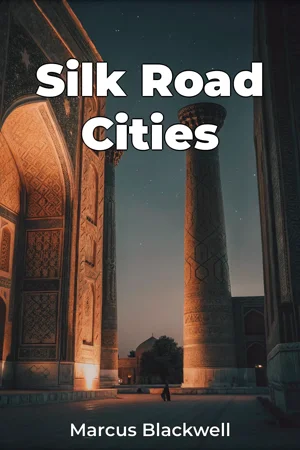
What if the stones beneath our feet could whisper tales of bustling bazaars, diplomatic encounters, and the ebb and flow of empires? "Silk Road Cities" unveils the rich tapestry of history woven along the legendary Silk Road, focusing on the major trading posts that served as vital arteries connecting East and West. This book explores how archaeological discoveries, combined with meticulous historical record analysis, reshape our understanding of these urban centers and their global impact. The central argument of "Silk Road Cities" is that these cities were not merely transit points for goods, but dynamic hubs of cultural exchange, innovation, and political maneuvering, far more complex than often portrayed. The book demonstrates how the blending of cultures, spurred by trade, resulted in the development of unique architectural styles, religious syncretism, and technological advancements that influenced societies across continents. To support this argument, the book will present a comprehensive overview of key Silk Road cities, drawing upon recent archaeological excavations and historical texts. The introduction establishes the historical context of the Silk Road, explaining its origins, key routes, and periods of significance. It highlights the challenges of studying these ancient sites, considering factors such as preservation, accessibility, and the interpretation of fragmented evidence. The core of the book is structured around several major points, each dedicating chapters to specific trading posts. Samarkand, for example, is examined as a case study of a city that served as a melting pot of cultures under various empires, revealing its complex urban layout, religious monuments, and sophisticated water management systems. Dunhuang, positioned at the crossroads of trade routes, is analyzed through the lens of its monastic cave complexes, illustrating the spread of Buddhism and the preservation of invaluable historical documents. The book will also explore the cities of Ctesiphon and Palmyra, highlighting their roles in the western reaches of this network and illustrating how trade impacted Roman and Persian interactions. Each case study incorporates detailed descriptions of architectural landmarks, such as caravanserai, marketplaces, and fortifications while delving into the social structures and economic activities that defined each settlement. The book utilizes diverse data sources, including excavation reports, ancient maps, travelers' accounts, dynastic histories, and religious texts to provide a multifaceted perspective. Specifically, the book uses primary source translation to reassess established theories. "Silk Road Cities" bridges the disciplines of archaeology, history, art history, and religious studies to offer a holistic understanding of the Silk Road phenomenon. By analyzing the architectural styles of these cities, it sheds light on cross-cultural influences and the adaptation of building techniques. The study of religious artifacts and texts reveals the exchange of spiritual beliefs and philosophical ideas. This interdisciplinary approach enriches the understanding of the Silk Road as a conduit for the dissemination of knowledge and artistic expression. The book deliberately focuses on a selection of major trading posts to provide in-depth analysis within a manageable scope. While acknowledging the vastness of the Silk Road network, this book prioritizes detailed case studies to illustrate the broader themes of cultural exchange and urban development. It acknowledges the limitations of relying on incomplete archaeological records and potentially biased historical accounts. Written in a professional and accessible style, "Silk Road Cities" is aimed at a broad audience, including students, researchers, history enthusiasts, and armchair travelers with an interest in archaeology, world history, and cultural exchange. The book offers practical applications by encouraging readers to appreciate the interconnectedness of cultures and the enduring legacy of the Silk Road in shaping our modern world. By presenting tangible evidence and compelling narratives, "Silk Road Cities" invites readers to embark on a journey of discovery along the Silk Road, uncovering the hidden stories of these ancient metropolises. This book addresses debates surrounding the impact of trade on cultural diffusion and the agency of local populations in shaping their own destinies amidst global interactions, offering nuanced perspectives supported by archaeological and historical evidence.
What if the stones beneath our feet could whisper tales of bustling bazaars, diplomatic encounters, and the ebb and flow of empires? "Silk Road Cities" unveils the rich tapestry of history woven along the legendary Silk Road, focusing on the major trading posts that served as vital arteries connecting East and West. This book explores how archaeological discoveries, combined with meticulous historical record analysis, reshape our understanding of these urban centers and their global impact. The central argument of "Silk Road Cities" is that these cities were not merely transit points for goods, but dynamic hubs of cultural exchange, innovation, and political maneuvering, far more complex than often portrayed. The book demonstrates how the blending of cultures, spurred by trade, resulted in the development of unique architectural styles, religious syncretism, and technological advancements that influenced societies across continents. To support this argument, the book will present a comprehensive overview of key Silk Road cities, drawing upon recent archaeological excavations and historical texts. The introduction establishes the historical context of the Silk Road, explaining its origins, key routes, and periods of significance. It highlights the challenges of studying these ancient sites, considering factors such as preservation, accessibility, and the interpretation of fragmented evidence. The core of the book is structured around several major points, each dedicating chapters to specific trading posts. Samarkand, for example, is examined as a case study of a city that served as a melting pot of cultures under various empires, revealing its complex urban layout, religious monuments, and sophisticated water management systems. Dunhuang, positioned at the crossroads of trade routes, is analyzed through the lens of its monastic cave complexes, illustrating the spread of Buddhism and the preservation of invaluable historical documents. The book will also explore the cities of Ctesiphon and Palmyra, highlighting their roles in the western reaches of this network and illustrating how trade impacted Roman and Persian interactions. Each case study incorporates detailed descriptions of architectural landmarks, such as caravanserai, marketplaces, and fortifications while delving into the social structures and economic activities that defined each settlement. The book utilizes diverse data sources, including excavation reports, ancient maps, travelers' accounts, dynastic histories, and religious texts to provide a multifaceted perspective. Specifically, the book uses primary source translation to reassess established theories. "Silk Road Cities" bridges the disciplines of archaeology, history, art history, and religious studies to offer a holistic understanding of the Silk Road phenomenon. By analyzing the architectural styles of these cities, it sheds light on cross-cultural influences and the adaptation of building techniques. The study of religious artifacts and texts reveals the exchange of spiritual beliefs and philosophical ideas. This interdisciplinary approach enriches the understanding of the Silk Road as a conduit for the dissemination of knowledge and artistic expression. The book deliberately focuses on a selection of major trading posts to provide in-depth analysis within a manageable scope. While acknowledging the vastness of the Silk Road network, this book prioritizes detailed case studies to illustrate the broader themes of cultural exchange and urban development. It acknowledges the limitations of relying on incomplete archaeological records and potentially biased historical accounts. Written in a professional and accessible style, "Silk Road Cities" is aimed at a broad audience, including students, researchers, history enthusiasts, and armchair travelers with an interest in archaeology, world history, and cultural exchange. The book offers practical applications by encouraging readers to appreciate the interconnectedness of cultures and the enduring legacy of the Silk Road in shaping our modern world. By presenting tangible evidence and compelling narratives, "Silk Road Cities" invites readers to embark on a journey of discovery along the Silk Road, uncovering the hidden stories of these ancient metropolises. This book addresses debates surrounding the impact of trade on cultural diffusion and the agency of local populations in shaping their own destinies amidst global interactions, offering nuanced perspectives supported by archaeological and historical evidence.
"Silk Road Cities" explores the historical significance of key urban centers along the Silk Road, revealing them not just as transit points for goods, but as dynamic hubs of cultural exchange and innovation. By examining archaeological discoveries and historical records, the book sheds light on the intricate social, economic, and political dynamics that shaped these cities. The book highlights how the blending of cultures led to unique architectural styles, religious syncretism, and technological advancements that influenced societies across continents. The book adopts an interdisciplinary approach, bridging archaeology, history, art history, and religious studies to offer a holistic understanding of the Silk Road phenomenon. It progresses through chapters dedicated to specific trading posts, such as Samarkand, Dunhuang, Ctesiphon, and Palmyra. Each case study incorporates detailed descriptions of architectural landmarks, social structures, and economic activities, drawing upon diverse data sources, including excavation reports, ancient maps, and dynastic histories.
Book Details
ISBN
9788233961336
Publisher
Publifye AS
Your Licenses
You don't own any licenses for this book
Purchase a license below to unlock this book and download the EPUB.
Purchase License
Select a tier to unlock this book
Need bulk licensing?
Contact us for enterprise agreements.