
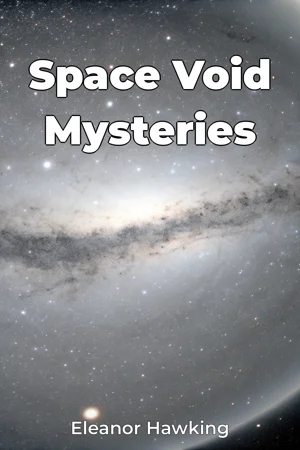
About This Book
Have you ever considered that the vast emptiness of space might hold the key to understanding the universe's grand design? "Space Void Mysteries" delves into the enigmatic world of astronomical voids – the colossal, near-empty regions that punctuate the cosmic web – and explores their profound implications for cosmology. We embark on a journey to uncover how these seemingly barren spaces influence the formation of galaxies, the distribution of dark matter, and even the ultimate fate of the universe. This book is important because voids, representing the underdense side of cosmic structure formation, offer a unique perspective on the standard cosmological model. Their evolution is less influenced by complex astrophysical processes compared to denser regions, making them a cleaner probe of fundamental cosmological parameters like dark energy and the sum of the neutrino masses. To fully appreciate the significance of voids, we first establish a foundational understanding of the Big Bang theory, the accelerating expansion of the universe, and the role of dark matter and dark energy in shaping cosmic structures. We will also discuss the basics of galaxy formation and large-scale structure, ensuring readers have the necessary context. The central argument of "Space Void Mysteries" is that astronomical voids are not merely passive bystanders in the cosmic drama but active players whose properties and evolution provide crucial tests of our cosmological models, particularly concerning dark energy and modified gravity theories. By meticulously examining the observed characteristics of voids, we can constrain cosmological parameters and potentially reveal deviations from the standard model, offering exciting avenues for future research. The book unfolds in a structured manner. We begin by introducing the concept of voids, their discovery, and their classification. Building upon this, we explore the methods used to detect and characterize voids, including the analysis of galaxy redshift surveys, such as the Sloan Digital Sky Survey (SDSS) and the Dark Energy Survey (DES), and the application of sophisticated algorithms for void identification. We will then delve into the theoretical framework governing void evolution, discussing the influence of dark matter, dark energy, and gravity. The book culminates by examining the implications of void studies for our understanding of cosmology, including constraints on cosmological parameters and tests of modified gravity theories. We conclude with a look toward the future, discussing upcoming surveys and the potential for groundbreaking discoveries in the field of void cosmology. Our exploration relies heavily on data obtained from extensive astronomical surveys, alongside theoretical models and simulations. We present observational evidence derived from galaxy catalogues, cosmic microwave background data, and gravitational lensing studies. "Space Void Mysteries" bridges the gap between cosmology and particle physics, connecting the observed properties of voids to the fundamental nature of dark matter and dark energy. Additionally, it touches upon computer science through discussions of the algorithms used, and touches upon statistics where data analysis is explored. This book provides a unique perspective by highlighting the under-explored potential of voids as cosmological probes. While much research focuses on dense regions like galaxy clusters, we champion the idea that voids offer a complementary and often more powerful tool for understanding the universe. The writing style adopted is fact-based, aiming for clarity and precision while remaining accessible to a broad audience. Complex concepts are explained in a thoughtful manner. This book is targeted towards science enthusiasts, undergraduate and graduate students in physics and astronomy, and researchers interested in cosmology and large-scale structure. Readers seeking a comprehensive and up-to-date overview of void cosmology will undoubtedly find this book valuable. As a work of science, it adheres to principles of verifiable evidence, logical argumentation, and peer review. Focus is placed on current research and existing theories. While we aim to provide a comprehensive overview of void cosmology, we acknowledge that certain aspects, such as the detailed mathematical treatment of void evolution, are kept at an introductory level. This limitation allows us to maintain focus on the broader implications and applications of void studies. The knowledge gained from studying voids has practical applications in refining cosmological models, improving our understanding of dark matter and dark energy, and guiding future astronomical surveys. The field of void cosmology is not without its challenges and ongoing debates. We address the controversy surrounding different void identification techniques and the interpretation of void properties in the context of modified gravity theories. By acknowledging these debates, we present a balanced and nuanced view of the field.
Have you ever considered that the vast emptiness of space might hold the key to understanding the universe's grand design? "Space Void Mysteries" delves into the enigmatic world of astronomical voids – the colossal, near-empty regions that punctuate the cosmic web – and explores their profound implications for cosmology. We embark on a journey to uncover how these seemingly barren spaces influence the formation of galaxies, the distribution of dark matter, and even the ultimate fate of the universe. This book is important because voids, representing the underdense side of cosmic structure formation, offer a unique perspective on the standard cosmological model. Their evolution is less influenced by complex astrophysical processes compared to denser regions, making them a cleaner probe of fundamental cosmological parameters like dark energy and the sum of the neutrino masses. To fully appreciate the significance of voids, we first establish a foundational understanding of the Big Bang theory, the accelerating expansion of the universe, and the role of dark matter and dark energy in shaping cosmic structures. We will also discuss the basics of galaxy formation and large-scale structure, ensuring readers have the necessary context. The central argument of "Space Void Mysteries" is that astronomical voids are not merely passive bystanders in the cosmic drama but active players whose properties and evolution provide crucial tests of our cosmological models, particularly concerning dark energy and modified gravity theories. By meticulously examining the observed characteristics of voids, we can constrain cosmological parameters and potentially reveal deviations from the standard model, offering exciting avenues for future research. The book unfolds in a structured manner. We begin by introducing the concept of voids, their discovery, and their classification. Building upon this, we explore the methods used to detect and characterize voids, including the analysis of galaxy redshift surveys, such as the Sloan Digital Sky Survey (SDSS) and the Dark Energy Survey (DES), and the application of sophisticated algorithms for void identification. We will then delve into the theoretical framework governing void evolution, discussing the influence of dark matter, dark energy, and gravity. The book culminates by examining the implications of void studies for our understanding of cosmology, including constraints on cosmological parameters and tests of modified gravity theories. We conclude with a look toward the future, discussing upcoming surveys and the potential for groundbreaking discoveries in the field of void cosmology. Our exploration relies heavily on data obtained from extensive astronomical surveys, alongside theoretical models and simulations. We present observational evidence derived from galaxy catalogues, cosmic microwave background data, and gravitational lensing studies. "Space Void Mysteries" bridges the gap between cosmology and particle physics, connecting the observed properties of voids to the fundamental nature of dark matter and dark energy. Additionally, it touches upon computer science through discussions of the algorithms used, and touches upon statistics where data analysis is explored. This book provides a unique perspective by highlighting the under-explored potential of voids as cosmological probes. While much research focuses on dense regions like galaxy clusters, we champion the idea that voids offer a complementary and often more powerful tool for understanding the universe. The writing style adopted is fact-based, aiming for clarity and precision while remaining accessible to a broad audience. Complex concepts are explained in a thoughtful manner. This book is targeted towards science enthusiasts, undergraduate and graduate students in physics and astronomy, and researchers interested in cosmology and large-scale structure. Readers seeking a comprehensive and up-to-date overview of void cosmology will undoubtedly find this book valuable. As a work of science, it adheres to principles of verifiable evidence, logical argumentation, and peer review. Focus is placed on current research and existing theories. While we aim to provide a comprehensive overview of void cosmology, we acknowledge that certain aspects, such as the detailed mathematical treatment of void evolution, are kept at an introductory level. This limitation allows us to maintain focus on the broader implications and applications of void studies. The knowledge gained from studying voids has practical applications in refining cosmological models, improving our understanding of dark matter and dark energy, and guiding future astronomical surveys. The field of void cosmology is not without its challenges and ongoing debates. We address the controversy surrounding different void identification techniques and the interpretation of void properties in the context of modified gravity theories. By acknowledging these debates, we present a balanced and nuanced view of the field.
"Space Void Mysteries" explores the vast, seemingly empty regions of space known as astronomical voids and their crucial role in understanding the universe's structure and evolution. These voids, representing the underdense side of cosmic structure, offer a unique window into fundamental cosmological parameters. Intriguingly, because voids are less influenced by complex astrophysical processes compared to denser regions, they provide a cleaner probe of dark energy, dark matter, and the very nature of gravity itself. The book begins with an overview of the Big Bang theory, dark matter, and dark energy. It then transitions into the methods scientists use to detect and characterize voids, including data from surveys like the Sloan Digital Sky Survey (SDSS) and the Dark Energy Survey (DES). The core of the book argues that voids aren't just empty space but active components influencing galaxy formation and providing tests for cosmological models. By examining void properties, we can constrain cosmological parameters and potentially uncover deviations from the standard model, offering new avenues for research in cosmology and modified gravity theories. The book progresses systematically, from introducing the concept of voids and their classification to discussing the theoretical framework governing their evolution. It culminates by examining the implications of void studies for our understanding of cosmology, offering a unique perspective on these under-explored cosmic phenomena and their potential to revolutionize our understanding of the universe.
Book Details
ISBN
9788233961107
Publisher
Publifye AS
Your Licenses
You don't own any licenses for this book
Purchase a license below to unlock this book and download the EPUB.
Purchase License
Select a tier to unlock this book
Need bulk licensing?
Contact us for enterprise agreements.