
About This Book
Have you ever wondered how life persists in the harshest environments on Earth? *Desert Life Cycles* explores the fascinating world of desert ecosystems, revealing the intricate survival mechanisms of the plants and animals that call these arid landscapes home. This book delves into the unique adaptations, ecological relationships, and life cycles that allow species to thrive in conditions where water is scarce and temperatures fluctuate wildly. This book focuses primarily on two critical themes: adaptation and interdependence. Adaptation refers to the diverse strategies organisms employ to overcome the challenges of desert life, while interdependence refers to the complex relationships that species have developed to survive in the desert. These topics provide critical insight because understanding the mechanisms behind desert survival offers insights into the effects of climate change. To fully appreciate the intricacies of desert life cycles, we will first establish a foundational understanding of desert environments worldwide. This will involve a detailed survey of different desert types – from hot, sandy expanses to cold, high-altitude regions – and the climatic factors that define them. Basic biological principles such as photosynthesis, respiration, and evolutionary adaptation are assumed. The central argument of *Desert Life Cycles* is that the persistence of life in deserts is a testament to the power of adaptation and the interconnectedness of species within these fragile ecosystems. This understanding is critical not merely for academic knowledge but also for informing conservation efforts in the face of increasing desertification and climate change impacts. We will begin by introducing core concepts of desert ecology, establishing the groundwork needed to comprehend complex survival strategies. The book is structured in three major parts. The first sections cover plant life, highlighting adaptations like drought resistance, water storage, and specialized root systems, focusing on examples such as cacti, succulents, and ephemeral plants. The next section transitions to desert animal life, exploring behavioral, physiological, and morphological adaptations that include nocturnal habits, efficient water conservation, and specialized diets, using examples like reptiles, insects, and desert mammals. We will finish by examining the ecological relationships within desert communities, exploring symbiotic relationships, predator-prey dynamics, and nutrient cycling, illustrating how interdependence is crucial for maintaining ecosystem stability. The book culminates by offering practical applications of the knowledge gleaned, discussing conservation strategies, sustainable land management practices, and the potential for biomimicry based on desert adaptations. Evidence presented includes detailed case studies of specific desert ecosystems, comprehensive analyses of plant and animal adaptations, and recent research findings on the impacts of climate change on desert biodiversity. We will draw upon data from long-term ecological studies, physiological experiments, and behavioral observations. We will also include visual data such as photographs, illustrations, and climate graphs to support the written material so that the concepts are more clear. *Desert Life Cycles* connects to several fields, including climatology, evolutionary biology, and conservation ecology. Climatology helps explain the factors that create deserts, evolutionary biology clarifies adaptation that desert organisms had to undergo, and conservation ecology highlights the steps necessary to preserve the ecosystems. This book offers a unique perspective by integrating ecological principles with real-world conservation challenges, providing a holistic understanding of desert life cycles. It differs from existing literature by emphasizing not only individual adaptations but also the intricate ecological relationships that sustain desert ecosystems. The tone is academic and informative, grounded in scientific principles but presented in a way for a general audience to follow. We aim to present complex information in a clear and engaging manner, making it accessible to a wide range of readers. The target audience includes students, ecologists, environment enthusiasts, and anyone who is interested in learning about the desert biome. This book aligns with the conventions of scientific non-fiction, offering a balanced blend of empirical evidence, theoretical frameworks, and real-world applications. It adheres to accuracy, objectivity, and evidence-based reasoning. The scope is broad, covering a range of desert types and species worldwide, but it focuses primarily on adaptation and interdependence. While the book touches on geological factors, it does not delve into the full geomorphology of desert landscapes. The information can be applied to inform conservation efforts, promote sustainable land management practices, and inspire innovative solutions to environmental challenges. While the book presents a balanced view of desert ecosystems, it acknowledges the complexities and ongoing debates regarding the best approaches to conservation and sustainable development in these sensitive environments.
Have you ever wondered how life persists in the harshest environments on Earth? *Desert Life Cycles* explores the fascinating world of desert ecosystems, revealing the intricate survival mechanisms of the plants and animals that call these arid landscapes home. This book delves into the unique adaptations, ecological relationships, and life cycles that allow species to thrive in conditions where water is scarce and temperatures fluctuate wildly. This book focuses primarily on two critical themes: adaptation and interdependence. Adaptation refers to the diverse strategies organisms employ to overcome the challenges of desert life, while interdependence refers to the complex relationships that species have developed to survive in the desert. These topics provide critical insight because understanding the mechanisms behind desert survival offers insights into the effects of climate change. To fully appreciate the intricacies of desert life cycles, we will first establish a foundational understanding of desert environments worldwide. This will involve a detailed survey of different desert types – from hot, sandy expanses to cold, high-altitude regions – and the climatic factors that define them. Basic biological principles such as photosynthesis, respiration, and evolutionary adaptation are assumed. The central argument of *Desert Life Cycles* is that the persistence of life in deserts is a testament to the power of adaptation and the interconnectedness of species within these fragile ecosystems. This understanding is critical not merely for academic knowledge but also for informing conservation efforts in the face of increasing desertification and climate change impacts. We will begin by introducing core concepts of desert ecology, establishing the groundwork needed to comprehend complex survival strategies. The book is structured in three major parts. The first sections cover plant life, highlighting adaptations like drought resistance, water storage, and specialized root systems, focusing on examples such as cacti, succulents, and ephemeral plants. The next section transitions to desert animal life, exploring behavioral, physiological, and morphological adaptations that include nocturnal habits, efficient water conservation, and specialized diets, using examples like reptiles, insects, and desert mammals. We will finish by examining the ecological relationships within desert communities, exploring symbiotic relationships, predator-prey dynamics, and nutrient cycling, illustrating how interdependence is crucial for maintaining ecosystem stability. The book culminates by offering practical applications of the knowledge gleaned, discussing conservation strategies, sustainable land management practices, and the potential for biomimicry based on desert adaptations. Evidence presented includes detailed case studies of specific desert ecosystems, comprehensive analyses of plant and animal adaptations, and recent research findings on the impacts of climate change on desert biodiversity. We will draw upon data from long-term ecological studies, physiological experiments, and behavioral observations. We will also include visual data such as photographs, illustrations, and climate graphs to support the written material so that the concepts are more clear. *Desert Life Cycles* connects to several fields, including climatology, evolutionary biology, and conservation ecology. Climatology helps explain the factors that create deserts, evolutionary biology clarifies adaptation that desert organisms had to undergo, and conservation ecology highlights the steps necessary to preserve the ecosystems. This book offers a unique perspective by integrating ecological principles with real-world conservation challenges, providing a holistic understanding of desert life cycles. It differs from existing literature by emphasizing not only individual adaptations but also the intricate ecological relationships that sustain desert ecosystems. The tone is academic and informative, grounded in scientific principles but presented in a way for a general audience to follow. We aim to present complex information in a clear and engaging manner, making it accessible to a wide range of readers. The target audience includes students, ecologists, environment enthusiasts, and anyone who is interested in learning about the desert biome. This book aligns with the conventions of scientific non-fiction, offering a balanced blend of empirical evidence, theoretical frameworks, and real-world applications. It adheres to accuracy, objectivity, and evidence-based reasoning. The scope is broad, covering a range of desert types and species worldwide, but it focuses primarily on adaptation and interdependence. While the book touches on geological factors, it does not delve into the full geomorphology of desert landscapes. The information can be applied to inform conservation efforts, promote sustainable land management practices, and inspire innovative solutions to environmental challenges. While the book presents a balanced view of desert ecosystems, it acknowledges the complexities and ongoing debates regarding the best approaches to conservation and sustainable development in these sensitive environments.
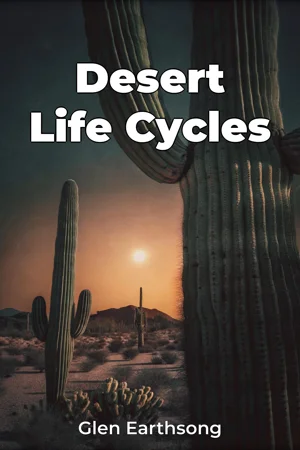
"Desert Life Cycles" explores the remarkable survival strategies of plants and animals in Earth's harshest environments. The book highlights how adaptation and interdependence are key to thriving in arid landscapes. Discover the unique features of desert ecosystems, from adaptations like drought resistance in plants to efficient water conservation methods in animals. The text emphasizes the interconnectedness of species, revealing how symbiotic relationships and predator-prey dynamics maintain ecosystem stability. The book begins by establishing a foundation in desert ecology and progresses through plant and animal life, concluding with ecological relationships. It showcases the power of adaptation using detailed case studies and recent research to inform conservation efforts. Explore how understanding these life cycles is crucial for addressing climate change impacts and promoting sustainable practices by integrating ecological principles with real-world conservation challenges.
Book Details
ISBN
9788233960445
Publisher
Publifye AS
Your Licenses
You don't own any licenses for this book
Purchase a license below to unlock this book and download the EPUB.
Purchase License
Select a tier to unlock this book
Need bulk licensing?
Contact us for enterprise agreements.