
About This Book
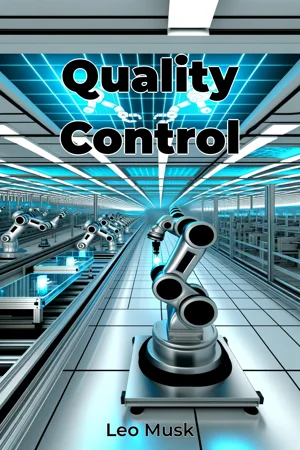
In today's rapidly evolving industrial landscape, the difference between success and failure often hinges on the consistent delivery of quality products and services. "Quality Control" presents a comprehensive examination of modern quality management systems and their critical role in maintaining production excellence. The book addresses three fundamental aspects of quality control: systematic quality management processes, real-time monitoring systems, and continuous improvement methodologies. These elements form the backbone of successful production environments, where quality isn't merely inspected but built into every step of the manufacturing process. Drawing from six decades of industrial quality control evolution, from post-World War II manufacturing practices to current Industry 4.0 implementations, the text provides essential context for understanding contemporary quality management challenges. The book establishes how quality control has transformed from simple end-product inspection to integrated process control systems that prevent defects before they occur. The central thesis argues that effective quality control must be proactive rather than reactive, integrated rather than isolated, and data-driven rather than intuition-based. This approach is supported by case studies from various industries, including automotive manufacturing, pharmaceutical production, and electronics assembly. The content progresses logically through three major sections. The first introduces fundamental quality control concepts and statistical process control tools. The second explores implementation strategies, including Six Sigma methodologies and lean manufacturing principles. The final section addresses emerging technologies in quality management, such as machine learning algorithms and IoT-enabled monitoring systems. The book's arguments are supported by empirical research from manufacturing facilities across four continents, featuring both successful implementations and cautionary failures. Statistical analyses and process capability studies demonstrate the quantitative benefits of robust quality control systems. Interdisciplinary connections are drawn between quality control and fields such as organizational psychology, data science, and supply chain management. These connections highlight how quality control influences and is influenced by human factors, technological capabilities, and broader business operations. The text employs a structured, technical approach while maintaining accessibility through practical examples and clear explanations. Complex statistical concepts are presented with real-world applications, making them accessible to both quality professionals and operations managers. This book serves multiple audiences: quality control engineers seeking advanced methodologies, production managers looking to optimize their operations, and business leaders working to implement quality management systems. Each chapter includes practical implementation guides and decision-making frameworks. While focusing primarily on manufacturing environments, the book acknowledges limitations in applying certain methodologies to service industries or small-scale operations. However, it provides adaptable principles that can be scaled to different operational contexts. The real-world applications section includes implementation roadmaps, audit checklists, and troubleshooting guides. These tools enable readers to translate theoretical knowledge into practical quality improvements within their organizations. The book addresses ongoing debates in the quality control field, such as the role of automation versus human judgment and the balance between quality and productivity. It presents balanced perspectives on these issues, supported by current research and industry practices. For professionals in manufacturing, operations management, or quality control, this book provides a comprehensive guide to establishing and maintaining effective quality control systems in modern production environments.
In today's rapidly evolving industrial landscape, the difference between success and failure often hinges on the consistent delivery of quality products and services. "Quality Control" presents a comprehensive examination of modern quality management systems and their critical role in maintaining production excellence. The book addresses three fundamental aspects of quality control: systematic quality management processes, real-time monitoring systems, and continuous improvement methodologies. These elements form the backbone of successful production environments, where quality isn't merely inspected but built into every step of the manufacturing process. Drawing from six decades of industrial quality control evolution, from post-World War II manufacturing practices to current Industry 4.0 implementations, the text provides essential context for understanding contemporary quality management challenges. The book establishes how quality control has transformed from simple end-product inspection to integrated process control systems that prevent defects before they occur. The central thesis argues that effective quality control must be proactive rather than reactive, integrated rather than isolated, and data-driven rather than intuition-based. This approach is supported by case studies from various industries, including automotive manufacturing, pharmaceutical production, and electronics assembly. The content progresses logically through three major sections. The first introduces fundamental quality control concepts and statistical process control tools. The second explores implementation strategies, including Six Sigma methodologies and lean manufacturing principles. The final section addresses emerging technologies in quality management, such as machine learning algorithms and IoT-enabled monitoring systems. The book's arguments are supported by empirical research from manufacturing facilities across four continents, featuring both successful implementations and cautionary failures. Statistical analyses and process capability studies demonstrate the quantitative benefits of robust quality control systems. Interdisciplinary connections are drawn between quality control and fields such as organizational psychology, data science, and supply chain management. These connections highlight how quality control influences and is influenced by human factors, technological capabilities, and broader business operations. The text employs a structured, technical approach while maintaining accessibility through practical examples and clear explanations. Complex statistical concepts are presented with real-world applications, making them accessible to both quality professionals and operations managers. This book serves multiple audiences: quality control engineers seeking advanced methodologies, production managers looking to optimize their operations, and business leaders working to implement quality management systems. Each chapter includes practical implementation guides and decision-making frameworks. While focusing primarily on manufacturing environments, the book acknowledges limitations in applying certain methodologies to service industries or small-scale operations. However, it provides adaptable principles that can be scaled to different operational contexts. The real-world applications section includes implementation roadmaps, audit checklists, and troubleshooting guides. These tools enable readers to translate theoretical knowledge into practical quality improvements within their organizations. The book addresses ongoing debates in the quality control field, such as the role of automation versus human judgment and the balance between quality and productivity. It presents balanced perspectives on these issues, supported by current research and industry practices. For professionals in manufacturing, operations management, or quality control, this book provides a comprehensive guide to establishing and maintaining effective quality control systems in modern production environments.
"Quality Control" delivers a comprehensive exploration of modern quality management systems, tracing their evolution from post-World War II manufacturing practices to today's Industry 4.0 implementations. The book emphasizes a fundamental shift in quality control philosophy: from reactive end-product inspection to proactive, integrated process control that prevents defects before they occur. Through real-world case studies spanning automotive, pharmaceutical, and electronics industries, the text demonstrates how quality control has become an essential driver of manufacturing success. The book's structure progressively builds understanding through three key sections, beginning with fundamental concepts and statistical process control tools. It then delves into practical implementation strategies, including Six Sigma methodologies and lean manufacturing principles, before exploring cutting-edge quality management technologies such as machine learning and IoT-enabled monitoring systems. What sets this book apart is its blend of theoretical foundation with practical application, supported by empirical research from manufacturing facilities across four continents. This accessible guide bridges the gap between complex statistical concepts and their real-world applications, making it valuable for quality control engineers, production managers, and business leaders alike. The inclusion of implementation roadmaps, audit checklists, and troubleshooting guides enables readers to translate theoretical knowledge into actionable quality improvements. While focused on manufacturing environments, the book's principles can be adapted to various operational contexts, providing a comprehensive framework for establishing and maintaining effective quality control systems in modern production settings.
Book Details
ISBN
9788233959302
Publisher
Publifye AS
Your Licenses
You don't own any licenses for this book
Purchase a license below to unlock this book and download the EPUB.
Purchase License
Select a tier to unlock this book
Need bulk licensing?
Contact us for enterprise agreements.