
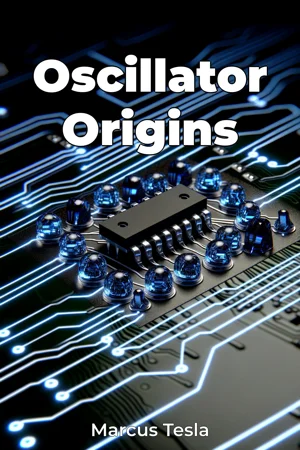
About This Book
Imagine a world without precision timekeeping, radio communications, or modern electronics. At the heart of these technologies lies a fundamental component that has shaped our technological landscape: the oscillator. "Oscillator Origins" takes readers on a comprehensive journey through the science, history, and applications of electronic oscillators, revealing how these rhythmic electrical pulses serve as the heartbeat of modern technology. The book begins by exploring the basic principles of oscillation, from the simple pendulum to crystal oscillators, before delving into how these components revolutionized telecommunications and timekeeping. Through detailed technical explanations and practical examples, the text examines three core areas: the physics of oscillation, the evolution of oscillator technology, and modern applications in electronic systems. Each chapter builds upon fundamental concepts, allowing readers to develop a thorough understanding of how oscillators generate and maintain stable frequencies that power our digital world. The book presents extensive research from both historical and contemporary sources, including original patents, laboratory studies, and industry applications. Technical diagrams, circuit analyses, and case studies illustrate key concepts, while mathematical models demonstrate the underlying principles that govern oscillator behavior. The first section establishes the theoretical foundation, exploring the mathematics of periodic motion and the principles of feedback systems. The middle chapters trace the development of oscillator technology from early radio pioneers to modern semiconductor designs. The final section examines current applications in telecommunications, computing, and precision measurement systems. Readers will discover how oscillators bridge multiple disciplines, connecting physics, electrical engineering, and communications technology. The book explains how these connections have enabled technological breakthroughs, from the first radio broadcasts to today's cellular networks and atomic clocks. The text maintains a technical yet accessible approach, suitable for engineering students, electronics professionals, and technically-minded readers interested in understanding the fundamental building blocks of modern electronics. Mathematical concepts are presented with clear explanations and practical context, making complex principles comprehensible without oversimplification. "Oscillator Origins" addresses current developments in the field, including the role of oscillators in quantum computing, 5G communications, and emerging timing technologies. It examines challenges in oscillator design, such as frequency stability, phase noise, and power efficiency, presenting both traditional solutions and innovative approaches. The book includes practical sections on oscillator circuit design, troubleshooting techniques, and selection criteria for different applications. These hands-on elements allow readers to apply theoretical knowledge to real-world engineering challenges. Special attention is given to the growing importance of precision timing in distributed systems, autonomous vehicles, and the Internet of Things. The text explores how advances in oscillator technology continue to enable new applications while addressing increasing demands for accuracy and reliability. Throughout its chapters, the book maintains focus on technical accuracy while illustrating the profound impact of oscillator technology on modern life. It serves as both a technical reference and a narrative of how a fundamental electronic component has shaped the development of modern technology, making it valuable for students, professionals, and anyone seeking to understand the building blocks of our connected world.
Imagine a world without precision timekeeping, radio communications, or modern electronics. At the heart of these technologies lies a fundamental component that has shaped our technological landscape: the oscillator. "Oscillator Origins" takes readers on a comprehensive journey through the science, history, and applications of electronic oscillators, revealing how these rhythmic electrical pulses serve as the heartbeat of modern technology. The book begins by exploring the basic principles of oscillation, from the simple pendulum to crystal oscillators, before delving into how these components revolutionized telecommunications and timekeeping. Through detailed technical explanations and practical examples, the text examines three core areas: the physics of oscillation, the evolution of oscillator technology, and modern applications in electronic systems. Each chapter builds upon fundamental concepts, allowing readers to develop a thorough understanding of how oscillators generate and maintain stable frequencies that power our digital world. The book presents extensive research from both historical and contemporary sources, including original patents, laboratory studies, and industry applications. Technical diagrams, circuit analyses, and case studies illustrate key concepts, while mathematical models demonstrate the underlying principles that govern oscillator behavior. The first section establishes the theoretical foundation, exploring the mathematics of periodic motion and the principles of feedback systems. The middle chapters trace the development of oscillator technology from early radio pioneers to modern semiconductor designs. The final section examines current applications in telecommunications, computing, and precision measurement systems. Readers will discover how oscillators bridge multiple disciplines, connecting physics, electrical engineering, and communications technology. The book explains how these connections have enabled technological breakthroughs, from the first radio broadcasts to today's cellular networks and atomic clocks. The text maintains a technical yet accessible approach, suitable for engineering students, electronics professionals, and technically-minded readers interested in understanding the fundamental building blocks of modern electronics. Mathematical concepts are presented with clear explanations and practical context, making complex principles comprehensible without oversimplification. "Oscillator Origins" addresses current developments in the field, including the role of oscillators in quantum computing, 5G communications, and emerging timing technologies. It examines challenges in oscillator design, such as frequency stability, phase noise, and power efficiency, presenting both traditional solutions and innovative approaches. The book includes practical sections on oscillator circuit design, troubleshooting techniques, and selection criteria for different applications. These hands-on elements allow readers to apply theoretical knowledge to real-world engineering challenges. Special attention is given to the growing importance of precision timing in distributed systems, autonomous vehicles, and the Internet of Things. The text explores how advances in oscillator technology continue to enable new applications while addressing increasing demands for accuracy and reliability. Throughout its chapters, the book maintains focus on technical accuracy while illustrating the profound impact of oscillator technology on modern life. It serves as both a technical reference and a narrative of how a fundamental electronic component has shaped the development of modern technology, making it valuable for students, professionals, and anyone seeking to understand the building blocks of our connected world.
"Oscillator Origins" explores the fundamental role of electronic oscillators in modern technology, from basic timekeeping to advanced telecommunications. This comprehensive guide begins with the physics of oscillation, progressing through historical developments to cutting-edge applications in quantum computing and 5G communications. The book artfully bridges multiple disciplines, revealing how these rhythmic electrical pulses serve as the foundation for our interconnected digital world. The text is structured to build understanding progressively, starting with fundamental concepts like periodic motion and feedback systems before advancing to complex applications. Through detailed technical explanations and practical examples, readers discover how oscillators maintain the precise frequencies that power everything from radio broadcasts to atomic clocks. One particularly fascinating aspect is the exploration of how early radio pioneers' work with basic oscillator circuits evolved into today's sophisticated semiconductor designs. The book uniquely combines theoretical knowledge with practical applications, making complex principles accessible without sacrificing technical depth. It includes hands-on elements for circuit design and troubleshooting, while addressing contemporary challenges in frequency stability and phase noise. Special attention is given to emerging technologies, including the critical role of precision timing in autonomous vehicles and the Internet of Things, demonstrating the continuing evolution and importance of oscillator technology in modern engineering.
Book Details
ISBN
9788233959142
Publisher
Publifye AS
Your Licenses
You don't own any licenses for this book
Purchase a license below to unlock this book and download the EPUB.
Purchase License
Select a tier to unlock this book
Need bulk licensing?
Contact us for enterprise agreements.