
About This Book
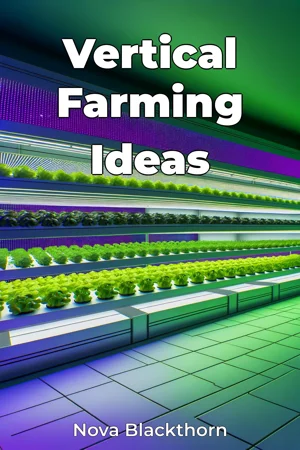
In an era where global food security meets urban expansion, vertical farming emerges as a crucial solution for sustainable agriculture. "Vertical Farming Ideas" presents a systematic exploration of cutting-edge cultivation techniques that transform limited spaces into highly productive growing environments. The book delivers a comprehensive analysis of three fundamental aspects: spatial optimization through vertical growing systems, hydroponics and aeroponics integration, and environmental control technologies. These elements form the foundation of successful vertical farming operations, from small-scale home setups to commercial installations. Beginning with the scientific principles of plant growth in vertical systems, the text examines how gravity, light distribution, and air circulation influence crop development. Readers gain insight into the biological mechanisms that allow plants to thrive in vertically stacked configurations, supported by current research from agricultural institutions worldwide. The core argument presents vertical farming as not merely an alternative but a necessary evolution in agricultural practices, particularly in urban environments. This position is reinforced through case studies of successful implementations across different climates and settings, demonstrating yields up to ten times higher than traditional farming methods per square foot. Structured in three main sections, the book first establishes the fundamental science behind vertical farming, including plant biology and environmental factors. The second section details practical implementation, covering system design, crop selection, and resource management. The final section addresses scaling and optimization, featuring real-world examples and troubleshooting guides. The content draws from extensive research, including data from controlled environment agriculture studies, urban farming initiatives, and commercial vertical farm operations. The methodology combines empirical research with practical application, offering readers both theoretical understanding and actionable insights. The book creates meaningful connections between agriculture, engineering, and environmental science, demonstrating how principles from each field contribute to successful vertical farming systems. This interdisciplinary approach provides readers with a robust framework for understanding and implementing vertical farming techniques. Written in a technical yet accessible style, the text maintains a balanced approach between scientific explanation and practical guidance. Each chapter includes detailed diagrams, tables, and step-by-step instructions, making complex concepts understandable for both newcomers and experienced practitioners. The target audience includes urban farmers, agricultural professionals, sustainability enthusiasts, and anyone interested in efficient food production methods. The book serves as both an educational resource and a practical guide, suitable for individual growers and commercial operators. Particular attention is given to resource efficiency, examining how vertical farming systems optimize water usage, reduce energy consumption, and minimize environmental impact. The book addresses current debates surrounding the economic viability of vertical farming and its role in future food security. Real-world applications are emphasized throughout, with specific focus on system design, crop selection, maintenance procedures, and yield optimization. Readers learn how to adapt these principles to their specific circumstances, whether converting a spare room or developing a commercial operation. The book concludes with an exploration of future developments in vertical farming technology, including automated systems, AI integration, and advanced lighting solutions, while maintaining a practical focus on currently implementable solutions.
In an era where global food security meets urban expansion, vertical farming emerges as a crucial solution for sustainable agriculture. "Vertical Farming Ideas" presents a systematic exploration of cutting-edge cultivation techniques that transform limited spaces into highly productive growing environments. The book delivers a comprehensive analysis of three fundamental aspects: spatial optimization through vertical growing systems, hydroponics and aeroponics integration, and environmental control technologies. These elements form the foundation of successful vertical farming operations, from small-scale home setups to commercial installations. Beginning with the scientific principles of plant growth in vertical systems, the text examines how gravity, light distribution, and air circulation influence crop development. Readers gain insight into the biological mechanisms that allow plants to thrive in vertically stacked configurations, supported by current research from agricultural institutions worldwide. The core argument presents vertical farming as not merely an alternative but a necessary evolution in agricultural practices, particularly in urban environments. This position is reinforced through case studies of successful implementations across different climates and settings, demonstrating yields up to ten times higher than traditional farming methods per square foot. Structured in three main sections, the book first establishes the fundamental science behind vertical farming, including plant biology and environmental factors. The second section details practical implementation, covering system design, crop selection, and resource management. The final section addresses scaling and optimization, featuring real-world examples and troubleshooting guides. The content draws from extensive research, including data from controlled environment agriculture studies, urban farming initiatives, and commercial vertical farm operations. The methodology combines empirical research with practical application, offering readers both theoretical understanding and actionable insights. The book creates meaningful connections between agriculture, engineering, and environmental science, demonstrating how principles from each field contribute to successful vertical farming systems. This interdisciplinary approach provides readers with a robust framework for understanding and implementing vertical farming techniques. Written in a technical yet accessible style, the text maintains a balanced approach between scientific explanation and practical guidance. Each chapter includes detailed diagrams, tables, and step-by-step instructions, making complex concepts understandable for both newcomers and experienced practitioners. The target audience includes urban farmers, agricultural professionals, sustainability enthusiasts, and anyone interested in efficient food production methods. The book serves as both an educational resource and a practical guide, suitable for individual growers and commercial operators. Particular attention is given to resource efficiency, examining how vertical farming systems optimize water usage, reduce energy consumption, and minimize environmental impact. The book addresses current debates surrounding the economic viability of vertical farming and its role in future food security. Real-world applications are emphasized throughout, with specific focus on system design, crop selection, maintenance procedures, and yield optimization. Readers learn how to adapt these principles to their specific circumstances, whether converting a spare room or developing a commercial operation. The book concludes with an exploration of future developments in vertical farming technology, including automated systems, AI integration, and advanced lighting solutions, while maintaining a practical focus on currently implementable solutions.
"Vertical Farming Ideas" presents a groundbreaking exploration of modern agricultural innovation, focusing on how vertical farming technologies can revolutionize food production in urban environments. This comprehensive guide bridges the gap between traditional agriculture and cutting-edge growing techniques, offering practical solutions for maximizing food production in limited spaces through advanced methods like hydroponics and aeroponics. The book uniquely integrates scientific principles with hands-on applications, progressing from fundamental concepts of plant biology and environmental controls to practical implementation strategies. Readers discover how vertical farming systems can achieve up to ten times higher yields per square foot compared to conventional farming methods, while learning about crucial factors such as gravity management, light distribution, and air circulation. The text expertly balances technical information with accessible explanations, making complex concepts understandable for both beginners and experienced practitioners. Through three well-structured sections, the book moves from basic science and plant biology to system design and resource management, culminating in real-world applications and scaling strategies. What sets this resource apart is its interdisciplinary approach, combining insights from agriculture, engineering, and environmental science to provide a complete framework for successful vertical farming implementation. Whether readers are interested in small-scale home setups or commercial installations, they'll find valuable guidance on system optimization, crop selection, and sustainable resource management.
Book Details
ISBN
9788233958039
Publisher
Publifye AS
Your Licenses
You don't own any licenses for this book
Purchase a license below to unlock this book and download the EPUB.
Purchase License
Select a tier to unlock this book
Need bulk licensing?
Contact us for enterprise agreements.