
About This Book
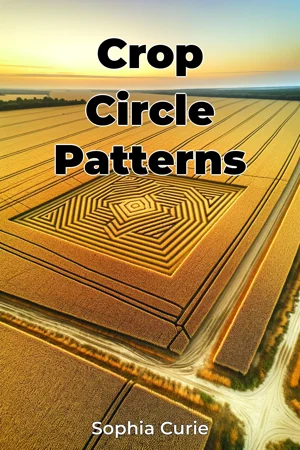
Have these intricate patterns etched onto fields worldwide baffled scientists and captured imaginations for decades? "Crop Circle Patterns" delves into the facts surrounding these enigmatic formations, separating documented evidence from speculation. We explore the science, human ingenuity, and cultural impact of crop circles, offering a comprehensive analysis for both enthusiasts and skeptics. This book addresses two fundamental questions: what are the verifiable origins of crop circles, and what cultural significance do they hold? The answers are important because understanding these phenomena requires a multidisciplinary approach, blending scientific investigation with an appreciation for cultural narratives. The book provides essential context by tracing the history of crop circle sightings from early reports to the complex geometric designs of recent years. It examines the social conditions that fostered interest in these patterns and the scientific methods applied in attempts to explain them. A basic understanding of geometry and agricultural practices will enhance the reader's comprehension, but it's far from necessary. The primary purpose of "Crop Circle Patterns" is to present a balanced assessment of the available evidence, arguing that while some crop circles are undoubtedly human-made, others resist easy explanation and continue to stimulate scientific inquiry and artistic expression. This argument challenges the widely accepted notion that all crop circles are hoaxes and invites a nuanced perspective on the interaction between human activity and unexplained phenomena. The book unfolds in three key sections. First, it meticulously documents the history and evolution of crop circles, detailing the shift from simple circles to intricate fractal designs. Second, it critically examines the scientific research conducted on crop circles, including soil analysis, plant examination, and electromagnetic field measurements. This portion explores the proposed natural explanations, such as plasma vortices and animal activity, alongside the documented methods used by hoaxers. Third, "Crop Circle Patterns" explores the cultural impact of crop circles, examining their role in art, literature, and popular culture, as well as the socio-psychological factors driving the phenomenon. The book relies on a variety of sources, including peer-reviewed scientific papers, eyewitness accounts, photographic and video evidence, and reports from organizations dedicated to crop circle research. It presents unique data drawn from field investigations and interviews with crop circle researchers and artists. "Crop Circle Patterns" connects to several fields, including agriculture, physics, art history, and sociology. This interdisciplinary approach provides a richer understanding of the multifaceted nature of crop circles and enhances the book's central argument by demonstrating how scientific scrutiny interacts with cultural interpretation. A notable aspect of this book is its detailed analysis of the techniques used by crop circle artists, contrasting these methods with the physical characteristics observed in purportedly genuine formations. It differentiates itself by avoiding sensationalism and focusing on verifiable facts and scientific analysis. This approach ensures the book maintains an objective stance amidst a topic often characterized by conjecture and anecdotal evidence. Written in a clear and accessible style, "Crop Circle Patterns" is aimed at a broad audience, including science enthusiasts, curious readers interested in unexplained phenomena, and researchers in related fields. The book avoids overly technical jargon, making it accessible to readers without specialized knowledge. The book is written for anyone interested in a detailed and unbiased analysis of crop circles. As a work of non-fiction, "Crop Circle Patterns" adheres to the principles of accuracy, objectivity, and transparency. It presents information in a balanced manner, acknowledging alternative viewpoints and limitations in the available evidence. The scope of the book is limited to a factual assessment, avoiding speculation about extraterrestrial involvement or other unsubstantiated claims. The information presented has real-world applications in fields such as agricultural science, where researchers can study the effects of different formation methods on crop health, and art, where the intricate designs of crop circles inspire new forms of expression. The book engages with ongoing debates about the authenticity and origins of crop circles, providing a framework for critical evaluation of evidence and a call for further scientific investigation. We aim to equip the reader with the tools to assess claims for and against the various theories surrounding the phenomenon.
Have these intricate patterns etched onto fields worldwide baffled scientists and captured imaginations for decades? "Crop Circle Patterns" delves into the facts surrounding these enigmatic formations, separating documented evidence from speculation. We explore the science, human ingenuity, and cultural impact of crop circles, offering a comprehensive analysis for both enthusiasts and skeptics. This book addresses two fundamental questions: what are the verifiable origins of crop circles, and what cultural significance do they hold? The answers are important because understanding these phenomena requires a multidisciplinary approach, blending scientific investigation with an appreciation for cultural narratives. The book provides essential context by tracing the history of crop circle sightings from early reports to the complex geometric designs of recent years. It examines the social conditions that fostered interest in these patterns and the scientific methods applied in attempts to explain them. A basic understanding of geometry and agricultural practices will enhance the reader's comprehension, but it's far from necessary. The primary purpose of "Crop Circle Patterns" is to present a balanced assessment of the available evidence, arguing that while some crop circles are undoubtedly human-made, others resist easy explanation and continue to stimulate scientific inquiry and artistic expression. This argument challenges the widely accepted notion that all crop circles are hoaxes and invites a nuanced perspective on the interaction between human activity and unexplained phenomena. The book unfolds in three key sections. First, it meticulously documents the history and evolution of crop circles, detailing the shift from simple circles to intricate fractal designs. Second, it critically examines the scientific research conducted on crop circles, including soil analysis, plant examination, and electromagnetic field measurements. This portion explores the proposed natural explanations, such as plasma vortices and animal activity, alongside the documented methods used by hoaxers. Third, "Crop Circle Patterns" explores the cultural impact of crop circles, examining their role in art, literature, and popular culture, as well as the socio-psychological factors driving the phenomenon. The book relies on a variety of sources, including peer-reviewed scientific papers, eyewitness accounts, photographic and video evidence, and reports from organizations dedicated to crop circle research. It presents unique data drawn from field investigations and interviews with crop circle researchers and artists. "Crop Circle Patterns" connects to several fields, including agriculture, physics, art history, and sociology. This interdisciplinary approach provides a richer understanding of the multifaceted nature of crop circles and enhances the book's central argument by demonstrating how scientific scrutiny interacts with cultural interpretation. A notable aspect of this book is its detailed analysis of the techniques used by crop circle artists, contrasting these methods with the physical characteristics observed in purportedly genuine formations. It differentiates itself by avoiding sensationalism and focusing on verifiable facts and scientific analysis. This approach ensures the book maintains an objective stance amidst a topic often characterized by conjecture and anecdotal evidence. Written in a clear and accessible style, "Crop Circle Patterns" is aimed at a broad audience, including science enthusiasts, curious readers interested in unexplained phenomena, and researchers in related fields. The book avoids overly technical jargon, making it accessible to readers without specialized knowledge. The book is written for anyone interested in a detailed and unbiased analysis of crop circles. As a work of non-fiction, "Crop Circle Patterns" adheres to the principles of accuracy, objectivity, and transparency. It presents information in a balanced manner, acknowledging alternative viewpoints and limitations in the available evidence. The scope of the book is limited to a factual assessment, avoiding speculation about extraterrestrial involvement or other unsubstantiated claims. The information presented has real-world applications in fields such as agricultural science, where researchers can study the effects of different formation methods on crop health, and art, where the intricate designs of crop circles inspire new forms of expression. The book engages with ongoing debates about the authenticity and origins of crop circles, providing a framework for critical evaluation of evidence and a call for further scientific investigation. We aim to equip the reader with the tools to assess claims for and against the various theories surrounding the phenomenon.
"Crop Circle Patterns" explores the world of intricate geometric designs appearing in fields, separating fact from fiction surrounding these unexplained phenomena. Rather than focusing solely on speculation, the book presents a balanced analysis of scientific research and cultural interpretations. Readers will discover how some formations defy simple explanations, prompting ongoing investigations in agricultural science and artistic expression. The book traces the history of crop circles, from simple shapes to complex fractal patterns, while critically examining scientific research, like soil analysis and electromagnetic field measurements. A key focus is differentiating between human-made formations and those exhibiting unique characteristics that resist easy explanation. This approach highlights a fundamental tension between scientific investigation and cultural narratives. Progressing through history, scientific analysis, and cultural impact, "Crop Circle Patterns" offers a unique perspective. It challenges the assumption that all crop circles are hoaxes and encourages a nuanced understanding of these agricultural anomalies. By blending scientific scrutiny with cultural interpretation, the book provides a comprehensive overview of a captivating subject.
Book Details
ISBN
9788233957674
Publisher
Publifye AS
Your Licenses
You don't own any licenses for this book
Purchase a license below to unlock this book and download the EPUB.
Purchase License
Select a tier to unlock this book
Need bulk licensing?
Contact us for enterprise agreements.