
About This Book
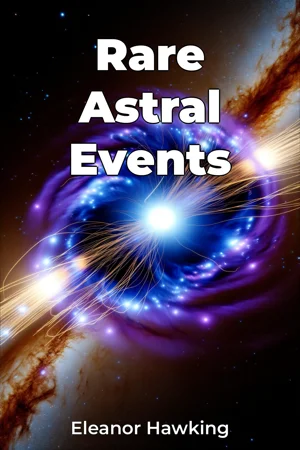
In the vastness of space, certain cosmic events reshape our understanding of the universe while occurring so rarely that each instance becomes a crucial piece in the puzzle of astrophysics. "Rare Astral Events" examines these infrequent yet pivotal astronomical phenomena, offering readers a comprehensive analysis of their mechanisms, implications, and contributions to our evolving comprehension of the cosmos. The book systematically explores three primary categories of uncommon celestial events: supernovae explosions, gamma-ray bursts, and gravitational wave events. Each phenomenon is analyzed through observational data spanning decades, including findings from ground-based telescopes, space observatories, and advanced detection systems like LIGO (Laser Interferometer Gravitational-Wave Observatory). Beginning with supernovae, readers learn about the different classification types and their role in element creation. The text delves into how these stellar explosions serve as cosmic factories, producing and distributing heavy elements essential for planetary formation and potential life development. Recent discoveries of unusual supernovae that don't fit traditional categories are examined, challenging current stellar evolution models. The section on gamma-ray bursts investigates these brief yet intense flashes of high-energy radiation, which rank among the most energetic events observed in the universe. The book presents current theories about their origins, including the merger of neutron stars and the collapse of massive stars, supported by data from international gamma-ray observatories and follow-up observations across the electromagnetic spectrum. A significant portion focuses on the intersection of these rare events with other scientific disciplines. The book explores connections to nuclear physics in element formation, chemistry in interstellar medium enrichment, and biology in the potential effects of nearby bursts on Earth's historical evolution. This interdisciplinary approach provides context for understanding these events' broader scientific significance. The text incorporates recent technological advances in detection methods, including the revolutionary role of multi-messenger astronomy in observing these phenomena. Detailed case studies of specific events, such as the neutron star merger GW170817, demonstrate how different observational techniques combine to provide comprehensive data. Written for scientifically literate readers with basic physics knowledge, the book maintains technical accuracy while ensuring accessibility. Complex concepts are explained through carefully chosen analogies and visual aids, including spectral analyses, light curves, and computer simulations of event dynamics. The work addresses ongoing debates in the field, such as the mechanisms behind unusually bright supernovae and the nature of short gamma-ray burst progenitors. Rather than simply presenting established theories, it examines competing hypotheses and evaluates supporting evidence. Practical applications are highlighted throughout, including how studying these events advances our understanding of fundamental physics, aids in developing new observational technologies, and influences our assessment of cosmic risks to Earth. The book concludes by exploring future research directions and anticipated discoveries with next-generation observatories. This systematic examination of rare astronomical phenomena provides readers with both the theoretical framework to understand these events and the practical implications of their study. By focusing on verified data and current research, while acknowledging areas of uncertainty, the book offers a balanced perspective on these remarkable cosmic occurrences and their significance in modern astrophysics.
In the vastness of space, certain cosmic events reshape our understanding of the universe while occurring so rarely that each instance becomes a crucial piece in the puzzle of astrophysics. "Rare Astral Events" examines these infrequent yet pivotal astronomical phenomena, offering readers a comprehensive analysis of their mechanisms, implications, and contributions to our evolving comprehension of the cosmos. The book systematically explores three primary categories of uncommon celestial events: supernovae explosions, gamma-ray bursts, and gravitational wave events. Each phenomenon is analyzed through observational data spanning decades, including findings from ground-based telescopes, space observatories, and advanced detection systems like LIGO (Laser Interferometer Gravitational-Wave Observatory). Beginning with supernovae, readers learn about the different classification types and their role in element creation. The text delves into how these stellar explosions serve as cosmic factories, producing and distributing heavy elements essential for planetary formation and potential life development. Recent discoveries of unusual supernovae that don't fit traditional categories are examined, challenging current stellar evolution models. The section on gamma-ray bursts investigates these brief yet intense flashes of high-energy radiation, which rank among the most energetic events observed in the universe. The book presents current theories about their origins, including the merger of neutron stars and the collapse of massive stars, supported by data from international gamma-ray observatories and follow-up observations across the electromagnetic spectrum. A significant portion focuses on the intersection of these rare events with other scientific disciplines. The book explores connections to nuclear physics in element formation, chemistry in interstellar medium enrichment, and biology in the potential effects of nearby bursts on Earth's historical evolution. This interdisciplinary approach provides context for understanding these events' broader scientific significance. The text incorporates recent technological advances in detection methods, including the revolutionary role of multi-messenger astronomy in observing these phenomena. Detailed case studies of specific events, such as the neutron star merger GW170817, demonstrate how different observational techniques combine to provide comprehensive data. Written for scientifically literate readers with basic physics knowledge, the book maintains technical accuracy while ensuring accessibility. Complex concepts are explained through carefully chosen analogies and visual aids, including spectral analyses, light curves, and computer simulations of event dynamics. The work addresses ongoing debates in the field, such as the mechanisms behind unusually bright supernovae and the nature of short gamma-ray burst progenitors. Rather than simply presenting established theories, it examines competing hypotheses and evaluates supporting evidence. Practical applications are highlighted throughout, including how studying these events advances our understanding of fundamental physics, aids in developing new observational technologies, and influences our assessment of cosmic risks to Earth. The book concludes by exploring future research directions and anticipated discoveries with next-generation observatories. This systematic examination of rare astronomical phenomena provides readers with both the theoretical framework to understand these events and the practical implications of their study. By focusing on verified data and current research, while acknowledging areas of uncertainty, the book offers a balanced perspective on these remarkable cosmic occurrences and their significance in modern astrophysics.
"Rare Astral Events" offers a fascinating exploration of the universe's most extraordinary and infrequent cosmic phenomena, focusing on three primary categories: supernovae explosions, gamma-ray bursts, and gravitational wave events. This comprehensive guide examines how these astronomical occurrences shape our understanding of the cosmos, drawing from decades of observational data collected through ground-based telescopes, space observatories, and advanced detection systems like LIGO. The book uniquely bridges multiple scientific disciplines, demonstrating how these celestial events connect to nuclear physics, chemistry, and even biological evolution on Earth. The text progresses systematically through each phenomenon, beginning with supernovae and their crucial role in element creation, moving to the intense energy releases of gamma-ray bursts, and culminating in the groundbreaking field of gravitational wave detection. What sets this book apart is its integration of cutting-edge research with practical applications, including detailed case studies like the neutron star merger GW170817. Written for scientifically literate readers, complex concepts are made accessible through carefully chosen analogies and visual aids, while maintaining technical accuracy. The book excels in presenting verified data alongside current debates in the field, such as the mechanisms behind unusually bright supernovae and the nature of short gamma-ray burst progenitors. Through the lens of multi-messenger astronomy, readers gain insight into how modern detection methods are revolutionizing our ability to observe and understand these rare but pivotal cosmic events, while also exploring their broader implications for fundamental physics and potential cosmic risks to Earth.
Book Details
ISBN
9788233957360
Publisher
Publifye AS
Your Licenses
You don't own any licenses for this book
Purchase a license below to unlock this book and download the EPUB.
Purchase License
Select a tier to unlock this book
Need bulk licensing?
Contact us for enterprise agreements.