
About This Book
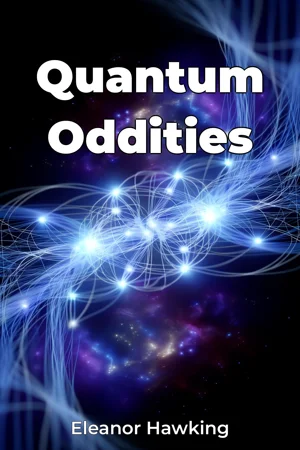
What happens when particles separated by vast distances instantaneously influence each other, defying our classical understanding of physics? "Quantum Oddities" delves into the most perplexing phenomena of quantum mechanics, offering readers a structured exploration of the microscopic realm where traditional physics breaks down. The book systematically examines three fundamental quantum phenomena: entanglement, where particles maintain instantaneous connections regardless of distance; superposition, where quantum systems exist in multiple states simultaneously; and quantum tunneling, where particles traverse seemingly impassable barriers. These concepts form the foundation for modern technologies, from quantum computers to advanced encryption systems. Drawing from historical experiments like the double-slit test and Bell's inequality measurements, the text traces the development of quantum theory from its early challenges to Einstein's classical worldview through to current applications in computing and cryptography. Each chapter builds upon established physics principles while introducing readers to increasingly complex quantum behaviors. The central thesis argues that quantum mechanics, despite its counter-intuitive nature, represents our most accurate description of reality at the microscopic scale. The book presents evidence through detailed analysis of laboratory results, including recent experiments from leading research institutions that validate quantum theoretical predictions. Structured in three main sections, the work first establishes the mathematical and conceptual framework necessary for understanding quantum phenomena. The middle section examines specific quantum effects through both theoretical models and practical demonstrations. The final portion explores technological applications, including quantum computing, quantum cryptography, and quantum sensors. The research presented includes data from CERN, quantum computing laboratories, and space-based experiments. The book incorporates insights from interviews with leading quantum physicists and draws connections between quantum mechanics and fields such as information theory, computing, and cosmology. Written in a methodical, accessible style, the text balances technical accuracy with clear explanations suitable for readers with a basic understanding of physics. Mathematical concepts are introduced gradually, with emphasis on physical interpretation rather than complex calculations. The book serves advanced undergraduate students, professional scientists, and technically-minded general readers interested in understanding quantum mechanics' fundamental principles and practical applications. It addresses ongoing debates in the field, including measurement problems, the nature of quantum reality, and competing interpretations of quantum mechanics. The scope encompasses both theoretical foundations and current experimental work, while acknowledging the limits of our understanding in areas such as quantum gravity and the quantum-classical boundary. Practical applications discussed include quantum sensors for medical imaging, secure communication systems, and next-generation computing architectures. The work maintains scientific rigor while highlighting the human aspects of scientific discovery, featuring insights from researchers who have shaped our understanding of quantum phenomena. It examines both settled science and active areas of research, providing readers with a comprehensive view of quantum mechanics' current state and future directions. This book positions itself as a bridge between introductory quantum mechanics texts and specialized research papers, offering readers the tools to understand both the fundamental principles and their practical implications in modern technology.
What happens when particles separated by vast distances instantaneously influence each other, defying our classical understanding of physics? "Quantum Oddities" delves into the most perplexing phenomena of quantum mechanics, offering readers a structured exploration of the microscopic realm where traditional physics breaks down. The book systematically examines three fundamental quantum phenomena: entanglement, where particles maintain instantaneous connections regardless of distance; superposition, where quantum systems exist in multiple states simultaneously; and quantum tunneling, where particles traverse seemingly impassable barriers. These concepts form the foundation for modern technologies, from quantum computers to advanced encryption systems. Drawing from historical experiments like the double-slit test and Bell's inequality measurements, the text traces the development of quantum theory from its early challenges to Einstein's classical worldview through to current applications in computing and cryptography. Each chapter builds upon established physics principles while introducing readers to increasingly complex quantum behaviors. The central thesis argues that quantum mechanics, despite its counter-intuitive nature, represents our most accurate description of reality at the microscopic scale. The book presents evidence through detailed analysis of laboratory results, including recent experiments from leading research institutions that validate quantum theoretical predictions. Structured in three main sections, the work first establishes the mathematical and conceptual framework necessary for understanding quantum phenomena. The middle section examines specific quantum effects through both theoretical models and practical demonstrations. The final portion explores technological applications, including quantum computing, quantum cryptography, and quantum sensors. The research presented includes data from CERN, quantum computing laboratories, and space-based experiments. The book incorporates insights from interviews with leading quantum physicists and draws connections between quantum mechanics and fields such as information theory, computing, and cosmology. Written in a methodical, accessible style, the text balances technical accuracy with clear explanations suitable for readers with a basic understanding of physics. Mathematical concepts are introduced gradually, with emphasis on physical interpretation rather than complex calculations. The book serves advanced undergraduate students, professional scientists, and technically-minded general readers interested in understanding quantum mechanics' fundamental principles and practical applications. It addresses ongoing debates in the field, including measurement problems, the nature of quantum reality, and competing interpretations of quantum mechanics. The scope encompasses both theoretical foundations and current experimental work, while acknowledging the limits of our understanding in areas such as quantum gravity and the quantum-classical boundary. Practical applications discussed include quantum sensors for medical imaging, secure communication systems, and next-generation computing architectures. The work maintains scientific rigor while highlighting the human aspects of scientific discovery, featuring insights from researchers who have shaped our understanding of quantum phenomena. It examines both settled science and active areas of research, providing readers with a comprehensive view of quantum mechanics' current state and future directions. This book positions itself as a bridge between introductory quantum mechanics texts and specialized research papers, offering readers the tools to understand both the fundamental principles and their practical implications in modern technology.
"Quantum Oddities" takes readers on a fascinating journey through the most puzzling aspects of quantum mechanics, where traditional physics rules break down at the microscopic level. The book expertly navigates three core quantum phenomena: entanglement, superposition, and quantum tunneling, demonstrating how these counterintuitive concepts form the backbone of cutting-edge technologies like quantum computing and cryptography. Through a careful blend of historical context and modern experimental evidence, the book illuminates how particles can maintain instantaneous connections across vast distances and exist in multiple states simultaneously. The narrative progresses thoughtfully from foundational concepts to practical applications, making complex ideas accessible without sacrificing scientific accuracy. Starting with essential mathematical and conceptual frameworks, the book builds through specific quantum effects and culminates in exploring real-world applications in computing, cryptography, and sensing technologies. Notable experiments, including the famous double-slit test and Bell's inequality measurements, are presented alongside data from contemporary research at institutions like CERN, providing compelling evidence for quantum theory's validity. What sets this book apart is its ability to bridge the gap between introductory texts and specialized research papers, making it invaluable for both advanced students and curious general readers with basic physics knowledge. The author balances technical precision with clear explanations, emphasizing physical interpretation over complex mathematics while incorporating insights from leading quantum physicists. This approach helps readers understand not just the 'what' but also the 'why' of quantum phenomena, positioning quantum mechanics as our most accurate description of microscopic reality.
Book Details
ISBN
9788233957216
Publisher
Publifye AS
Your Licenses
You don't own any licenses for this book
Purchase a license below to unlock this book and download the EPUB.
Purchase License
Select a tier to unlock this book
Need bulk licensing?
Contact us for enterprise agreements.