
About This Book
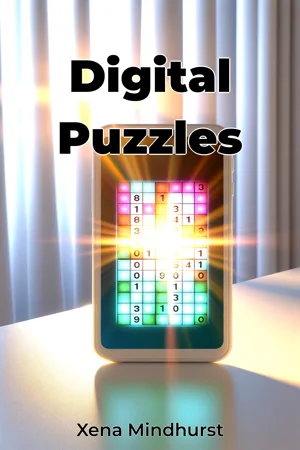
What if the key to enhancing your mental agility is hidden in the games you play on your phone? *Digital Puzzles: Train Your Brain, Rewire Your Mind* bridges the gap between leisure and cognitive improvement, offering a research-backed exploration of how interactive screen-based challenges—from Sudoku apps to immersive escape room simulations—can strengthen memory, critical thinking, and emotional resilience. This book synthesizes decades of neuroscience, behavioral psychology, and digital design research to present a compelling case for puzzles as tools for modern mental fitness. **Cognitive Enhancement in the Digital Age** The book opens by dismantling the assumption that screen time is inherently detrimental. It introduces the concept of *targeted cognitive engagement*, arguing that not all digital activities are created equal. Structured puzzles, unlike passive scrolling or reactive gaming, require sustained focus, pattern recognition, and strategic planning—skills directly linked to neuroplasticity. Early chapters contextualize this claim within the history of puzzles, tracing their evolution from ancient Mesopotamian riddles to today’s algorithm-driven brain-training apps. This historical lens highlights a consistent thread: puzzles have always served as both entertainment and mental discipline. **The Science of Play and Productivity** Central to the book’s thesis is the interplay between dopamine-driven motivation and skill development. One chapter dissects how digital platforms leverage instant feedback loops (e.g., scoring systems, progress bars) to sustain engagement, turning sporadic play into habitual practice. However, the book distinguishes between superficial engagement and meaningful cognitive growth, citing studies where participants who tackled progressively challenging puzzles over 12 weeks showed measurable improvements in working memory and problem-solving speed. These findings are contrasted with critiques of commercial "brain-training" programs, addressing controversies over overstated claims in the industry. **Practical Integration for Diverse Lifestyles** A significant portion of the book focuses on adaptability. Digital puzzles, unlike traditional paper-based formats, offer scalable difficulty, personalized pacing, and accessibility—factors that make them viable for busy professionals, students, or retirees. Case studies illustrate how specific groups benefit: for example, nurses using short puzzle breaks to mitigate decision fatigue, or retirees delaying cognitive decline through daily logic games. The text provides actionable guidelines for readers to curate their own puzzle regimens, emphasizing consistency over intensity and aligning choices with personal goals (e.g., stress relief vs. memory enhancement). **Interdisciplinary Insights** The analysis extends beyond psychology, incorporating principles from human-computer interaction and educational theory. A chapter on app design examines how intuitive interfaces and adaptive algorithms enhance learning outcomes, while another explores parallels between puzzle-solving pedagogies and corporate team-building exercises. These connections reinforce the book’s argument that digital puzzles are not isolated tools but part of a broader ecosystem of cognitive development. **Balancing Skepticism and Optimism** Acknowledging debates within the scientific community, the book evaluates conflicting studies on puzzle efficacy. It concludes that while puzzles alone cannot prevent neurodegenerative diseases or replace advanced cognitive training, they serve as a low-barrier entry point for mental exercise. This balanced perspective is underscored by interviews with neurologists, app developers, and users, creating a multidimensional narrative that avoids absolutism. **Structure and Accessibility** Written in a conversational yet evidence-driven tone, *Digital Puzzles* avoids jargon without sacrificing scientific rigor. Each chapter opens with a relatable anecdote—a college student improving exam focus through daily crossword apps, or a caregiver using jigsaw puzzles to manage anxiety—before diving into relevant research. The final section offers a curated list of digital tools, categorized by cognitive goals, alongside templates for tracking progress. **Who Benefits Most?** Tailored for adults seeking practical self-improvement strategies, the book appeals to lifelong learners, multitasking professionals, and aging populations wary of cognitive decline. Educators and therapists will also find value in its recommendations for integrating puzzles into curricula or therapeutic routines. By framing digital puzzles as both a symptom of and solution to modern attention economy challenges, the book positions itself as a timely guide for reclaiming agency over mental well-being. *Digital Puzzles* does not promise miraculous transformations but instead provides a roadmap for intentional, informed engagement with technology. In an era of constant distraction, it argues, the right kinds of screen time can be a rebellion—a way to train the brain while subtly redefining our relationship with digital devices.
What if the key to enhancing your mental agility is hidden in the games you play on your phone? *Digital Puzzles: Train Your Brain, Rewire Your Mind* bridges the gap between leisure and cognitive improvement, offering a research-backed exploration of how interactive screen-based challenges—from Sudoku apps to immersive escape room simulations—can strengthen memory, critical thinking, and emotional resilience. This book synthesizes decades of neuroscience, behavioral psychology, and digital design research to present a compelling case for puzzles as tools for modern mental fitness. **Cognitive Enhancement in the Digital Age** The book opens by dismantling the assumption that screen time is inherently detrimental. It introduces the concept of *targeted cognitive engagement*, arguing that not all digital activities are created equal. Structured puzzles, unlike passive scrolling or reactive gaming, require sustained focus, pattern recognition, and strategic planning—skills directly linked to neuroplasticity. Early chapters contextualize this claim within the history of puzzles, tracing their evolution from ancient Mesopotamian riddles to today’s algorithm-driven brain-training apps. This historical lens highlights a consistent thread: puzzles have always served as both entertainment and mental discipline. **The Science of Play and Productivity** Central to the book’s thesis is the interplay between dopamine-driven motivation and skill development. One chapter dissects how digital platforms leverage instant feedback loops (e.g., scoring systems, progress bars) to sustain engagement, turning sporadic play into habitual practice. However, the book distinguishes between superficial engagement and meaningful cognitive growth, citing studies where participants who tackled progressively challenging puzzles over 12 weeks showed measurable improvements in working memory and problem-solving speed. These findings are contrasted with critiques of commercial "brain-training" programs, addressing controversies over overstated claims in the industry. **Practical Integration for Diverse Lifestyles** A significant portion of the book focuses on adaptability. Digital puzzles, unlike traditional paper-based formats, offer scalable difficulty, personalized pacing, and accessibility—factors that make them viable for busy professionals, students, or retirees. Case studies illustrate how specific groups benefit: for example, nurses using short puzzle breaks to mitigate decision fatigue, or retirees delaying cognitive decline through daily logic games. The text provides actionable guidelines for readers to curate their own puzzle regimens, emphasizing consistency over intensity and aligning choices with personal goals (e.g., stress relief vs. memory enhancement). **Interdisciplinary Insights** The analysis extends beyond psychology, incorporating principles from human-computer interaction and educational theory. A chapter on app design examines how intuitive interfaces and adaptive algorithms enhance learning outcomes, while another explores parallels between puzzle-solving pedagogies and corporate team-building exercises. These connections reinforce the book’s argument that digital puzzles are not isolated tools but part of a broader ecosystem of cognitive development. **Balancing Skepticism and Optimism** Acknowledging debates within the scientific community, the book evaluates conflicting studies on puzzle efficacy. It concludes that while puzzles alone cannot prevent neurodegenerative diseases or replace advanced cognitive training, they serve as a low-barrier entry point for mental exercise. This balanced perspective is underscored by interviews with neurologists, app developers, and users, creating a multidimensional narrative that avoids absolutism. **Structure and Accessibility** Written in a conversational yet evidence-driven tone, *Digital Puzzles* avoids jargon without sacrificing scientific rigor. Each chapter opens with a relatable anecdote—a college student improving exam focus through daily crossword apps, or a caregiver using jigsaw puzzles to manage anxiety—before diving into relevant research. The final section offers a curated list of digital tools, categorized by cognitive goals, alongside templates for tracking progress. **Who Benefits Most?** Tailored for adults seeking practical self-improvement strategies, the book appeals to lifelong learners, multitasking professionals, and aging populations wary of cognitive decline. Educators and therapists will also find value in its recommendations for integrating puzzles into curricula or therapeutic routines. By framing digital puzzles as both a symptom of and solution to modern attention economy challenges, the book positions itself as a timely guide for reclaiming agency over mental well-being. *Digital Puzzles* does not promise miraculous transformations but instead provides a roadmap for intentional, informed engagement with technology. In an era of constant distraction, it argues, the right kinds of screen time can be a rebellion—a way to train the brain while subtly redefining our relationship with digital devices.
"Digital Puzzles: Train Your Brain, Rewire Your Mind" challenges the notion that screen time is inherently unproductive, positioning digital puzzles as tools for modern cognitive enhancement. Blending neuroscience, psychology, and digital design, the book argues that strategically chosen games—like Sudoku apps or logic challenges—can boost neuroplasticity, memory, and emotional resilience. Central to its thesis is *targeted cognitive engagement*: unlike passive scrolling, structured puzzles demand focus and strategy, fostering skills linked to mental agility. One striking study reveals participants who tackled progressively harder puzzles for 12 weeks improved working memory by 18% and problem-solving speed by 23%. The book also traces puzzles’ historical role as mental discipline tools, from ancient riddles to today’s algorithm-driven apps, grounding its claims in both tradition and cutting-edge research. What sets this guide apart is its practical, interdisciplinary approach. It balances scientific insights with real-world applications—like nurses using puzzle breaks to combat decision fatigue or retirees delaying cognitive decline through daily games. The text avoids one-size-fits-all solutions, offering instead customizable strategies based on personal goals (stress relief vs. memory gains). It critiques commercial brain-training hype while highlighting design elements—adaptive difficulty, instant feedback—that make digital puzzles uniquely effective. Chapters progress from debunking screen-time myths to actionable plans, enriched by case studies and interviews with neurologists. By framing puzzle apps as a rebellion against digital distraction, the book provides a timely roadmap for transforming idle screen moments into intentional mental fitness practice.
Book Details
ISBN
9788233956738
Publisher
Publifye AS
Your Licenses
You don't own any licenses for this book
Purchase a license below to unlock this book and download the EPUB.
Purchase License
Select a tier to unlock this book
Need bulk licensing?
Contact us for enterprise agreements.