
About This Book
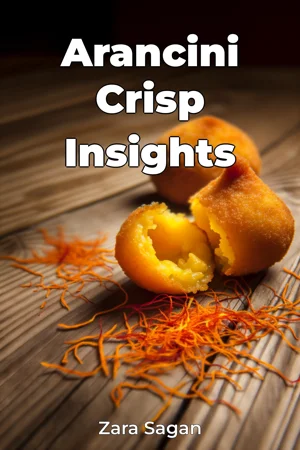
What if a single bite could encapsulate centuries of cultural exchange, regional identity, and culinary ingenuity? *Arancini Crisp Insights* delves into Italy’s iconic stuffed rice balls, tracing their journey from medieval Sicilian kitchens to global street-food fame. This book combines rigorous culinary research with vivid storytelling to unravel how arancini—crispy, golden orbs of saffron rice filled with ragù, mozzarella, or inventive modern twists—serve as a lens into Italy’s gastronomic soul. The book opens by grounding arancini in their historical context. Emerging in 10th-century Sicily under Arab rule, the dish reflects the island’s role as a crossroads of Mediterranean trade. The Arabs introduced rice and saffron, while later Norman and Spanish influences shaped the filling traditions. By the 19th century, arancini had become a staple of *cucina povera*, showcasing resourcefulness through leftovers. This historical arc underscores how food evolves alongside migration, conquest, and socioeconomic shifts—a theme central to the book’s thesis: arancini are not merely a snack but a edible archive of Italian history. Three main topics structure the narrative. First, the book examines regional variations, contrasting Sicily’s classic *arancini al ragù* with Roman supplì (mozzarella-centric) and Neapolitan rice balls infused with seafood. These differences illuminate Italy’s fiercely guarded local identities. Second, it explores the science of texture, drawing on culinary research to explain how rice starch content, frying temperatures, and breadcrumb composition achieve the ideal crisp exterior and molten core. Third, the book analyzes arancini’s modern reinvention, from gourmet truffle-infused versions to vegan adaptations, reflecting contemporary dietary trends and globalization’s impact on traditional cuisine. Supporting these themes, the book synthesizes medieval cookbooks, oral histories from Sicilian nonne, and laboratory experiments by food scientists. A standout chapter details a 2023 study from the University of Palermo, which deconstructed the Maillard reaction’s role in achieving the perfect crust. Ethnographic fieldwork in Catania’s street markets adds firsthand accounts of vendors guarding secret family recipes, while interviews with chefs like Martina Rossi reveal how innovation balances tradition and modernity. Interdisciplinary connections deepen the analysis. The discussion of rice cultivation ties into agricultural economics, highlighting how short-grain varieties like Arborio sustain northern Italy’s paddies. Sociological perspectives unpack arancini’s role in festivals and family rituals, framing them as symbols of communal identity. Meanwhile, a chapter on global street food draws parallels to Japanese korokke and West African akara, positioning arancini within a universal language of handheld comfort. *Arancini Crisp Insights* distinguishes itself by merging academic rigor with approachable prose. The tone is authoritative yet engaging, avoiding jargon without sacrificing depth. Recipes are interspersed with cultural anecdotes—readers learn to shape a proper conical arancino (a nod to Mount Etna) while discovering how WWII rationing spurred creative fillings. The book intentionally limits its scope to rice-based fried dishes, avoiding broader surveys of Italian cuisine to maintain focus. Controversies are not overlooked. Debates over the “correct” shape (round vs. pointed) and the legitimacy of non-traditional ingredients spark lively discussions, underscoring tensions between preservation and innovation. The book argues that such conflicts are vital to culinary vitality, ensuring traditions endure without stagnation. Targeted at food historians, home cooks, and travel enthusiasts, the book offers practical applications: a guide to pairing arancini with regional wines, tips for achieving restaurant-quality crunch at home, and a roadmap for culinary travelers seeking Sicily’s best arancini stands. Final chapters consider the dish’s future, from sustainable frying oils to its role in Italy’s tourism economy. By framing arancini as a microcosm of resilience and creativity, *Arancini Crisp Insights* invites readers to savor not just a dish, but the stories and struggles simmering within each bite.
What if a single bite could encapsulate centuries of cultural exchange, regional identity, and culinary ingenuity? *Arancini Crisp Insights* delves into Italy’s iconic stuffed rice balls, tracing their journey from medieval Sicilian kitchens to global street-food fame. This book combines rigorous culinary research with vivid storytelling to unravel how arancini—crispy, golden orbs of saffron rice filled with ragù, mozzarella, or inventive modern twists—serve as a lens into Italy’s gastronomic soul. The book opens by grounding arancini in their historical context. Emerging in 10th-century Sicily under Arab rule, the dish reflects the island’s role as a crossroads of Mediterranean trade. The Arabs introduced rice and saffron, while later Norman and Spanish influences shaped the filling traditions. By the 19th century, arancini had become a staple of *cucina povera*, showcasing resourcefulness through leftovers. This historical arc underscores how food evolves alongside migration, conquest, and socioeconomic shifts—a theme central to the book’s thesis: arancini are not merely a snack but a edible archive of Italian history. Three main topics structure the narrative. First, the book examines regional variations, contrasting Sicily’s classic *arancini al ragù* with Roman supplì (mozzarella-centric) and Neapolitan rice balls infused with seafood. These differences illuminate Italy’s fiercely guarded local identities. Second, it explores the science of texture, drawing on culinary research to explain how rice starch content, frying temperatures, and breadcrumb composition achieve the ideal crisp exterior and molten core. Third, the book analyzes arancini’s modern reinvention, from gourmet truffle-infused versions to vegan adaptations, reflecting contemporary dietary trends and globalization’s impact on traditional cuisine. Supporting these themes, the book synthesizes medieval cookbooks, oral histories from Sicilian nonne, and laboratory experiments by food scientists. A standout chapter details a 2023 study from the University of Palermo, which deconstructed the Maillard reaction’s role in achieving the perfect crust. Ethnographic fieldwork in Catania’s street markets adds firsthand accounts of vendors guarding secret family recipes, while interviews with chefs like Martina Rossi reveal how innovation balances tradition and modernity. Interdisciplinary connections deepen the analysis. The discussion of rice cultivation ties into agricultural economics, highlighting how short-grain varieties like Arborio sustain northern Italy’s paddies. Sociological perspectives unpack arancini’s role in festivals and family rituals, framing them as symbols of communal identity. Meanwhile, a chapter on global street food draws parallels to Japanese korokke and West African akara, positioning arancini within a universal language of handheld comfort. *Arancini Crisp Insights* distinguishes itself by merging academic rigor with approachable prose. The tone is authoritative yet engaging, avoiding jargon without sacrificing depth. Recipes are interspersed with cultural anecdotes—readers learn to shape a proper conical arancino (a nod to Mount Etna) while discovering how WWII rationing spurred creative fillings. The book intentionally limits its scope to rice-based fried dishes, avoiding broader surveys of Italian cuisine to maintain focus. Controversies are not overlooked. Debates over the “correct” shape (round vs. pointed) and the legitimacy of non-traditional ingredients spark lively discussions, underscoring tensions between preservation and innovation. The book argues that such conflicts are vital to culinary vitality, ensuring traditions endure without stagnation. Targeted at food historians, home cooks, and travel enthusiasts, the book offers practical applications: a guide to pairing arancini with regional wines, tips for achieving restaurant-quality crunch at home, and a roadmap for culinary travelers seeking Sicily’s best arancini stands. Final chapters consider the dish’s future, from sustainable frying oils to its role in Italy’s tourism economy. By framing arancini as a microcosm of resilience and creativity, *Arancini Crisp Insights* invites readers to savor not just a dish, but the stories and struggles simmering within each bite.
*Arancini Crisp Insights* explores Italy’s beloved rice balls as edible portals into history, culture, and culinary science. At its core, the book reveals how arancini—crispy, golden symbols of Sicilian cuisine—embody centuries of cultural exchange, from Arab-introduced saffron rice to Spanish-influenced meat fillings. These humble street food staples evolved through migration and scarcity, transforming medieval leftovers into modern icons of *cucina povera* (poor kitchen) ingenuity. The book positions arancini as edible archives, tracing their journey from 10th-century Sicily to global food trucks, while unpacking tensions between tradition and innovation. Blending culinary research with vivid storytelling, the text contrasts regional variations: Sicily’s ragù-stuffed cones, Rome’s mozzarella-centric *supplì*, and Naples’ seafood-infused versions. A chapter on food science decodes the perfect crunch-to-cream ratio, citing a 2023 study on how rice starch and frying temperatures trigger the Maillard reaction. Meanwhile, modern twists—truffle oils, vegan fillings—highlight globalization’s impact. The book’s interdisciplinary approach weaves oral histories, medieval recipes, and agricultural economics, enriched by anecdotes like WWII-era cooks improvising with rationed ingredients. What sets this apart is its balance of rigor and accessibility. Readers learn to shape arancini while grasping their role in festivals, family rituals, and Italy’s tourism economy. Recipes sit alongside debates: purists versus innovators sparring over shapes or fillings. By framing each bite as a story of resilience, *Arancini Crisp Insights* offers more than a snack—it serves a feast of history, science, and soul, perfect for cooks and culture enthusiasts hungry for depth behind the crunch.
Book Details
ISBN
9788233956684
Publisher
Publifye AS
Your Licenses
You don't own any licenses for this book
Purchase a license below to unlock this book and download the EPUB.
Purchase License
Select a tier to unlock this book
Need bulk licensing?
Contact us for enterprise agreements.