
About This Book
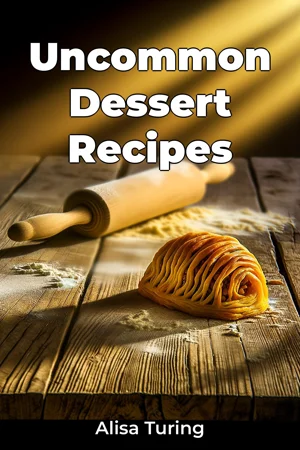
What if the world’s most intriguing desserts remain hidden in the corners of home kitchens, village festivals, and forgotten culinary manuscripts? *Uncommon Dessert Recipes* invites readers on a journey beyond tiramisu and baklava to explore sweet traditions that have shaped—and been shaped by—cultures often overlooked in mainstream baking guides. This book is a meticulous compilation of desserts rooted in regional histories, offering both recipes and the stories behind them, framed by rigorous research and a commitment to preserving culinary heritage. The book centers on three core themes: the role of desserts in cultural identity, the revival of endangered recipes, and the adaptation of traditional techniques for modern kitchens. Each theme underscores how food acts as a living archive, reflecting migration patterns, local agriculture, and social rituals. For instance, the Armenian *nazook*, a spiced pastry, traces its origins to medieval trade routes, while Indonesia’s *klepon*, sticky rice balls filled with palm sugar, embody the archipelago’s reliance on tropical crops. By examining such dishes, the text argues that preserving these recipes is not merely about taste but about safeguarding intangible cultural heritage in an era of globalization. Contextual chapters provide historical groundwork, explaining how colonization, trade, and climate have influenced ingredient availability and dessert evolution. A chapter on West Africa’s *kanyah*—a roasted peanut and rice flour confection—links its simplicity to resilience during food scarcity, while Japan’s *mochi* traditions reveal the intersection of Shinto rituals and seasonal celebrations. The book assumes basic baking familiarity but includes glossaries for uncommon ingredients like *mahleb* (a Middle Eastern spice) or *palm syrup*, ensuring accessibility. Structurally, the book opens with an exploration of desserts as cultural artifacts, followed by region-specific chapters organized by ingredient themes: grains, fruits, and spices. Each chapter pairs recipes with essays on their sociohistorical roots, such as the role of *saffron ice cream* in Persian New Year celebrations or the symbolism of *basbousa* in Egyptian family gatherings. The final sections address practical adaptation, guiding readers on modifying techniques for contemporary tools without erasing tradition—for example, using silicone molds for India’s *sandesh* while retaining its hand-shaped artistry. Research draws from ethnographic interviews, historical cookbooks, and collaborations with local bakers. A standout feature is the inclusion of recipes reconstructed from oral traditions, such as a nearly lost Berber fig-and-barley cake documented through conversations with Moroccan elders. The interdisciplinary approach weaves anthropology, environmental science, and economics, illustrating how dessert traditions intersect with land use and global trade. For instance, the decline of heirloom sugarcane varieties in the Caribbean is tied to colonial plantation systems, contextualizing the rarity of desserts like *guava cheese*. What distinguishes this book is its dual focus on narrative and utility. Each recipe is preceded by a vignette detailing its cultural significance, followed by precise, tested instructions. The tone balances academic rigor with the warmth of a travelogue, avoiding jargon while maintaining depth. Photographs of finished dishes and archival images of preparation rituals enhance the textual content. Targeted at home bakers, culinary historians, and adventurous eaters, the book appeals to those seeking to broaden their palates and understand the “why” behind the “how” of baking. It adheres to food writing conventions by prioritizing sensory detail—describing the crackle of Filipino *sinudlan* (coconut custard) crusts or the floral aroma of Ottoman *lokum*—while providing clear, recipe-focused directives expected in cooking guides. The scope is intentionally narrow, highlighting 20 desserts from regions including the Caucasus, Southeast Asia, and Indigenous North America, rather than attempting a global survey. This specificity allows deeper exploration but acknowledges gaps, such as limited coverage of Pacific Island traditions. Practical applications are emphasized: readers learn not just to replicate a Finnish *mämmi* (rye pudding) but to adapt its fermentation method to alternative grains. The book also engages debates about authenticity, encouraging respectful innovation—substituting honey for refined sugar in Andean *chicha* desserts, for instance, to align with health trends without erasing ancestral roots. By bridging kitchen and culture, *Uncommon Dessert Recipes* offers more than instructions; it provides a lens to view history, identity, and creativity through the universal language of sweetness.
What if the world’s most intriguing desserts remain hidden in the corners of home kitchens, village festivals, and forgotten culinary manuscripts? *Uncommon Dessert Recipes* invites readers on a journey beyond tiramisu and baklava to explore sweet traditions that have shaped—and been shaped by—cultures often overlooked in mainstream baking guides. This book is a meticulous compilation of desserts rooted in regional histories, offering both recipes and the stories behind them, framed by rigorous research and a commitment to preserving culinary heritage. The book centers on three core themes: the role of desserts in cultural identity, the revival of endangered recipes, and the adaptation of traditional techniques for modern kitchens. Each theme underscores how food acts as a living archive, reflecting migration patterns, local agriculture, and social rituals. For instance, the Armenian *nazook*, a spiced pastry, traces its origins to medieval trade routes, while Indonesia’s *klepon*, sticky rice balls filled with palm sugar, embody the archipelago’s reliance on tropical crops. By examining such dishes, the text argues that preserving these recipes is not merely about taste but about safeguarding intangible cultural heritage in an era of globalization. Contextual chapters provide historical groundwork, explaining how colonization, trade, and climate have influenced ingredient availability and dessert evolution. A chapter on West Africa’s *kanyah*—a roasted peanut and rice flour confection—links its simplicity to resilience during food scarcity, while Japan’s *mochi* traditions reveal the intersection of Shinto rituals and seasonal celebrations. The book assumes basic baking familiarity but includes glossaries for uncommon ingredients like *mahleb* (a Middle Eastern spice) or *palm syrup*, ensuring accessibility. Structurally, the book opens with an exploration of desserts as cultural artifacts, followed by region-specific chapters organized by ingredient themes: grains, fruits, and spices. Each chapter pairs recipes with essays on their sociohistorical roots, such as the role of *saffron ice cream* in Persian New Year celebrations or the symbolism of *basbousa* in Egyptian family gatherings. The final sections address practical adaptation, guiding readers on modifying techniques for contemporary tools without erasing tradition—for example, using silicone molds for India’s *sandesh* while retaining its hand-shaped artistry. Research draws from ethnographic interviews, historical cookbooks, and collaborations with local bakers. A standout feature is the inclusion of recipes reconstructed from oral traditions, such as a nearly lost Berber fig-and-barley cake documented through conversations with Moroccan elders. The interdisciplinary approach weaves anthropology, environmental science, and economics, illustrating how dessert traditions intersect with land use and global trade. For instance, the decline of heirloom sugarcane varieties in the Caribbean is tied to colonial plantation systems, contextualizing the rarity of desserts like *guava cheese*. What distinguishes this book is its dual focus on narrative and utility. Each recipe is preceded by a vignette detailing its cultural significance, followed by precise, tested instructions. The tone balances academic rigor with the warmth of a travelogue, avoiding jargon while maintaining depth. Photographs of finished dishes and archival images of preparation rituals enhance the textual content. Targeted at home bakers, culinary historians, and adventurous eaters, the book appeals to those seeking to broaden their palates and understand the “why” behind the “how” of baking. It adheres to food writing conventions by prioritizing sensory detail—describing the crackle of Filipino *sinudlan* (coconut custard) crusts or the floral aroma of Ottoman *lokum*—while providing clear, recipe-focused directives expected in cooking guides. The scope is intentionally narrow, highlighting 20 desserts from regions including the Caucasus, Southeast Asia, and Indigenous North America, rather than attempting a global survey. This specificity allows deeper exploration but acknowledges gaps, such as limited coverage of Pacific Island traditions. Practical applications are emphasized: readers learn not just to replicate a Finnish *mämmi* (rye pudding) but to adapt its fermentation method to alternative grains. The book also engages debates about authenticity, encouraging respectful innovation—substituting honey for refined sugar in Andean *chicha* desserts, for instance, to align with health trends without erasing ancestral roots. By bridging kitchen and culture, *Uncommon Dessert Recipes* offers more than instructions; it provides a lens to view history, identity, and creativity through the universal language of sweetness.
"Uncommon Dessert Recipes" unveils the hidden stories behind rare sweet traditions, blending culinary history with practical baking to preserve desserts at risk of being forgotten. The book’s core theme explores how sweets like Armenia’s spiced *nazook* or Indonesia’s palm sugar-filled *klepon* act as edible archives, reflecting cultural identity, migration, and local ecosystems. Through vivid examples, it argues that saving these recipes safeguards intangible heritage—not just flavors—in a globalized world. Structured as part travelogue, part cookbook, the text moves from historical context to hands-on adaptation. Early chapters trace how trade, colonization, and climate shaped ingredients, as seen in West Africa’s resourceful *kanyah* (a peanut-rice treat born from scarcity) or Japan’s ritualistic *mochi*. Recipes are paired with essays: Persian saffron ice cream ties to New Year celebrations, while Egyptian *basbousa* symbolizes family bonds. The book’s unique value lies in reconstructing near-lost dishes, like a Berber fig-and-barley cake documented through Moroccan elders’ memories, and bridging tradition with modern tools—think silicone molds for India’s hand-shaped *sandesh*. Balancing academic rigor and approachable prose, the book avoids jargon while delving into food anthropology. Its 20 focused examples, from the Caucasus to Indigenous North America, prioritize depth over breadth, offering both tested recipes and adaptable techniques. For bakers curious about the “why” behind their creations, it transforms kitchen experiments into acts of cultural preservation, proving that every bite holds a history.
Book Details
ISBN
9788233956677
Publisher
Publifye AS
Your Licenses
You don't own any licenses for this book
Purchase a license below to unlock this book and download the EPUB.
Purchase License
Select a tier to unlock this book
Need bulk licensing?
Contact us for enterprise agreements.