
About This Book
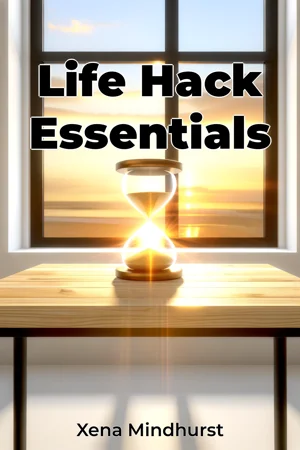
What if gaining an extra hour of productivity each day required no drastic lifestyle changes, but rather a series of intentional, science-backed adjustments? *Life Hack Essentials: Small Shifts for Big Impact* answers this question by distilling decades of behavioral research into actionable strategies for enhancing daily effectiveness. Designed for readers seeking sustainable self-improvement, this book bridges the gap between academic insights and real-world application, offering tools to transform routines without overwhelming effort. **Core Concepts and Relevance** The book focuses on three pillars: **habit formation**, **time optimization**, and **decision fatigue mitigation**. These topics form the backbone of daily effectiveness, addressing universal challenges such as procrastination, inefficient workflows, and mental exhaustion. By anchoring its advice in behavioral psychology, the text moves beyond generic productivity tips, providing mechanisms rooted in how humans naturally respond to environmental cues, rewards, and cognitive constraints. **Scientific Foundations** Drawing on studies like Charles Duhigg’s habit loop model and Roy Baumeister’s research on ego depletion, *Life Hack Essentials* establishes a foundation in behavioral science. It introduces concepts such as the “20-Second Rule” (reducing barriers to positive habits) and “cognitive stacking” (grouping tasks by mental demand), explaining their origins in peer-reviewed experiments. The book also examines the Pareto Principle (80% of results from 20% of efforts) through the lens of workplace efficiency studies, demonstrating how readers can identify high-impact tasks. **Structure and Application** The book opens by dismantling common misconceptions about productivity, arguing that effectiveness stems from systemic adjustments rather than sheer willpower. Subsequent chapters delve into: 1. **Habit Architecture**: How to design routines that align with neurological reward systems. 2. **Time-Blocking Strategies**: Techniques to minimize multitasking and context-switching. 3. **Decision Conservation**: Reducing trivial choices to preserve mental energy for critical tasks. Each chapter concludes with “Micro-Action Plans”—concrete steps like creating a “decision menu” for recurring dilemmas or restructuring physical spaces to cue desired behaviors. The final section synthesizes these elements, guiding readers to build personalized systems that adapt to shifting priorities. **Interdisciplinary Insights** The text connects behavioral psychology with neuroscience (exploring synaptic plasticity in habit formation), organizational theory (adopting Agile methodology principles for personal workflows), and behavioral economics (applying nudges to encourage long-term goals). These intersections reinforce the universality of its strategies, showing how corporate efficiency models and individual habit science share underlying mechanisms. **Practical Distinctions** Unlike productivity guides that prioritize rigid discipline, *Life Hack Essentials* emphasizes flexibility and incremental change. It introduces the “5% Principle”—small, consistent adjustments that compound over time—and provides tools like audit templates to track progress without self-judgment. Case studies illustrate how individuals with diverse lifestyles (e.g., working parents, entrepreneurs) have successfully implemented these methods. **Audience and Accessibility** Written in a conversational tone with minimal jargon, the book targets time-constrained professionals, students, and anyone feeling overwhelmed by modern demands. While grounded in research, it avoids academic density, using relatable anecdotes and visual summaries to clarify concepts. Critics of conventional self-help will appreciate its rejection of “quick fixes” in favor of sustainable, evidence-based methods. **Scope and Considerations** The book focuses narrowly on daily effectiveness, avoiding broader psychological issues like trauma or clinical anxiety. It acknowledges that individual results may vary based on circumstances but argues that its framework offers adaptable principles rather than rigid rules. A dedicated chapter addresses common pitfalls, such as over-optimization, and advises readers on balancing structure with spontaneity. **Engaging Debates** *Life Hack Essentials* engages with ongoing debates in behavioral science, notably the “willpower debate” between finite versus renewable models of self-control. While citing evidence for both perspectives, it advocates for environmental redesign over reliance on mental fortitude alone. This balanced approach equips readers to experiment with strategies that align with their unique cognitive styles. By merging rigorous research with pragmatic tools, *Life Hack Essentials* redefines productivity as a series of intentional, manageable shifts. It invites readers to view effectiveness not as a destination, but as a dynamic process of aligning daily actions with deeper priorities—one scientifically informed adjustment at a time.
What if gaining an extra hour of productivity each day required no drastic lifestyle changes, but rather a series of intentional, science-backed adjustments? *Life Hack Essentials: Small Shifts for Big Impact* answers this question by distilling decades of behavioral research into actionable strategies for enhancing daily effectiveness. Designed for readers seeking sustainable self-improvement, this book bridges the gap between academic insights and real-world application, offering tools to transform routines without overwhelming effort. **Core Concepts and Relevance** The book focuses on three pillars: **habit formation**, **time optimization**, and **decision fatigue mitigation**. These topics form the backbone of daily effectiveness, addressing universal challenges such as procrastination, inefficient workflows, and mental exhaustion. By anchoring its advice in behavioral psychology, the text moves beyond generic productivity tips, providing mechanisms rooted in how humans naturally respond to environmental cues, rewards, and cognitive constraints. **Scientific Foundations** Drawing on studies like Charles Duhigg’s habit loop model and Roy Baumeister’s research on ego depletion, *Life Hack Essentials* establishes a foundation in behavioral science. It introduces concepts such as the “20-Second Rule” (reducing barriers to positive habits) and “cognitive stacking” (grouping tasks by mental demand), explaining their origins in peer-reviewed experiments. The book also examines the Pareto Principle (80% of results from 20% of efforts) through the lens of workplace efficiency studies, demonstrating how readers can identify high-impact tasks. **Structure and Application** The book opens by dismantling common misconceptions about productivity, arguing that effectiveness stems from systemic adjustments rather than sheer willpower. Subsequent chapters delve into: 1. **Habit Architecture**: How to design routines that align with neurological reward systems. 2. **Time-Blocking Strategies**: Techniques to minimize multitasking and context-switching. 3. **Decision Conservation**: Reducing trivial choices to preserve mental energy for critical tasks. Each chapter concludes with “Micro-Action Plans”—concrete steps like creating a “decision menu” for recurring dilemmas or restructuring physical spaces to cue desired behaviors. The final section synthesizes these elements, guiding readers to build personalized systems that adapt to shifting priorities. **Interdisciplinary Insights** The text connects behavioral psychology with neuroscience (exploring synaptic plasticity in habit formation), organizational theory (adopting Agile methodology principles for personal workflows), and behavioral economics (applying nudges to encourage long-term goals). These intersections reinforce the universality of its strategies, showing how corporate efficiency models and individual habit science share underlying mechanisms. **Practical Distinctions** Unlike productivity guides that prioritize rigid discipline, *Life Hack Essentials* emphasizes flexibility and incremental change. It introduces the “5% Principle”—small, consistent adjustments that compound over time—and provides tools like audit templates to track progress without self-judgment. Case studies illustrate how individuals with diverse lifestyles (e.g., working parents, entrepreneurs) have successfully implemented these methods. **Audience and Accessibility** Written in a conversational tone with minimal jargon, the book targets time-constrained professionals, students, and anyone feeling overwhelmed by modern demands. While grounded in research, it avoids academic density, using relatable anecdotes and visual summaries to clarify concepts. Critics of conventional self-help will appreciate its rejection of “quick fixes” in favor of sustainable, evidence-based methods. **Scope and Considerations** The book focuses narrowly on daily effectiveness, avoiding broader psychological issues like trauma or clinical anxiety. It acknowledges that individual results may vary based on circumstances but argues that its framework offers adaptable principles rather than rigid rules. A dedicated chapter addresses common pitfalls, such as over-optimization, and advises readers on balancing structure with spontaneity. **Engaging Debates** *Life Hack Essentials* engages with ongoing debates in behavioral science, notably the “willpower debate” between finite versus renewable models of self-control. While citing evidence for both perspectives, it advocates for environmental redesign over reliance on mental fortitude alone. This balanced approach equips readers to experiment with strategies that align with their unique cognitive styles. By merging rigorous research with pragmatic tools, *Life Hack Essentials* redefines productivity as a series of intentional, manageable shifts. It invites readers to view effectiveness not as a destination, but as a dynamic process of aligning daily actions with deeper priorities—one scientifically informed adjustment at a time.
"Life Hack Essentials: Small Shifts for Big Impact" redefines productivity by demonstrating how science-backed micro-adjustments can create lasting change without overwhelming effort. Centered on habit formation, time optimization, and decision fatigue mitigation, the book bridges behavioral psychology with practical daily strategies. Its core insight? Sustainable self-improvement stems from aligning routines with how our brains naturally work—like using the “20-Second Rule” to reduce barriers to positive habits or applying “cognitive stacking” to group tasks by mental demand. Unlike rigid productivity guides, this book emphasizes flexibility through concepts like the “5% Principle,” where small, consistent tweaks compound over time. Chapters blend research—such as the Pareto Principle’s role in prioritizing high-impact tasks—with tools like “Micro-Action Plans” to redesign environments or create “decision menus” that conserve mental energy. The structure progresses from debunking willpower myths to building personalized systems, integrating neuroscience (habit loops) and organizational theory (Agile workflows) into accessible advice. What sets *Life Hack Essentials* apart is its rejection of one-size-fits-all solutions. Instead, it offers adaptable frameworks for diverse lifestyles, using relatable anecdotes and visual summaries. By focusing on environmental redesign over sheer discipline, it empowers readers to transform effectiveness into a dynamic process—not a grind—making it ideal for anyone seeking evidence-based strategies to align daily choices with long-term goals.
Book Details
ISBN
9788233956370
Publisher
Publifye AS
Your Licenses
You don't own any licenses for this book
Purchase a license below to unlock this book and download the EPUB.
Purchase License
Select a tier to unlock this book
Need bulk licensing?
Contact us for enterprise agreements.