
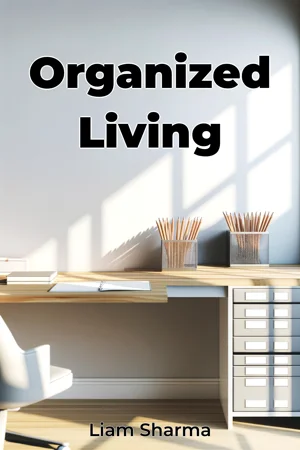
About This Book
What if the key to lowering stress isn’t found in a meditation app or a therapist’s office, but in the way you arrange your shoes or organize your desk? *Organized Living: The Science of Order for Stress Management and Productivity* challenges readers to reconsider the relationship between their physical environments and mental well-being. Grounded in neuroscience, psychology, and behavioral research, this book argues that tidiness is not merely an aesthetic preference but a foundational tool for reducing anxiety, sharpening focus, and reclaiming control in an increasingly chaotic world. The book explores three core themes: the physiological impact of clutter on stress hormones, the link between spatial order and cognitive performance, and the role of habitual tidying in sustaining mental clarity. These topics are examined through a blend of scientific studies, historical analysis of organizational practices, and real-world case studies. For instance, research from the University of California reveals that individuals with cluttered homes exhibit higher cortisol levels, while organizational psychologists at Princeton University have demonstrated that orderly environments improve task completion rates by up to 30%. By anchoring its claims in empirical data, *Organized Living* positions tidiness as a measurable intervention for modern stressors. Contextualizing its arguments, the book traces humanity’s evolving relationship with order—from ancient philosophies like Feng Shui to the Industrial Revolution’s efficiency frameworks—and highlights how digital-age overload has intensified the need for intentional space management. It acknowledges that tidiness is often perceived as a privilege, requiring time and resources, but counters this by emphasizing adaptable, incremental strategies. The central thesis posits that small, consistent acts of organization create compounding benefits, fostering resilience against overwhelm and decision fatigue. Structured into three sections, the book first establishes the biological and psychological mechanisms tying clutter to stress, including fMRI studies showing how disarray activates the brain’s threat response. The second section details practical methodologies, such as the “Five-Minute Reset” (a daily decluttering ritual) and zoning techniques for high-functionality spaces. The final chapters address sustaining habits, with insights from behavioral economics on overcoming procrastination and maintaining systems amid life disruptions. Interdisciplinary connections strengthen its case: neuroscientific findings on cortisol reduction intersect with minimalist design principles, while behavioral studies on habit formation draw from gamification theory. The book distinguishes itself by merging micro-habit frameworks—focusing on “atomic changes” rather than overhauls—with a critique of productivity culture, arguing that tidiness should serve calm, not efficiency alone. Written in a conversational tone, *Organized Living* avoids prescriptive jargon, using relatable anecdotes (e.g., a parent transforming meal-prep chaos through pantry zoning) and actionable checklists. It targets overwhelmed professionals, caregivers, and students seeking evidence-based strategies for mental clarity. While centered on individual spaces, the book acknowledges limitations, noting that systemic factors like housing insecurity or chronic illness may require broader solutions. Controversies are addressed head-on: Can creativity thrive in sterile environments? The book cites MIT research showing that *controlled* disorder aids innovation but emphasizes that purposeful design—not randomness—yields sustainable results. A chapter on “flexible tidiness” guides readers in personalizing systems without reverting to chaos. By the conclusion, readers are equipped not only to reorganize drawers but to reframe tidiness as a form of self-care. The final pages offer a 21-day challenge, integrating digital decluttering (e.g., inbox management) with physical space audits, underscoring the book’s premise: Order is not a rigid ideal but a dynamic tool for crafting a calmer, more intentional life.
What if the key to lowering stress isn’t found in a meditation app or a therapist’s office, but in the way you arrange your shoes or organize your desk? *Organized Living: The Science of Order for Stress Management and Productivity* challenges readers to reconsider the relationship between their physical environments and mental well-being. Grounded in neuroscience, psychology, and behavioral research, this book argues that tidiness is not merely an aesthetic preference but a foundational tool for reducing anxiety, sharpening focus, and reclaiming control in an increasingly chaotic world. The book explores three core themes: the physiological impact of clutter on stress hormones, the link between spatial order and cognitive performance, and the role of habitual tidying in sustaining mental clarity. These topics are examined through a blend of scientific studies, historical analysis of organizational practices, and real-world case studies. For instance, research from the University of California reveals that individuals with cluttered homes exhibit higher cortisol levels, while organizational psychologists at Princeton University have demonstrated that orderly environments improve task completion rates by up to 30%. By anchoring its claims in empirical data, *Organized Living* positions tidiness as a measurable intervention for modern stressors. Contextualizing its arguments, the book traces humanity’s evolving relationship with order—from ancient philosophies like Feng Shui to the Industrial Revolution’s efficiency frameworks—and highlights how digital-age overload has intensified the need for intentional space management. It acknowledges that tidiness is often perceived as a privilege, requiring time and resources, but counters this by emphasizing adaptable, incremental strategies. The central thesis posits that small, consistent acts of organization create compounding benefits, fostering resilience against overwhelm and decision fatigue. Structured into three sections, the book first establishes the biological and psychological mechanisms tying clutter to stress, including fMRI studies showing how disarray activates the brain’s threat response. The second section details practical methodologies, such as the “Five-Minute Reset” (a daily decluttering ritual) and zoning techniques for high-functionality spaces. The final chapters address sustaining habits, with insights from behavioral economics on overcoming procrastination and maintaining systems amid life disruptions. Interdisciplinary connections strengthen its case: neuroscientific findings on cortisol reduction intersect with minimalist design principles, while behavioral studies on habit formation draw from gamification theory. The book distinguishes itself by merging micro-habit frameworks—focusing on “atomic changes” rather than overhauls—with a critique of productivity culture, arguing that tidiness should serve calm, not efficiency alone. Written in a conversational tone, *Organized Living* avoids prescriptive jargon, using relatable anecdotes (e.g., a parent transforming meal-prep chaos through pantry zoning) and actionable checklists. It targets overwhelmed professionals, caregivers, and students seeking evidence-based strategies for mental clarity. While centered on individual spaces, the book acknowledges limitations, noting that systemic factors like housing insecurity or chronic illness may require broader solutions. Controversies are addressed head-on: Can creativity thrive in sterile environments? The book cites MIT research showing that *controlled* disorder aids innovation but emphasizes that purposeful design—not randomness—yields sustainable results. A chapter on “flexible tidiness” guides readers in personalizing systems without reverting to chaos. By the conclusion, readers are equipped not only to reorganize drawers but to reframe tidiness as a form of self-care. The final pages offer a 21-day challenge, integrating digital decluttering (e.g., inbox management) with physical space audits, underscoring the book’s premise: Order is not a rigid ideal but a dynamic tool for crafting a calmer, more intentional life.
"Organized Living: The Science of Order for Stress Management and Productivity" reveals how everyday spaces—from cluttered desks to chaotic pantries—shape mental well-being. The book argues that tidiness isn’t just about aesthetics but acts as a science-backed tool to lower stress and sharpen focus. Grounded in neuroscience and psychology, it uncovers startling connections: cluttered homes correlate with elevated cortisol levels (per University of California studies), while orderly environments boost task efficiency by 30% (Princeton University research). By linking physical disarray to the brain’s threat response—shown in fMRI scans—the book positions organization as a measurable antidote to modern overwhelm. What sets *Organized Living* apart is its blend of empirical rigor and practical solutions. It avoids rigid overhauls, favoring “atomic changes” like the “Five-Minute Reset” decluttering ritual or zoning strategies for high-use areas. The book traces humanity’s relationship with order, from Feng Shui to digital-age challenges, while addressing critiques (e.g., creativity thrives in *controlled* disorder, per MIT findings). Structured in three sections, it progresses from the science of stress to habit-building techniques, concluding with a 21-day challenge integrating digital and physical decluttering. Written conversationally with relatable anecdotes—like streamlining meal prep through pantry zoning—it frames tidiness as dynamic self-care, offering adaptable tools for overwhelmed professionals and caregivers. By merging behavioral economics with minimalist principles, the book turns daily organization into a pathway to resilience, combating decision fatigue one small habit at a time.
Book Details
ISBN
9788233956080
Publisher
Publifye AS
Your Licenses
You don't own any licenses for this book
Purchase a license below to unlock this book and download the EPUB.
Purchase License
Select a tier to unlock this book
Need bulk licensing?
Contact us for enterprise agreements.