
About This Book
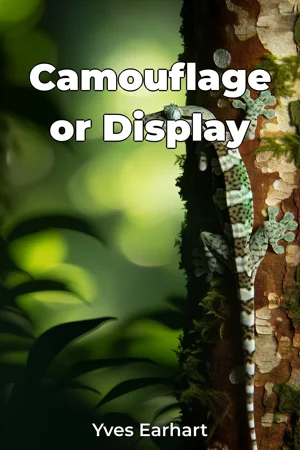
In the shadowed undergrowth of the Amazon rainforest, a leaf-tailed gecko clings to a branch, its body indistinguishable from the bark. Meanwhile, in the sun-dappled savanna, a male peacock fans iridescent feathers in a shimmering spectacle. Why do some species vanish into their environments, while others broadcast their presence with audacious brilliance? *Camouflage or Display: The Dueling Strategies of Survival* explores this evolutionary paradox, unraveling how life’s most successful organisms navigate the twin imperatives of concealment and revelation. This book examines two foundational survival strategies: the art of disappearing through camouflage and the bold tactics of visual or behavioral display. These adaptations, shaped over millions of years, reflect the relentless pressures of predation, reproduction, and environmental competition. By dissecting their mechanisms, evolutionary origins, and ecological impacts, the text illuminates how these strategies define species’ interactions and shape biodiversity. The narrative begins by grounding readers in the principles of natural selection, emphasizing how survival and reproductive success drive morphological and behavioral traits. Early chapters contrast passive camouflage—such as the stick insect’s mimicry or the octopus’s dynamic color-shifting—with active displays like the bioluminescent signals of fireflies or the competitive dances of birds-of-paradise. These examples underscore a central thesis: both strategies are equally vital, representing divergent solutions to the same existential challenges. A pivotal chapter investigates the genetic and physiological foundations of these traits. Camouflage often relies on complex pigment systems and adaptive neural responses, while displays frequently hinge on metabolic investments, such as the energy-intensive plumage of peacocks. Case studies illustrate trade-offs: the chameleon’s stealth limits its mobility, whereas the cardinal’s vivid hue risks attracting predators. The book synthesizes research from field biology, genomics, and behavioral ecology, citing landmark studies like the peppered moth’s industrial melanism and recent breakthroughs in understanding how cuttlefish manipulate skin texture. Interdisciplinary connections deepen the analysis. The psychology of perception explains how predators’ visual systems influence prey evolution, while materials science draws inspiration from camouflage mechanisms to develop adaptive textiles. Conversely, the study of animal displays informs marketing strategies and robotics, where exaggerated signals enhance human-robot interaction. These intersections reveal how biological principles resonate beyond ecology, spurring innovation in unexpected domains. The latter sections address evolutionary trade-offs and environmental pressures. In habitats with high predation, camouflage dominates; in stable ecosystems with fierce mating competition, displays flourish. However, climate change and habitat fragmentation disrupt these balances, forcing species to adapt rapidly—or face extinction. The book highlights conservation implications, arguing that understanding these strategies is critical for predicting species resilience. *Camouflage or Display* distinguishes itself by framing adaptation as a spectrum rather than a binary. A chapter on “dual-purpose” traits—such as the zebra’s stripes, which may deter insects and confuse predators—challenges simplistic categorizations. Interviews with researchers provide firsthand insights into ongoing debates, such as whether sexual selection drives display complexity more than natural selection. Written in a lucid, narrative style, the book balances scientific rigor with accessible storytelling. It avoids technical jargon, making it suitable for readers with basic biology knowledge while offering fresh perspectives for experts. Photographic illustrations and habitat maps enhance key examples, from Arctic foxes’ seasonal coat changes to the hypnotic courtship rituals of mandrills. Targeted at nature enthusiasts, students, and professionals in ecology or design, the book bridges academic research and public curiosity. It intentionally limits its scope to animal adaptations, briefly acknowledging but sidestepping human cultural displays to maintain focus. Practical takeaways encourage readers to observe local wildlife with renewed discernment, recognizing the invisible arms race unfolding in backyards and forests alike. Ultimately, *Camouflage or Display* posits that survival hinges on context—a lesson with profound implications for conservation and biomimetic innovation. By decoding nature’s visual language, the book invites readers to reconsider the delicate equilibrium between visibility and invisibility, a dynamic that sustains life’s diversity.
In the shadowed undergrowth of the Amazon rainforest, a leaf-tailed gecko clings to a branch, its body indistinguishable from the bark. Meanwhile, in the sun-dappled savanna, a male peacock fans iridescent feathers in a shimmering spectacle. Why do some species vanish into their environments, while others broadcast their presence with audacious brilliance? *Camouflage or Display: The Dueling Strategies of Survival* explores this evolutionary paradox, unraveling how life’s most successful organisms navigate the twin imperatives of concealment and revelation. This book examines two foundational survival strategies: the art of disappearing through camouflage and the bold tactics of visual or behavioral display. These adaptations, shaped over millions of years, reflect the relentless pressures of predation, reproduction, and environmental competition. By dissecting their mechanisms, evolutionary origins, and ecological impacts, the text illuminates how these strategies define species’ interactions and shape biodiversity. The narrative begins by grounding readers in the principles of natural selection, emphasizing how survival and reproductive success drive morphological and behavioral traits. Early chapters contrast passive camouflage—such as the stick insect’s mimicry or the octopus’s dynamic color-shifting—with active displays like the bioluminescent signals of fireflies or the competitive dances of birds-of-paradise. These examples underscore a central thesis: both strategies are equally vital, representing divergent solutions to the same existential challenges. A pivotal chapter investigates the genetic and physiological foundations of these traits. Camouflage often relies on complex pigment systems and adaptive neural responses, while displays frequently hinge on metabolic investments, such as the energy-intensive plumage of peacocks. Case studies illustrate trade-offs: the chameleon’s stealth limits its mobility, whereas the cardinal’s vivid hue risks attracting predators. The book synthesizes research from field biology, genomics, and behavioral ecology, citing landmark studies like the peppered moth’s industrial melanism and recent breakthroughs in understanding how cuttlefish manipulate skin texture. Interdisciplinary connections deepen the analysis. The psychology of perception explains how predators’ visual systems influence prey evolution, while materials science draws inspiration from camouflage mechanisms to develop adaptive textiles. Conversely, the study of animal displays informs marketing strategies and robotics, where exaggerated signals enhance human-robot interaction. These intersections reveal how biological principles resonate beyond ecology, spurring innovation in unexpected domains. The latter sections address evolutionary trade-offs and environmental pressures. In habitats with high predation, camouflage dominates; in stable ecosystems with fierce mating competition, displays flourish. However, climate change and habitat fragmentation disrupt these balances, forcing species to adapt rapidly—or face extinction. The book highlights conservation implications, arguing that understanding these strategies is critical for predicting species resilience. *Camouflage or Display* distinguishes itself by framing adaptation as a spectrum rather than a binary. A chapter on “dual-purpose” traits—such as the zebra’s stripes, which may deter insects and confuse predators—challenges simplistic categorizations. Interviews with researchers provide firsthand insights into ongoing debates, such as whether sexual selection drives display complexity more than natural selection. Written in a lucid, narrative style, the book balances scientific rigor with accessible storytelling. It avoids technical jargon, making it suitable for readers with basic biology knowledge while offering fresh perspectives for experts. Photographic illustrations and habitat maps enhance key examples, from Arctic foxes’ seasonal coat changes to the hypnotic courtship rituals of mandrills. Targeted at nature enthusiasts, students, and professionals in ecology or design, the book bridges academic research and public curiosity. It intentionally limits its scope to animal adaptations, briefly acknowledging but sidestepping human cultural displays to maintain focus. Practical takeaways encourage readers to observe local wildlife with renewed discernment, recognizing the invisible arms race unfolding in backyards and forests alike. Ultimately, *Camouflage or Display* posits that survival hinges on context—a lesson with profound implications for conservation and biomimetic innovation. By decoding nature’s visual language, the book invites readers to reconsider the delicate equilibrium between visibility and invisibility, a dynamic that sustains life’s diversity.
*Camouflage or Display: The Dueling Strategies of Survival* explores nature’s evolutionary balancing act between hiding and standing out. The book’s central theme reveals how survival hinges on two opposing tactics: vanishing into environments through camouflage or attracting attention via bold displays. These strategies, shaped by predation, reproduction, and competition, drive biodiversity and define species’ interactions. The book contrasts stealthy adaptations—like leaf-tailed geckos blending into bark or octopuses shifting skin texture—with flamboyant behaviors, such as peacocks fanning iridescent feathers or fireflies signaling with bioluminescence. Intriguingly, it highlights how these traits involve trade-offs: chameleons sacrifice mobility for invisibility, while cardinals risk predation for vivid mating signals. Landmark studies, like industrial melanism in peppered moths, illustrate natural selection’s role, while genomics uncovers how cuttlefish manipulate their skin. The narrative bridges biology with unexpected fields, showing how camouflage inspires adaptive textiles and animal displays inform robotics. Written in accessible prose, *Camouflage or Display* blends storytelling with scientific rigor, avoiding jargon while delving into ecology, genetics, and conservation. Chapters progress from core evolutionary principles to modern challenges like climate change disrupting these strategies. Unique insights emerge in “dual-purpose” traits—zebra stripes confuse predators *and* deter parasites—and debates over sexual versus natural selection. Rich with examples from Arctic foxes’ seasonal coats to mandrills’ courtship rituals, the book invites readers to see backyard wildlife as a stage for evolutionary drama. By framing adaptation as a spectrum rather than a binary, it offers fresh perspectives for nature enthusiasts and experts alike, underscoring how visibility’s delicate dance sustains life’s diversity.
Book Details
ISBN
9788233955533
Publisher
Publifye AS
Your Licenses
You don't own any licenses for this book
Purchase a license below to unlock this book and download the EPUB.
Purchase License
Select a tier to unlock this book
Need bulk licensing?
Contact us for enterprise agreements.