
About This Book
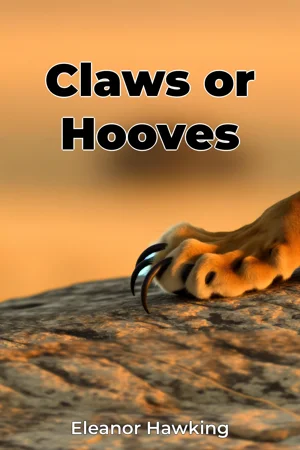
What separates a lion’s lethal ambush from a gazelle’s swift escape, or a bear’s grip on slippery river rocks from a bison’s steady trek across grasslands? *Claws or Hooves* examines the evolutionary marvels of these specialized appendages, revealing how they shape survival strategies across ecosystems. This book merges biomechanics, ecology, and evolutionary biology to explore how claws and hooves have become indispensable tools for predation, defense, and locomotion—adaptations forged by millions of years of natural selection. The book begins by establishing the foundational roles of claws and hooves in terrestrial vertebrates. Claws, curved and sharp, excel in gripping prey, climbing surfaces, or digging shelters. Hooves, compact and durable, distribute weight efficiently, enabling speed on open terrain and stability on uneven ground. These structures are not mere biological accessories; they are survival instruments that dictate an animal’s ecological niche. The text emphasizes how their form directly correlates with function, illustrating why a cheetah’s semi-retractable claws aid acceleration while a mountain goat’s concave hooves prevent fatal slips on cliffs. Central to the book’s thesis is the concept of evolutionary trade-offs. Claws offer versatility but require constant maintenance and energy investment, whereas hooves prioritize endurance over adaptability. This dichotomy is examined through case studies: the retractable claws of big cats, which remain sharp for precise killing, contrast with the hardened hooves of ungulates, which evolved to withstand marathon migrations. The book argues that these adaptations reflect broader principles of resource allocation and environmental pressure, offering insights into how species negotiate survival in competitive landscapes. Structured across three core sections, *Claws or Hooves* first decodes the anatomy and physics of these structures. Detailed chapters analyze keratin composition, stress distribution, and energy expenditure during movement. Fossil evidence traces the divergence of claws and hooves from a common ancestral form, highlighting pivotal moments such as the transition of early horses from multi-toed, clawed feet to single-toed hooves as grasslands expanded. The second section explores ecological interactions, detailing how predators like eagles use talons to manipulate prey, while herbivores like deer rely on hooves to outpace threats. The final chapters address human impacts, from the domestication of hoofed livestock to the ecological consequences of declining clawed species like pangolins. Research draws from comparative biomechanics, field observations, and paleontological data. High-speed videography captures the split-second deployment of a falcon’s claws mid-flight, while force-plate measurements reveal how bison hooves minimize soil compaction. The book also integrates Indigenous knowledge, such as tracking practices that interpret hoofprints and claw marks to predict animal behavior. Interdisciplinary connections bridge zoology with materials science, examining how claw and hoof structures inspire innovations in robotics and footwear design. Conservation biology threads throughout, emphasizing how habitat loss disrupts the delicate balance between predators (clawed) and prey (hoofed). A unique chapter contrasts artificial environments like zoos, where worn hooves and overgrown claws signal mismatches between captivity and evolutionary design. Written in a lucid, narrative style, the book avoids technical jargon without sacrificing scientific rigor. It caters to biology enthusiasts, students, and professionals seeking a holistic understanding of adaptation. By framing claws and hooves as evolutionary solutions to universal challenges—the need to eat, avoid being eaten, and traverse environments—the text underscores their relevance to broader discussions about biodiversity and resilience. While focused on terrestrial mammals and birds, the book acknowledges limitations in scope, excluding marine or exclusively arboreal species. Controversies, such as debates over whether claws or hooves confer greater evolutionary “success,” are presented through competing hypotheses, inviting readers to weigh evidence. Practical applications are underscored: Wildlife rehabilitators learn to assess hoof health in rescued deer, while engineers study claw mechanics to improve drone grasping tools. Ultimately, *Claws or Hooves* positions these adaptations as more than biological curiosities—they are keys to understanding the interplay of form, function, and survival in a rapidly changing world.
What separates a lion’s lethal ambush from a gazelle’s swift escape, or a bear’s grip on slippery river rocks from a bison’s steady trek across grasslands? *Claws or Hooves* examines the evolutionary marvels of these specialized appendages, revealing how they shape survival strategies across ecosystems. This book merges biomechanics, ecology, and evolutionary biology to explore how claws and hooves have become indispensable tools for predation, defense, and locomotion—adaptations forged by millions of years of natural selection. The book begins by establishing the foundational roles of claws and hooves in terrestrial vertebrates. Claws, curved and sharp, excel in gripping prey, climbing surfaces, or digging shelters. Hooves, compact and durable, distribute weight efficiently, enabling speed on open terrain and stability on uneven ground. These structures are not mere biological accessories; they are survival instruments that dictate an animal’s ecological niche. The text emphasizes how their form directly correlates with function, illustrating why a cheetah’s semi-retractable claws aid acceleration while a mountain goat’s concave hooves prevent fatal slips on cliffs. Central to the book’s thesis is the concept of evolutionary trade-offs. Claws offer versatility but require constant maintenance and energy investment, whereas hooves prioritize endurance over adaptability. This dichotomy is examined through case studies: the retractable claws of big cats, which remain sharp for precise killing, contrast with the hardened hooves of ungulates, which evolved to withstand marathon migrations. The book argues that these adaptations reflect broader principles of resource allocation and environmental pressure, offering insights into how species negotiate survival in competitive landscapes. Structured across three core sections, *Claws or Hooves* first decodes the anatomy and physics of these structures. Detailed chapters analyze keratin composition, stress distribution, and energy expenditure during movement. Fossil evidence traces the divergence of claws and hooves from a common ancestral form, highlighting pivotal moments such as the transition of early horses from multi-toed, clawed feet to single-toed hooves as grasslands expanded. The second section explores ecological interactions, detailing how predators like eagles use talons to manipulate prey, while herbivores like deer rely on hooves to outpace threats. The final chapters address human impacts, from the domestication of hoofed livestock to the ecological consequences of declining clawed species like pangolins. Research draws from comparative biomechanics, field observations, and paleontological data. High-speed videography captures the split-second deployment of a falcon’s claws mid-flight, while force-plate measurements reveal how bison hooves minimize soil compaction. The book also integrates Indigenous knowledge, such as tracking practices that interpret hoofprints and claw marks to predict animal behavior. Interdisciplinary connections bridge zoology with materials science, examining how claw and hoof structures inspire innovations in robotics and footwear design. Conservation biology threads throughout, emphasizing how habitat loss disrupts the delicate balance between predators (clawed) and prey (hoofed). A unique chapter contrasts artificial environments like zoos, where worn hooves and overgrown claws signal mismatches between captivity and evolutionary design. Written in a lucid, narrative style, the book avoids technical jargon without sacrificing scientific rigor. It caters to biology enthusiasts, students, and professionals seeking a holistic understanding of adaptation. By framing claws and hooves as evolutionary solutions to universal challenges—the need to eat, avoid being eaten, and traverse environments—the text underscores their relevance to broader discussions about biodiversity and resilience. While focused on terrestrial mammals and birds, the book acknowledges limitations in scope, excluding marine or exclusively arboreal species. Controversies, such as debates over whether claws or hooves confer greater evolutionary “success,” are presented through competing hypotheses, inviting readers to weigh evidence. Practical applications are underscored: Wildlife rehabilitators learn to assess hoof health in rescued deer, while engineers study claw mechanics to improve drone grasping tools. Ultimately, *Claws or Hooves* positions these adaptations as more than biological curiosities—they are keys to understanding the interplay of form, function, and survival in a rapidly changing world.
"Claws or Hooves" explores the evolutionary arms race between two iconic biological tools, revealing how these structures define survival for terrestrial vertebrates. At its core, the book examines how claws and hooves—shaped by millions of years of natural selection—dictate an animal’s ability to hunt, escape, and thrive. Blending biomechanics and ecology, it highlights striking adaptations: cheetahs’ semi-retractable claws act like cleats for explosive speed, while mountain goats’ concave hooves function as natural crampons on cliffs. These features aren’t arbitrary—their keratin composition and stress distribution reflect precise evolutionary trade-offs. Claws offer versatility for gripping prey or climbing but demand constant upkeep, whereas hooves prioritize endurance, enabling bison to traverse vast grasslands without injury. The book’s three-part structure first decodes the physics and fossil record behind these adaptations, such as how early horses transitioned from multi-toed claws to single hooves as grasslands expanded. Later chapters link form to ecological roles, showing how eagles’ talons manipulate prey and deer hooves optimize escape. Interdisciplinary insights stand out—Indigenous tracking knowledge enriches scientific data, while claw mechanics inspire robotics. Conservation threads tie these adaptations to modern challenges, like habitat loss disrupting predator-prey balances or zoo environments mismatching animals’ evolutionary designs. Written with narrative flair, "Claws or Hooves" transforms complex concepts into accessible stories, balancing fossil evidence with high-speed videography and field studies. It positions claws and hooves as keys to understanding biodiversity, urging readers to see them not just as biological tools but as solutions to universal demands: eat, avoid being eaten, and move through an ever-changing world.
Book Details
ISBN
9788233955472
Publisher
Publifye AS
Your Licenses
You don't own any licenses for this book
Purchase a license below to unlock this book and download the EPUB.
Purchase License
Select a tier to unlock this book
Need bulk licensing?
Contact us for enterprise agreements.