
About This Book
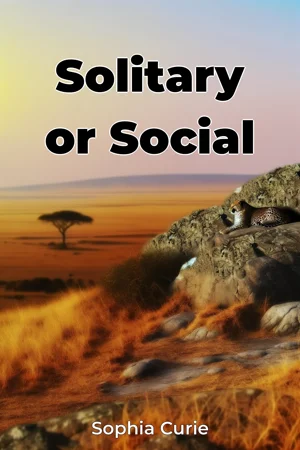
What determines whether an animal spends its life alone or surrounded by peers? *Solitary or Social: The Survival Strategies of Life* examines the evolutionary forces, ecological pressures, and behavioral adaptations that shape how species navigate existence—in isolation or in groups. Rooted in biology and ecology, this book explores the costs and benefits of these contrasting lifestyles, offering readers a deeper understanding of the diversity of life and the principles that govern survival. The book begins by grounding readers in foundational concepts of evolutionary biology, emphasizing that solitary and social behaviors are not random but products of millions of years of adaptation. Key topics include the evolutionary origins of sociality, the trade-offs between competition and cooperation, and the role of environmental factors—such as resource availability and predation risk—in driving behavioral strategies. These themes are critical for understanding how species carve out niches in ecosystems and respond to challenges like climate change or habitat loss. Central to the book’s thesis is the argument that neither strategy is inherently superior. Solitary animals, like tigers or octopuses, often excel in environments where resources are scarce or dispersed, minimizing conflict and maximizing efficiency. Social species, such as wolves or elephants, leverage collective intelligence, shared labor, and cooperative defense to thrive in riskier habitats. The book challenges assumptions about the “success” of one approach over the other, instead highlighting context-dependent advantages. Structured into three sections, the first part introduces core principles of animal behavior, defining key terms like *kin selection*, *altruism*, and *territoriality*. The middle chapters delve into case studies: solitary predators navigating vast territories, social insects organizing complex colonies, and semi-social species like bears that toggle between isolation and interaction. Each chapter contrasts physiological, cognitive, and social adaptations, supported by field research, genetic analyses, and observational data. The final section addresses human impacts, discussing how urbanization and agriculture disrupt natural behaviors, forcing species to adapt or decline. Evidence ranges from classic studies—such as Jane Goodall’s chimpanzee observations or George Schaller’s work on big cats—to contemporary research using GPS tracking and genomic sequencing. The book also incorporates ecological modeling to illustrate how shifting climates might favor certain strategies. For example, declining prey populations could push social hunters like lions toward solitary foraging, altering ecosystem dynamics. Interdisciplinary connections bridge ecology, anthropology, and conservation science. Insights into primate social structures shed light on human evolution, while examples of cooperative breeding in birds parallel human childcare practices. The book also links animal behavior to conservation policy, arguing that protecting species requires understanding their social or solitary needs—such as preserving migratory corridors for solitary roamers or safeguarding nesting sites for colonial birds. A unique feature is the book’s parallel examination of solitary and social species within the same ecosystems. By comparing, say, solitary leopards and social lions sharing African savannas, it reveals how divergent strategies coexist and shape ecological balance. This approach underscores biodiversity’s role in maintaining resilient ecosystems. Written in a clear, engaging style, the book balances scientific rigor with narrative storytelling, making it accessible to both biology students and general readers. It avoids technical jargon, with definitions woven seamlessly into examples. Targeted at nature enthusiasts, students of life sciences, and policymakers, *Solitary or Social* appeals to anyone curious about the roots of behavior—animal or human. Its practical applications extend to wildlife management, offering frameworks for designing reserves that accommodate species’ social structures. The book also addresses ethical debates, such as the welfare of social animals in captivity or the ethics of relocating solitary species. While focused on terrestrial mammals and birds, the book acknowledges limitations in scope, briefly referencing but not deeply exploring marine or insect societies. It emphasizes terrestrial examples to maintain depth and clarity. By the final chapter, readers will recognize that the line between solitary and social is often blurred—a spectrum shaped by necessity, not rigid instinct. In a rapidly changing world, understanding these strategies becomes not just a scientific pursuit but a tool for fostering coexistence.
What determines whether an animal spends its life alone or surrounded by peers? *Solitary or Social: The Survival Strategies of Life* examines the evolutionary forces, ecological pressures, and behavioral adaptations that shape how species navigate existence—in isolation or in groups. Rooted in biology and ecology, this book explores the costs and benefits of these contrasting lifestyles, offering readers a deeper understanding of the diversity of life and the principles that govern survival. The book begins by grounding readers in foundational concepts of evolutionary biology, emphasizing that solitary and social behaviors are not random but products of millions of years of adaptation. Key topics include the evolutionary origins of sociality, the trade-offs between competition and cooperation, and the role of environmental factors—such as resource availability and predation risk—in driving behavioral strategies. These themes are critical for understanding how species carve out niches in ecosystems and respond to challenges like climate change or habitat loss. Central to the book’s thesis is the argument that neither strategy is inherently superior. Solitary animals, like tigers or octopuses, often excel in environments where resources are scarce or dispersed, minimizing conflict and maximizing efficiency. Social species, such as wolves or elephants, leverage collective intelligence, shared labor, and cooperative defense to thrive in riskier habitats. The book challenges assumptions about the “success” of one approach over the other, instead highlighting context-dependent advantages. Structured into three sections, the first part introduces core principles of animal behavior, defining key terms like *kin selection*, *altruism*, and *territoriality*. The middle chapters delve into case studies: solitary predators navigating vast territories, social insects organizing complex colonies, and semi-social species like bears that toggle between isolation and interaction. Each chapter contrasts physiological, cognitive, and social adaptations, supported by field research, genetic analyses, and observational data. The final section addresses human impacts, discussing how urbanization and agriculture disrupt natural behaviors, forcing species to adapt or decline. Evidence ranges from classic studies—such as Jane Goodall’s chimpanzee observations or George Schaller’s work on big cats—to contemporary research using GPS tracking and genomic sequencing. The book also incorporates ecological modeling to illustrate how shifting climates might favor certain strategies. For example, declining prey populations could push social hunters like lions toward solitary foraging, altering ecosystem dynamics. Interdisciplinary connections bridge ecology, anthropology, and conservation science. Insights into primate social structures shed light on human evolution, while examples of cooperative breeding in birds parallel human childcare practices. The book also links animal behavior to conservation policy, arguing that protecting species requires understanding their social or solitary needs—such as preserving migratory corridors for solitary roamers or safeguarding nesting sites for colonial birds. A unique feature is the book’s parallel examination of solitary and social species within the same ecosystems. By comparing, say, solitary leopards and social lions sharing African savannas, it reveals how divergent strategies coexist and shape ecological balance. This approach underscores biodiversity’s role in maintaining resilient ecosystems. Written in a clear, engaging style, the book balances scientific rigor with narrative storytelling, making it accessible to both biology students and general readers. It avoids technical jargon, with definitions woven seamlessly into examples. Targeted at nature enthusiasts, students of life sciences, and policymakers, *Solitary or Social* appeals to anyone curious about the roots of behavior—animal or human. Its practical applications extend to wildlife management, offering frameworks for designing reserves that accommodate species’ social structures. The book also addresses ethical debates, such as the welfare of social animals in captivity or the ethics of relocating solitary species. While focused on terrestrial mammals and birds, the book acknowledges limitations in scope, briefly referencing but not deeply exploring marine or insect societies. It emphasizes terrestrial examples to maintain depth and clarity. By the final chapter, readers will recognize that the line between solitary and social is often blurred—a spectrum shaped by necessity, not rigid instinct. In a rapidly changing world, understanding these strategies becomes not just a scientific pursuit but a tool for fostering coexistence.
*Solitary or Social: The Survival Strategies of Life* explores how evolution and ecology shape the choice between living alone or in groups across the animal kingdom. At its core, the book argues that neither solitude nor sociality is inherently better—survival hinges on context. Drawing from evolutionary biology and ecology, it reveals how factors like food scarcity, predation, and environmental instability drive species toward strategies as varied as a tiger’s solitary stealth or an elephant herd’s cooperative vigilance. These adaptations, forged over millennia, highlight nature’s flexibility in balancing competition and cooperation. The book’s strength lies in its vivid comparisons. It contrasts solitary leopards with social lions sharing African savannas, showing how both strategies coexist to maintain ecological balance. Case studies—from octopuses minimizing conflict in resource-poor oceans to honeybees orchestrating complex colonies—illustrate trade-offs between independence and collective effort. The authors blend classic research, like Jane Goodall’s chimpanzee insights, with modern tools such as GPS tracking to trace how climate change might push lions toward solitary hunting. This interdisciplinary approach bridges animal behavior with human impacts, linking primate social structures to human evolution or bird cooperation to childcare practices. Structured in three sections, *Solitary or Social* first unpacks concepts like kin selection and territoriality, then dives into species-specific adaptations, and finally examines conservation challenges. Its accessible style demystifies technical terms through relatable examples, making it equally valuable for students and nature enthusiasts. By framing solitude and sociality as a spectrum shaped by necessity, the book offers a fresh lens for understanding biodiversity—and a urgent case for conservation policies that respect these survival strategies.
Book Details
ISBN
9788233955397
Publisher
Publifye AS
Your Licenses
You don't own any licenses for this book
Purchase a license below to unlock this book and download the EPUB.
Purchase License
Select a tier to unlock this book
Need bulk licensing?
Contact us for enterprise agreements.