
About This Book
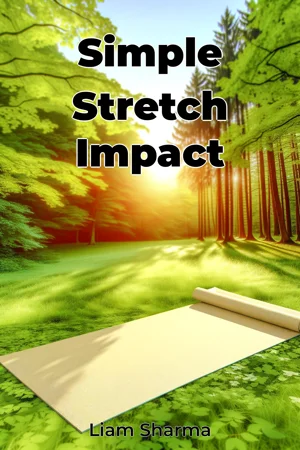
Have you ever considered that dedicating just 10 minutes a day to stretching could alleviate chronic fatigue, ease stress, and revitalize your body’s natural equilibrium? *Simple Stretch Impact* posits that small, intentional stretches—rooted in physiological science—hold the key to counteracting the physical and mental toll of modern sedentary lifestyles. Drawing from physical therapy research, ergonomic studies, and behavioral psychology, this book bridges the gap between clinical knowledge and everyday practice, offering readers actionable strategies to reclaim their vitality. **The Science of Stretching and Modern Life** The book opens by contextualizing the human body’s evolutionary design for movement—a stark contrast to today’s screen-centric routines. Prolonged sitting, poor posture, and repetitive motions contribute to muscle stiffness, joint pain, and systemic fatigue. Here, the text introduces its central thesis: targeted daily stretching is not merely a fitness accessory but a non-negotiable component of holistic health. It challenges the misconception that effective self-care requires significant time or resources, emphasizing that consistency and precision yield greater benefits than intensity. Three core themes structure the narrative: 1. **The Physiology of Stretching**: How stretching impacts muscle elasticity, blood flow, and nervous system regulation. 2. **Routine Design**: Crafting personalized stretches for specific needs (e.g., desk workers, caregivers, athletes). 3. **Behavioral Integration**: Overcoming psychological barriers to habit formation. **Evidence-Based Foundations** The book grounds its claims in peer-reviewed studies, including clinical trials demonstrating stretching’s role in reducing cortisol levels and improving parasympathetic nervous system activity. For example, a 2021 meta-analysis in the *Journal of Physical Therapy Science* found that office workers who performed thoracic spine and hamstring stretches twice daily reported 30% lower fatigue levels within three weeks. Case studies highlight individuals recovering from sedentary-related injuries, illustrating how incremental stretching restored mobility without invasive interventions. **Interdisciplinary Insights** *Simple Stretch Impact* distinguishes itself by weaving insights from disparate fields. Neuroscience clarifies how stretching mitigates stress by dampening amygdala hyperactivity; ergonomics informs posture-correction techniques; behavioral psychology provides frameworks for embedding micro-routines into chaotic schedules. This synthesis positions stretching as a gateway to broader well-being, influencing sleep quality, emotional resilience, and cognitive focus. **Practical Application and Accessibility** A standout feature is the book’s refusal to prescribe a one-size-fits-all regimen. Instead, it guides readers in auditing their daily patterns—commute, work setup, leisure habits—to identify “stretch opportunities.” Sample routines include wake-up spinal twists, desk-side hip flexor releases, and pre-bed nervous system cooldowns. Each exercise is paired with modifications for varying fitness levels and environments, ensuring adaptability. **Addressing Skepticism** Acknowledging common doubts, the book confronts the belief that stretching is ineffective for pain relief or energy boosts. It counters with electromyography (EMG) data showing reduced muscle tension post-stretching and testimonials from physical therapists who integrate these methods into rehabilitation programs. A chapter dedicated to “Myth vs. Mechanism” dismantles outdated notions, such as the necessity of pain for progress or the irrelevance of stretching for non-athletes. **Target Audience and Limitations** Tailored for time-strapped adults seeking sustainable self-care, the book particularly resonates with office professionals, parents, and aging populations. While it references strength training and cardio, its scope remains focused on low-impact, equipment-free stretching—avoiding overlap with nutrition or high-intensity fitness. **A Call to Action** The final chapters shift from theory to implementation, providing a 21-day roadmap with progress trackers and troubleshooting tips. Readers are encouraged to reframe stretching as a mindful practice rather than a chore, cultivating a mindset of bodily respect. By demystifying the science and prioritizing accessibility, *Simple Stretch Impact* aims to transform passive readers into active participants in their health journey—one deliberate stretch at a time. Written in a conversational yet evidence-anchored tone, the book balances relatable anecdotes with digestible explanations of biomechanics. Its strength lies in marrying rigor with realism, offering not just a compendium of stretches but a philosophy of self-care rooted in simplicity and scientific validation.
Have you ever considered that dedicating just 10 minutes a day to stretching could alleviate chronic fatigue, ease stress, and revitalize your body’s natural equilibrium? *Simple Stretch Impact* posits that small, intentional stretches—rooted in physiological science—hold the key to counteracting the physical and mental toll of modern sedentary lifestyles. Drawing from physical therapy research, ergonomic studies, and behavioral psychology, this book bridges the gap between clinical knowledge and everyday practice, offering readers actionable strategies to reclaim their vitality. **The Science of Stretching and Modern Life** The book opens by contextualizing the human body’s evolutionary design for movement—a stark contrast to today’s screen-centric routines. Prolonged sitting, poor posture, and repetitive motions contribute to muscle stiffness, joint pain, and systemic fatigue. Here, the text introduces its central thesis: targeted daily stretching is not merely a fitness accessory but a non-negotiable component of holistic health. It challenges the misconception that effective self-care requires significant time or resources, emphasizing that consistency and precision yield greater benefits than intensity. Three core themes structure the narrative: 1. **The Physiology of Stretching**: How stretching impacts muscle elasticity, blood flow, and nervous system regulation. 2. **Routine Design**: Crafting personalized stretches for specific needs (e.g., desk workers, caregivers, athletes). 3. **Behavioral Integration**: Overcoming psychological barriers to habit formation. **Evidence-Based Foundations** The book grounds its claims in peer-reviewed studies, including clinical trials demonstrating stretching’s role in reducing cortisol levels and improving parasympathetic nervous system activity. For example, a 2021 meta-analysis in the *Journal of Physical Therapy Science* found that office workers who performed thoracic spine and hamstring stretches twice daily reported 30% lower fatigue levels within three weeks. Case studies highlight individuals recovering from sedentary-related injuries, illustrating how incremental stretching restored mobility without invasive interventions. **Interdisciplinary Insights** *Simple Stretch Impact* distinguishes itself by weaving insights from disparate fields. Neuroscience clarifies how stretching mitigates stress by dampening amygdala hyperactivity; ergonomics informs posture-correction techniques; behavioral psychology provides frameworks for embedding micro-routines into chaotic schedules. This synthesis positions stretching as a gateway to broader well-being, influencing sleep quality, emotional resilience, and cognitive focus. **Practical Application and Accessibility** A standout feature is the book’s refusal to prescribe a one-size-fits-all regimen. Instead, it guides readers in auditing their daily patterns—commute, work setup, leisure habits—to identify “stretch opportunities.” Sample routines include wake-up spinal twists, desk-side hip flexor releases, and pre-bed nervous system cooldowns. Each exercise is paired with modifications for varying fitness levels and environments, ensuring adaptability. **Addressing Skepticism** Acknowledging common doubts, the book confronts the belief that stretching is ineffective for pain relief or energy boosts. It counters with electromyography (EMG) data showing reduced muscle tension post-stretching and testimonials from physical therapists who integrate these methods into rehabilitation programs. A chapter dedicated to “Myth vs. Mechanism” dismantles outdated notions, such as the necessity of pain for progress or the irrelevance of stretching for non-athletes. **Target Audience and Limitations** Tailored for time-strapped adults seeking sustainable self-care, the book particularly resonates with office professionals, parents, and aging populations. While it references strength training and cardio, its scope remains focused on low-impact, equipment-free stretching—avoiding overlap with nutrition or high-intensity fitness. **A Call to Action** The final chapters shift from theory to implementation, providing a 21-day roadmap with progress trackers and troubleshooting tips. Readers are encouraged to reframe stretching as a mindful practice rather than a chore, cultivating a mindset of bodily respect. By demystifying the science and prioritizing accessibility, *Simple Stretch Impact* aims to transform passive readers into active participants in their health journey—one deliberate stretch at a time. Written in a conversational yet evidence-anchored tone, the book balances relatable anecdotes with digestible explanations of biomechanics. Its strength lies in marrying rigor with realism, offering not just a compendium of stretches but a philosophy of self-care rooted in simplicity and scientific validation.
"Simple Stretch Impact" reveals how dedicating just 10 minutes daily to targeted stretching can counteract the physical and mental strain of modern sedentary life. Bridging physiology, behavioral psychology, and ergonomics, the book positions stretching as essential for holistic health—not just flexibility. It challenges the myth that self-care requires drastic lifestyle changes, showing how precise, consistent routines improve muscle elasticity, reduce stress hormones like cortisol, and enhance energy. Backed by clinical studies, including a 2021 trial where office workers lowered fatigue by 30% through twice-daily hamstring and spine stretches, the book transforms scientific insights into practical tools for everyone from desk professionals to caregivers. The guide stands out by blending interdisciplinary research with adaptable strategies. Readers learn to design personalized routines—like desk-side hip flexor releases or mindful cooldowns—that fit chaotic schedules. By explaining how stretching calms the nervous system and corrects posture, it frames these exercises as gateways to better sleep, focus, and resilience. Unlike generic fitness plans, the 21-day roadmap emphasizes habit formation through tiny, sustainable changes. Written in a conversational tone, "Simple Stretch Impact" demystifies biomechanics while offering realistic solutions, making it ideal for time-crunched adults seeking low-impact ways to reclaim vitality without equipment or intensity.
Book Details
ISBN
9788233955021
Publisher
Publifye AS
Your Licenses
You don't own any licenses for this book
Purchase a license below to unlock this book and download the EPUB.
Purchase License
Select a tier to unlock this book
Need bulk licensing?
Contact us for enterprise agreements.