
About This Book
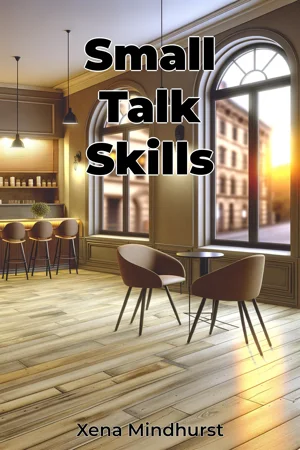
Have you ever wondered why a brief chat about the weather can leave you feeling deeply connected to a stranger—or why fumbling through a casual conversation might spark lingering anxiety? *Small Talk Skills* explores the hidden architecture of everyday dialogue, revealing how seemingly trivial exchanges shape our relationships, careers, and sense of belonging. Drawing from decades of communication research and social psychology, this book dismantles the myth that small talk is merely filler and positions it as a critical tool for human connection. **Main Topics and Context** The book centers on three pillars: the linguistic mechanics of casual conversation, the psychological underpinnings of social bonding, and the practical strategies for navigating these interactions confidently. Small talk, often dismissed as superficial, is reframed as a ritualized form of social glue. Historically, anthropologists have traced its roots to communal rituals that reinforce group cohesion, while modern studies highlight its role in reducing social friction in diverse settings, from workplaces to cross-cultural encounters. The text grounds these ideas in foundational theories, such as Penelope Brown and Stephen Levinson’s politeness theory and Roy Baumeister’s work on the human need for belonging, ensuring readers grasp the science behind the skills. **Central Thesis** The book argues that mastering small talk is not about perfecting charm but understanding its function as a scaffold for trust. By decoding the unspoken rules of casual dialogue—turn-taking rhythms, topic selection, and nonverbal cues—individuals can transform fleeting interactions into opportunities for meaningful connection. This thesis challenges the cultural dismissal of small talk as “empty” and instead positions it as a gateway to empathy and collaboration, with implications for mental health, professional success, and societal cohesion. **Structure and Evidence** Organized into three sections, *Small Talk Skills* begins by deconstructing the anatomy of casual conversations, including speech patterns, humor, and active listening. The second section shifts to social psychology, examining how these exchanges activate neural reward systems, mitigate loneliness, and foster inclusivity. The final chapters offer actionable techniques: initiating conversations in anxiety-inducing contexts, repairing miscommunications, and adapting strategies across cultures. Research cited ranges from sociolinguistic analyses of spontaneous dialogues to longitudinal studies linking conversational competence to career advancement. Unique datasets include workplace ethnographies documenting how teams bond through informal chatter and experiments measuring cortisol levels before and after social interactions. The book also incorporates cross-cultural comparisons, illustrating how norms around eye contact, personal space, or self-disclosure vary globally. **Interdisciplinary Insights** By bridging linguistics, psychology, and anthropology, the book demonstrates how small talk operates as a universal yet culturally nuanced practice. For instance, neuroscientific findings on mirror neurons explain why matching a conversation partner’s tone builds rapport, while organizational behavior research reveals how coffee-break dialogues correlate with team innovation. These intersections underscore small talk’s relevance to fields as varied as conflict resolution, public health, and AI development, where human-machine interactions increasingly mimic casual dialogue. **Practical Applications and Audience** Written in a conversational style with minimal jargon, the book targets professionals seeking networking skills, parents modeling social behaviors for children, and anyone navigating social anxiety. Exercises include role-playing scripts, reflection prompts to identify personal communication pitfalls, and frameworks for gauging when to pivot from small talk to deeper topics. A chapter on digital communication addresses virtual small talk’s unique challenges, such as maintaining engagement through screens. **Scope and Considerations** While focused on face-to-face interactions in Western and East Asian contexts, the book acknowledges limitations, such as its emphasis on verbal over nonverbal communication in certain chapters. It also engages with critiques—some researchers argue that excessive small talk can perpetuate superficiality—by advocating intentionality: using these skills to build bridges, not avoid authenticity. *Small Talk Skills* does not promise charisma but offers a evidence-based roadmap for harnessing the power of everyday conversation. In a world where loneliness is increasingly described as an epidemic, this book reimagines small talk as a vital, teachable skill—one that turns strangers into allies and conversations into connections.
Have you ever wondered why a brief chat about the weather can leave you feeling deeply connected to a stranger—or why fumbling through a casual conversation might spark lingering anxiety? *Small Talk Skills* explores the hidden architecture of everyday dialogue, revealing how seemingly trivial exchanges shape our relationships, careers, and sense of belonging. Drawing from decades of communication research and social psychology, this book dismantles the myth that small talk is merely filler and positions it as a critical tool for human connection. **Main Topics and Context** The book centers on three pillars: the linguistic mechanics of casual conversation, the psychological underpinnings of social bonding, and the practical strategies for navigating these interactions confidently. Small talk, often dismissed as superficial, is reframed as a ritualized form of social glue. Historically, anthropologists have traced its roots to communal rituals that reinforce group cohesion, while modern studies highlight its role in reducing social friction in diverse settings, from workplaces to cross-cultural encounters. The text grounds these ideas in foundational theories, such as Penelope Brown and Stephen Levinson’s politeness theory and Roy Baumeister’s work on the human need for belonging, ensuring readers grasp the science behind the skills. **Central Thesis** The book argues that mastering small talk is not about perfecting charm but understanding its function as a scaffold for trust. By decoding the unspoken rules of casual dialogue—turn-taking rhythms, topic selection, and nonverbal cues—individuals can transform fleeting interactions into opportunities for meaningful connection. This thesis challenges the cultural dismissal of small talk as “empty” and instead positions it as a gateway to empathy and collaboration, with implications for mental health, professional success, and societal cohesion. **Structure and Evidence** Organized into three sections, *Small Talk Skills* begins by deconstructing the anatomy of casual conversations, including speech patterns, humor, and active listening. The second section shifts to social psychology, examining how these exchanges activate neural reward systems, mitigate loneliness, and foster inclusivity. The final chapters offer actionable techniques: initiating conversations in anxiety-inducing contexts, repairing miscommunications, and adapting strategies across cultures. Research cited ranges from sociolinguistic analyses of spontaneous dialogues to longitudinal studies linking conversational competence to career advancement. Unique datasets include workplace ethnographies documenting how teams bond through informal chatter and experiments measuring cortisol levels before and after social interactions. The book also incorporates cross-cultural comparisons, illustrating how norms around eye contact, personal space, or self-disclosure vary globally. **Interdisciplinary Insights** By bridging linguistics, psychology, and anthropology, the book demonstrates how small talk operates as a universal yet culturally nuanced practice. For instance, neuroscientific findings on mirror neurons explain why matching a conversation partner’s tone builds rapport, while organizational behavior research reveals how coffee-break dialogues correlate with team innovation. These intersections underscore small talk’s relevance to fields as varied as conflict resolution, public health, and AI development, where human-machine interactions increasingly mimic casual dialogue. **Practical Applications and Audience** Written in a conversational style with minimal jargon, the book targets professionals seeking networking skills, parents modeling social behaviors for children, and anyone navigating social anxiety. Exercises include role-playing scripts, reflection prompts to identify personal communication pitfalls, and frameworks for gauging when to pivot from small talk to deeper topics. A chapter on digital communication addresses virtual small talk’s unique challenges, such as maintaining engagement through screens. **Scope and Considerations** While focused on face-to-face interactions in Western and East Asian contexts, the book acknowledges limitations, such as its emphasis on verbal over nonverbal communication in certain chapters. It also engages with critiques—some researchers argue that excessive small talk can perpetuate superficiality—by advocating intentionality: using these skills to build bridges, not avoid authenticity. *Small Talk Skills* does not promise charisma but offers a evidence-based roadmap for harnessing the power of everyday conversation. In a world where loneliness is increasingly described as an epidemic, this book reimagines small talk as a vital, teachable skill—one that turns strangers into allies and conversations into connections.
"Small Talk Skills" dismantles the myth that casual conversation is trivial, positioning it instead as a vital social tool that builds trust, reduces loneliness, and opens doors to professional opportunities. Blending insights from social psychology, linguistics, and anthropology, the book reveals how everyday exchanges—from weather chats to coffee-break banter—activate neural reward systems and strengthen communal bonds. It highlights intriguing findings: small talk rituals trace back to ancient group cohesion practices, workplace teams that engage in informal dialogue show higher innovation, and even brief interactions can lower stress hormones like cortisol. By framing these exchanges as "social glue," the book challenges the perception of small talk as shallow, showing its role in fostering empathy across cultures and easing social anxiety. Structured in three clear sections, the book first breaks down the mechanics of conversation—turn-taking, nonverbal cues, and active listening—then explores the psychology behind why these interactions matter. Final chapters provide actionable strategies, from navigating cross-cultural norms (like varying eye contact rules) to repairing digital miscommunications. Unique research, including workplace ethnographies and global politeness studies, grounds its advice in evidence. Unlike typical self-help guides, "Small Talk Skills" doesn’t promise charm but offers a science-backed toolkit for transforming fleeting chats into meaningful connections. Its interdisciplinary approach and focus on intentionality—using small talk to build bridges, not avoid depth—make it equally valuable for nervous networkers, parents teaching social skills, or professionals bridging cultural divides. Written in accessible language with role-play exercises and real-world examples, the book turns complex theories into practical habits. By linking conversational competence to career advancement and mental health, it reimagines small talk as an antidote to modern loneliness—a skill that turns strangers into allies, one dialogue at a time.
Book Details
ISBN
9788233954611
Publisher
Publifye AS
Your Licenses
You don't own any licenses for this book
Purchase a license below to unlock this book and download the EPUB.
Purchase License
Select a tier to unlock this book
Need bulk licensing?
Contact us for enterprise agreements.