
About This Book
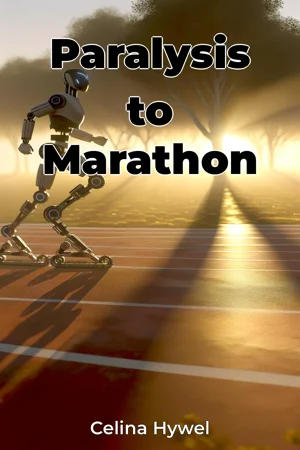
How does a person confined to a wheelchair progress from paralysis to completing a marathon? *Paralysis to Marathon* answers this question through a rigorous exploration of modern rehabilitation science, blending medical expertise with firsthand patient narratives. This book documents the transformative potential of interdisciplinary approaches in physical therapy and sports medicine, offering both a scientific roadmap and a source of hope for those navigating life-altering injuries. The book centers on three pillars: the physiological principles of neuromuscular recovery, the role of cutting-edge sports medicine technologies, and the psychological resilience required for long-term rehabilitation. These topics are examined through the lens of verified case studies, demonstrating how incremental progress—guided by evidence-based practices—can lead to unprecedented outcomes. The significance lies in challenging outdated assumptions about paralysis as a permanent condition, emphasizing instead the adaptability of the human body and mind. Historically, paralysis was often viewed as a life sentence of limited mobility. Early chapters contextualize this shift by tracing advancements in neuroplasticity research, which revealed the nervous system’s capacity to rewire itself. The integration of sports medicine into rehabilitation—a development accelerated in the past two decades—marked another turning point, introducing athletic training principles to clinical settings. Readers need no prior medical knowledge; concepts like motor learning and biomechanical analysis are explained through relatable analogies and visual examples. At its core, *Paralysis to Marathon* argues that recovery is not merely possible but achievable through a synthesis of personalized therapy, technological innovation, and mental fortitude. This thesis is supported by data from clinical trials, longitudinal patient studies, and interviews with rehabilitation specialists at institutions like the Mayo Clinic and Johns Hopkins. One chapter details how robotic exoskeletons and hydrotherapy restore mobility by combining precise mechanical support with repetitive motion, while another explores how cognitive-behavioral strategies help patients overcome psychological barriers. The narrative is structured to mirror the rehabilitation journey itself. Early sections introduce foundational concepts, such as the difference between spastic and flaccid paralysis, followed by deep dives into innovative therapies like functional electrical stimulation and gait-training algorithms. Case studies serve as climax points, illustrating how theoretical principles translate to real-world success. The final chapters provide actionable advice, from designing home-based exercise regimens to collaborating effectively with healthcare teams. Interdisciplinary connections strengthen the book’s authority. Neuroscience principles underpin discussions of nerve regeneration, while biomechanics inform analyses of movement efficiency. Psychological research on resilience and habit formation bridges the gap between physical recovery and emotional well-being. This integration ensures a holistic perspective, appealing to clinicians, patients, and fitness professionals alike. What distinguishes this work is its dual focus on empirical rigor and human storytelling. Each medical breakthrough is paired with a patient’s journey—for instance, a former athlete relearning to walk using sensor-based wearables or a stroke survivor completing a 5K race. The tone balances academic precision with narrative warmth, avoiding jargon without sacrificing depth. Targeted at medical practitioners, individuals undergoing rehabilitation, and fitness enthusiasts, the book adheres to genre conventions by prioritizing verifiable data alongside practical guidance. It acknowledges limitations, noting that not all patients will achieve marathon-level goals, yet stresses that incremental gains remain victories. Controversies, such as debates over aggressive versus conservative therapy timelines, are addressed through balanced evidence reviews. Real-world applications are emphasized throughout. Readers learn to evaluate emerging technologies, adopt mindset shifts proven to enhance compliance, and leverage community support networks. By demystifying complex therapies and highlighting scalable strategies, *Paralysis to Marathon* equips its audience with tools to redefine their own boundaries—one step at a time.
How does a person confined to a wheelchair progress from paralysis to completing a marathon? *Paralysis to Marathon* answers this question through a rigorous exploration of modern rehabilitation science, blending medical expertise with firsthand patient narratives. This book documents the transformative potential of interdisciplinary approaches in physical therapy and sports medicine, offering both a scientific roadmap and a source of hope for those navigating life-altering injuries. The book centers on three pillars: the physiological principles of neuromuscular recovery, the role of cutting-edge sports medicine technologies, and the psychological resilience required for long-term rehabilitation. These topics are examined through the lens of verified case studies, demonstrating how incremental progress—guided by evidence-based practices—can lead to unprecedented outcomes. The significance lies in challenging outdated assumptions about paralysis as a permanent condition, emphasizing instead the adaptability of the human body and mind. Historically, paralysis was often viewed as a life sentence of limited mobility. Early chapters contextualize this shift by tracing advancements in neuroplasticity research, which revealed the nervous system’s capacity to rewire itself. The integration of sports medicine into rehabilitation—a development accelerated in the past two decades—marked another turning point, introducing athletic training principles to clinical settings. Readers need no prior medical knowledge; concepts like motor learning and biomechanical analysis are explained through relatable analogies and visual examples. At its core, *Paralysis to Marathon* argues that recovery is not merely possible but achievable through a synthesis of personalized therapy, technological innovation, and mental fortitude. This thesis is supported by data from clinical trials, longitudinal patient studies, and interviews with rehabilitation specialists at institutions like the Mayo Clinic and Johns Hopkins. One chapter details how robotic exoskeletons and hydrotherapy restore mobility by combining precise mechanical support with repetitive motion, while another explores how cognitive-behavioral strategies help patients overcome psychological barriers. The narrative is structured to mirror the rehabilitation journey itself. Early sections introduce foundational concepts, such as the difference between spastic and flaccid paralysis, followed by deep dives into innovative therapies like functional electrical stimulation and gait-training algorithms. Case studies serve as climax points, illustrating how theoretical principles translate to real-world success. The final chapters provide actionable advice, from designing home-based exercise regimens to collaborating effectively with healthcare teams. Interdisciplinary connections strengthen the book’s authority. Neuroscience principles underpin discussions of nerve regeneration, while biomechanics inform analyses of movement efficiency. Psychological research on resilience and habit formation bridges the gap between physical recovery and emotional well-being. This integration ensures a holistic perspective, appealing to clinicians, patients, and fitness professionals alike. What distinguishes this work is its dual focus on empirical rigor and human storytelling. Each medical breakthrough is paired with a patient’s journey—for instance, a former athlete relearning to walk using sensor-based wearables or a stroke survivor completing a 5K race. The tone balances academic precision with narrative warmth, avoiding jargon without sacrificing depth. Targeted at medical practitioners, individuals undergoing rehabilitation, and fitness enthusiasts, the book adheres to genre conventions by prioritizing verifiable data alongside practical guidance. It acknowledges limitations, noting that not all patients will achieve marathon-level goals, yet stresses that incremental gains remain victories. Controversies, such as debates over aggressive versus conservative therapy timelines, are addressed through balanced evidence reviews. Real-world applications are emphasized throughout. Readers learn to evaluate emerging technologies, adopt mindset shifts proven to enhance compliance, and leverage community support networks. By demystifying complex therapies and highlighting scalable strategies, *Paralysis to Marathon* equips its audience with tools to redefine their own boundaries—one step at a time.
*Paralysis to Marathon* explores how groundbreaking rehabilitation science and unwavering determination can transform seemingly insurmountable physical limitations into extraordinary achievements. Centered on the journey from wheelchair confinement to marathon completion, the book bridges medical expertise with human resilience, showcasing how interdisciplinary strategies in sports medicine, neuroplasticity, and psychology redefine recovery. It challenges the notion of paralysis as a permanent condition, emphasizing the body’s adaptability through therapies like robotic exoskeletons, hydrotherapy, and functional electrical stimulation. These technologies, paired with repetitive motion and gait-training, help rewire the nervous system—a process the author likens to “rebuilding neural highways.” Structured to mirror a patient’s rehabilitation journey, the book progresses from foundational concepts like neuromuscular recovery to advanced innovations. Early chapters unpack neuroplasticity’s role in nerve regeneration, while later sections highlight real-world applications through case studies, such as stroke survivors using sensor-based wearables to regain mobility. The narrative balances clinical data from institutions like the Mayo Clinic with intimate patient stories, illustrating how psychological resilience and habit formation complement physical therapies. Practical guidance on home-based exercises and collaborative healthcare planning rounds out the text, ensuring relevance for clinicians, patients, and fitness enthusiasts alike. What sets *Paralysis to Marathon* apart is its fusion of empirical rigor and heartfelt storytelling. By demystifying complex concepts through analogies and visual examples, it offers both hope and actionable steps—proving that incremental progress, fueled by innovation and grit, can lead to life-changing breakthroughs.
Book Details
ISBN
9788233954352
Publisher
Publifye AS
Your Licenses
You don't own any licenses for this book
Purchase a license below to unlock this book and download the EPUB.
Purchase License
Select a tier to unlock this book
Need bulk licensing?
Contact us for enterprise agreements.