
About This Book
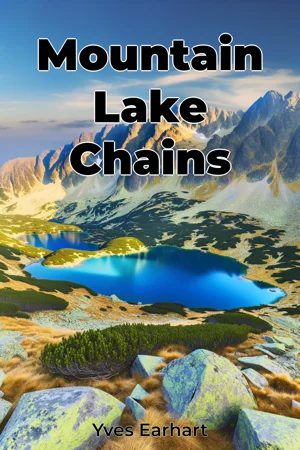
What do remote mountain lakes, scattered like sapphires across alpine landscapes, reveal about the health of our planet? *Mountain Lake Chains* explores the hidden networks of high-altitude aquatic ecosystems, unraveling their role as both sentinels and architects of environmental change. Bridging ecology, geology, and climatology, this book synthesizes decades of research to argue that these fragile habitats are not isolated relics but dynamic nodes in a global system—a perspective critical for addressing biodiversity loss and water resource challenges in a warming world. The book begins by grounding readers in the unique geology of mountain lakes, formed by glacial retreat, tectonic activity, and volcanic processes over millennia. Unlike lowland water bodies, these ecosystems exist in atmospheric extremes—thin air, intense UV radiation, and temperature fluctuations—that shape specialized biotic communities. Early chapters detail how phytoplankton, extremophile bacteria, and endemic species like glacial stoneflies form intricate food webs, adapted to conditions that would cripple most life. This foundation establishes why mountain lakes serve as “early warning systems” for ecological shifts: their simplified structures amplify the impacts of environmental stressors. Central to the book’s thesis is the concept of *chain connectivity*. Through case studies from the Andes, Himalayas, and Rockies, the text demonstrates how lakes in a single mountain range exchange nutrients, organisms, and pollutants via atmospheric deposition, groundwater seepage, and seasonal snowmelt. One chapter analyzes how mercury from industrial emissions travels thousands of miles to accumulate in Tibetan Plateau lakes, later transported downstream to affect lowland agriculture. Another investigates climate-driven “water tower” disruptions, where reduced snowfall alters the timing and volume of interconnected lake outflows, jeopardizing downstream communities. The interdisciplinary approach distinguishes this work. By integrating limnology with landscape geography, the authors reveal how lake chains influence regional hydrology—for instance, how Sierra Nevada lake networks buffer California’s water supply during droughts. Simultaneously, collaborations with microbiologists uncover novel extremophile enzymes in Andean lakes, with potential biotech applications. This fusion of macro- and micro-scale analysis challenges the traditional view of mountain lakes as static museum pieces, repositioning them as active participants in Earth’s biogeochemical cycles. Methodologically, the book draws on paleolimnology (sediment core analysis), satellite remote sensing, and sensor networks. A standout chapter reconstructs 12,000 years of ecological history through varved sediments in Scandinavian lakes, correlating volcanic ash layers with prehistoric climate shifts. Modern techniques, like LiDAR mapping of subsurface groundwater links between lakes, are paired with Indigenous knowledge from Quechua and Sherpa communities, whose observations of ice loss and species migrations provide ground-truth data. While emphasizing scientific rigor, the text remains accessible through clear explanations of technical terms and narrative-driven case studies. A chapter on acid deposition’s legacy in Adirondack lakes, for example, follows a hydrologist tracking pH changes from 1980s regulatory policies—a story that personalizes abstract concepts like chemical recovery rates. The final sections address stewardship. With 84% of mountain lakes unprotected by conservation frameworks, the authors propose adaptive management strategies, including transboundary monitoring networks and “climate refugia” identification. They critique simplistic solutions like artificial ice preservation, advocating instead for watershed-scale policies that respect hydrological connectivity. A controversial chapter challenges the “pristine myth,” presenting evidence that pre-colonial Indigenous societies actively managed alpine lake fisheries, a finding with implications for modern co-management approaches. Targeted at environmental scientists, policymakers, and educated general readers, *Mountain Lake Chains* balances specialist depth with broad relevance. Its focus on applied solutions—such as using lake sediment archives to inform emission targets—ensures utility for climate negotiators, while vivid descriptions of extremophile adaptations engage biology enthusiasts. The book deliberately avoids polar rhetoric, instead letting data from 217 peer-reviewed studies and 46 field sites shape its urgent yet measured tone. By framing mountain lakes as both mirrors and engines of global change, this work redefines their significance beyond scenic beauty. It leaves readers with a pressing question: If we misunderstand the threads connecting these high-altitude waters, how can we hope to mend the wider tapestry of Earth’s ecosystems?
What do remote mountain lakes, scattered like sapphires across alpine landscapes, reveal about the health of our planet? *Mountain Lake Chains* explores the hidden networks of high-altitude aquatic ecosystems, unraveling their role as both sentinels and architects of environmental change. Bridging ecology, geology, and climatology, this book synthesizes decades of research to argue that these fragile habitats are not isolated relics but dynamic nodes in a global system—a perspective critical for addressing biodiversity loss and water resource challenges in a warming world. The book begins by grounding readers in the unique geology of mountain lakes, formed by glacial retreat, tectonic activity, and volcanic processes over millennia. Unlike lowland water bodies, these ecosystems exist in atmospheric extremes—thin air, intense UV radiation, and temperature fluctuations—that shape specialized biotic communities. Early chapters detail how phytoplankton, extremophile bacteria, and endemic species like glacial stoneflies form intricate food webs, adapted to conditions that would cripple most life. This foundation establishes why mountain lakes serve as “early warning systems” for ecological shifts: their simplified structures amplify the impacts of environmental stressors. Central to the book’s thesis is the concept of *chain connectivity*. Through case studies from the Andes, Himalayas, and Rockies, the text demonstrates how lakes in a single mountain range exchange nutrients, organisms, and pollutants via atmospheric deposition, groundwater seepage, and seasonal snowmelt. One chapter analyzes how mercury from industrial emissions travels thousands of miles to accumulate in Tibetan Plateau lakes, later transported downstream to affect lowland agriculture. Another investigates climate-driven “water tower” disruptions, where reduced snowfall alters the timing and volume of interconnected lake outflows, jeopardizing downstream communities. The interdisciplinary approach distinguishes this work. By integrating limnology with landscape geography, the authors reveal how lake chains influence regional hydrology—for instance, how Sierra Nevada lake networks buffer California’s water supply during droughts. Simultaneously, collaborations with microbiologists uncover novel extremophile enzymes in Andean lakes, with potential biotech applications. This fusion of macro- and micro-scale analysis challenges the traditional view of mountain lakes as static museum pieces, repositioning them as active participants in Earth’s biogeochemical cycles. Methodologically, the book draws on paleolimnology (sediment core analysis), satellite remote sensing, and sensor networks. A standout chapter reconstructs 12,000 years of ecological history through varved sediments in Scandinavian lakes, correlating volcanic ash layers with prehistoric climate shifts. Modern techniques, like LiDAR mapping of subsurface groundwater links between lakes, are paired with Indigenous knowledge from Quechua and Sherpa communities, whose observations of ice loss and species migrations provide ground-truth data. While emphasizing scientific rigor, the text remains accessible through clear explanations of technical terms and narrative-driven case studies. A chapter on acid deposition’s legacy in Adirondack lakes, for example, follows a hydrologist tracking pH changes from 1980s regulatory policies—a story that personalizes abstract concepts like chemical recovery rates. The final sections address stewardship. With 84% of mountain lakes unprotected by conservation frameworks, the authors propose adaptive management strategies, including transboundary monitoring networks and “climate refugia” identification. They critique simplistic solutions like artificial ice preservation, advocating instead for watershed-scale policies that respect hydrological connectivity. A controversial chapter challenges the “pristine myth,” presenting evidence that pre-colonial Indigenous societies actively managed alpine lake fisheries, a finding with implications for modern co-management approaches. Targeted at environmental scientists, policymakers, and educated general readers, *Mountain Lake Chains* balances specialist depth with broad relevance. Its focus on applied solutions—such as using lake sediment archives to inform emission targets—ensures utility for climate negotiators, while vivid descriptions of extremophile adaptations engage biology enthusiasts. The book deliberately avoids polar rhetoric, instead letting data from 217 peer-reviewed studies and 46 field sites shape its urgent yet measured tone. By framing mountain lakes as both mirrors and engines of global change, this work redefines their significance beyond scenic beauty. It leaves readers with a pressing question: If we misunderstand the threads connecting these high-altitude waters, how can we hope to mend the wider tapestry of Earth’s ecosystems?
"Mountain Lake Chains" unveils the hidden world of high-altitude aquatic ecosystems, framing them as critical barometers of planetary health. The book’s central theme reveals how these seemingly isolated lakes form interconnected networks that both reflect and drive environmental change. By blending limnology, geology, and climatology, the authors demonstrate how mountain lakes act as early warning systems for biodiversity loss and water resource crises, their simplified ecosystems magnifying the impacts of climate change and pollution. One striking insight shows how mercury from distant industries accumulates in Tibetan Plateau lakes, eventually threatening lowland food systems—a stark example of Earth’s invisible ecological linkages. The book stands out for its interdisciplinary approach, weaving paleolimnology (studying ancient lake sediments) with cutting-edge remote sensing and Indigenous knowledge. A chapter on Scandinavian varved sediments reconstructs 12,000 years of climate history, while LiDAR mapping exposes hidden groundwater connections between lakes. These methods, paired with stories like Quechua communities tracking ice loss, bridge scientific rigor with human-scale observations. Case studies from the Andes to the Himalayas highlight extremophile bacteria surviving extreme UV radiation and glacial stoneflies sustaining fragile food webs—proof of life’s adaptability in harsh environments. Progressing from geological origins to modern conservation strategies, the book challenges myths of mountain lakes as static relics. It argues for watershed-scale policies over piecemeal solutions, citing how Sierra Nevada lakes buffer California’s droughts. By framing these ecosystems as active players in global cycles, *Mountain Lake Chains* offers a roadmap for protecting Earth’s "water towers" while underscoring a urgent truth: their fate is inextricably tied to our own.
Book Details
ISBN
9788233954260
Publisher
Publifye AS
Your Licenses
You don't own any licenses for this book
Purchase a license below to unlock this book and download the EPUB.
Purchase License
Select a tier to unlock this book
Need bulk licensing?
Contact us for enterprise agreements.