
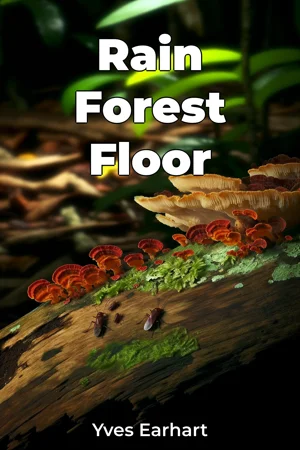
About This Book
Beneath the towering canopy of tropical rainforests lies a hidden world where life and death intertwine in a silent, ceaseless dance. *Rain Forest Floor: The Unseen Engine of Tropical Ecosystems* delves into the intricate networks of decomposition that sustain these biodiverse habitats, revealing how processes occurring in the soil shape the health of entire forests—and by extension, the planet. Combining rigorous scientific analysis with accessible prose, this book illuminates the critical role of decomposers, from fungi and bacteria to insects, in recycling nutrients, regulating carbon cycles, and maintaining ecological balance. The book opens by grounding readers in the fundamental principles of decomposition ecology. It explains how fallen leaves, decaying wood, and organic detritus are broken down into nutrients that fuel new growth, forming the foundation of tropical forest productivity. This process is not merely a biological curiosity but a linchpin of global carbon sequestration, with implications for climate change mitigation. The text emphasizes that understanding these networks is urgent: human activities such as deforestation, agriculture, and pollution disrupt these systems, risking cascading consequences for biodiversity and atmospheric carbon levels. Central to the book’s thesis is the argument that decomposition networks are as vital to rainforest resilience as the more visible flora and fauna. By examining case studies from the Amazon, Congo Basin, and Southeast Asia, the author demonstrates how microbial communities and detritivores adapt to environmental stressors, such as drought or invasive species. These insights challenge the notion of forests as static entities, instead portraying them as dynamic systems where soil organisms actively mediate ecosystem responses to change. Structured into three sections, the book first introduces the biological actors and chemical processes driving decomposition. Detailed chapters explore the symbiotic relationships between fungi and tree roots, the enzymatic breakdown of cellulose by bacteria, and the role of termites as ecosystem engineers. The second section investigates human impacts, including logging, agrochemical runoff, and climate shifts, using longitudinal data to show declines in decomposition efficiency linked to habitat fragmentation. The final section addresses conservation strategies, advocating for policies that prioritize soil health alongside canopy preservation and wildlife protection. Evidence is drawn from recent metagenomic studies, isotopic tracing experiments, and field observations across undisturbed and degraded forests. The author highlights innovative methodologies, such as DNA barcoding to map microbial diversity and sensor networks monitoring real-time soil respiration rates. These tools reveal previously unseen connections between micro-scale processes and macro-scale ecological outcomes. Interdisciplinary connections bridge microbiology, climate science, and environmental policy. For instance, the book links soil carbon dynamics to atmospheric modeling, illustrating how disrupted decomposition can amplify greenhouse gas emissions. It also examines how traditional agricultural practices in indigenous communities harness decomposition principles, offering sustainable alternatives to slash-and-burn techniques. A unique contribution lies in its focus on the forest floor as a cohesive system rather than a backdrop. By centering decomposers as active agents, the book reframes conservation discourse to include subterranean biodiversity. This perspective is underscored by discussions of “bioeconomy” initiatives that value soil ecosystems as natural capital. Written in a clear, narrative-driven style, the book balances technical detail with broader storytelling, making it accessible to both scientific audiences and general readers. It appeals to biologists seeking a synthesis of decomposition ecology, policymakers grappling with land-use decisions, and environmentally engaged citizens interested in ecosystem stewardship. While the scope prioritizes tropical forests, the principles discussed have temperate and boreal forest applications. The author acknowledges limitations, such as gaps in data from understudied regions like New Guinea, but stresses the universal relevance of decomposition processes. Practical applications include guidelines for reducing soil compaction in logging operations, integrating organic waste into reforestation projects, and promoting mycorrhizal fungi in agroforestry. The book also engages with debates over “assisted decomposition” technologies, weighing their potential against ethical concerns about manipulating natural systems. By framing the rainforest floor as a living, breathing entity, *Rain Forest Floor* challenges readers to reconsider what constitutes conservation success—arguing that the health of our planet’s lungs depends as much on the unseen world below as the verdant canopy above.
Beneath the towering canopy of tropical rainforests lies a hidden world where life and death intertwine in a silent, ceaseless dance. *Rain Forest Floor: The Unseen Engine of Tropical Ecosystems* delves into the intricate networks of decomposition that sustain these biodiverse habitats, revealing how processes occurring in the soil shape the health of entire forests—and by extension, the planet. Combining rigorous scientific analysis with accessible prose, this book illuminates the critical role of decomposers, from fungi and bacteria to insects, in recycling nutrients, regulating carbon cycles, and maintaining ecological balance. The book opens by grounding readers in the fundamental principles of decomposition ecology. It explains how fallen leaves, decaying wood, and organic detritus are broken down into nutrients that fuel new growth, forming the foundation of tropical forest productivity. This process is not merely a biological curiosity but a linchpin of global carbon sequestration, with implications for climate change mitigation. The text emphasizes that understanding these networks is urgent: human activities such as deforestation, agriculture, and pollution disrupt these systems, risking cascading consequences for biodiversity and atmospheric carbon levels. Central to the book’s thesis is the argument that decomposition networks are as vital to rainforest resilience as the more visible flora and fauna. By examining case studies from the Amazon, Congo Basin, and Southeast Asia, the author demonstrates how microbial communities and detritivores adapt to environmental stressors, such as drought or invasive species. These insights challenge the notion of forests as static entities, instead portraying them as dynamic systems where soil organisms actively mediate ecosystem responses to change. Structured into three sections, the book first introduces the biological actors and chemical processes driving decomposition. Detailed chapters explore the symbiotic relationships between fungi and tree roots, the enzymatic breakdown of cellulose by bacteria, and the role of termites as ecosystem engineers. The second section investigates human impacts, including logging, agrochemical runoff, and climate shifts, using longitudinal data to show declines in decomposition efficiency linked to habitat fragmentation. The final section addresses conservation strategies, advocating for policies that prioritize soil health alongside canopy preservation and wildlife protection. Evidence is drawn from recent metagenomic studies, isotopic tracing experiments, and field observations across undisturbed and degraded forests. The author highlights innovative methodologies, such as DNA barcoding to map microbial diversity and sensor networks monitoring real-time soil respiration rates. These tools reveal previously unseen connections between micro-scale processes and macro-scale ecological outcomes. Interdisciplinary connections bridge microbiology, climate science, and environmental policy. For instance, the book links soil carbon dynamics to atmospheric modeling, illustrating how disrupted decomposition can amplify greenhouse gas emissions. It also examines how traditional agricultural practices in indigenous communities harness decomposition principles, offering sustainable alternatives to slash-and-burn techniques. A unique contribution lies in its focus on the forest floor as a cohesive system rather than a backdrop. By centering decomposers as active agents, the book reframes conservation discourse to include subterranean biodiversity. This perspective is underscored by discussions of “bioeconomy” initiatives that value soil ecosystems as natural capital. Written in a clear, narrative-driven style, the book balances technical detail with broader storytelling, making it accessible to both scientific audiences and general readers. It appeals to biologists seeking a synthesis of decomposition ecology, policymakers grappling with land-use decisions, and environmentally engaged citizens interested in ecosystem stewardship. While the scope prioritizes tropical forests, the principles discussed have temperate and boreal forest applications. The author acknowledges limitations, such as gaps in data from understudied regions like New Guinea, but stresses the universal relevance of decomposition processes. Practical applications include guidelines for reducing soil compaction in logging operations, integrating organic waste into reforestation projects, and promoting mycorrhizal fungi in agroforestry. The book also engages with debates over “assisted decomposition” technologies, weighing their potential against ethical concerns about manipulating natural systems. By framing the rainforest floor as a living, breathing entity, *Rain Forest Floor* challenges readers to reconsider what constitutes conservation success—arguing that the health of our planet’s lungs depends as much on the unseen world below as the verdant canopy above.
"Rain Forest Floor: The Unseen Engine of Tropical Ecosystems" unveils the hidden world beneath rainforest canopies, where decomposers like fungi, bacteria, and insects drive processes essential to planetary health. The book’s central theme explores how decomposition sustains tropical ecosystems, detailing how fallen leaves and decaying matter are transformed into nutrients that fuel forest growth and regulate Earth’s carbon cycle. It reveals startling insights: a single teaspoon of rainforest soil contains millions of microbes critical to soil health, and termites alone can recycle up to a third of dead wood in some regions, acting as “ecosystem engineers.” These processes, the author argues, are not just local curiosities but global safeguards—tropical forests store 25% of the world’s terrestrial carbon, with decomposition balancing carbon release and sequestration. The book uniquely frames the forest floor as a dynamic, interconnected system, challenging readers to view soil organisms as active players in conservation. Through case studies from the Amazon to Southeast Asia, it demonstrates how deforestation and agrochemicals disrupt microbial communities, reducing decomposition efficiency and amplifying climate change. Unlike traditional conservation narratives focused on visible species, this work highlights innovative tools like DNA barcoding to map microbial diversity, bridging microbiology and policy. Structured in three sections, it progresses from ecological fundamentals to human impacts and solutions. Accessible yet rigorous, it blends storytelling with science, advocating for soil-centric conservation strategies. By spotlighting the unseen engine beneath our feet, *Rain Forest Floor* redefines rainforest resilience, urging readers to protect these vital underground networks as fiercely as the iconic canopy above.
Book Details
ISBN
9788233954246
Publisher
Publifye AS
Your Licenses
You don't own any licenses for this book
Purchase a license below to unlock this book and download the EPUB.
Purchase License
Select a tier to unlock this book
Need bulk licensing?
Contact us for enterprise agreements.