
About This Book
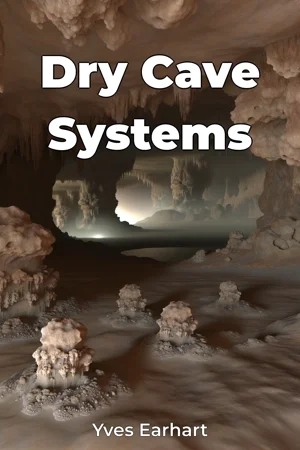
How do organisms not only survive but thrive in caves where water—the essence of life—is nearly absent? *Dry Cave Systems: Life and Geology in Moisture-Scarce Environments* investigates this paradox, unraveling the hidden mechanisms that sustain biodiversity and shape geological processes in Earth’s most arid subterranean realms. Bridging ecology, geology, and climatology, this book challenges assumptions about lifeless voids, revealing dry caves as dynamic ecosystems teeming with resilience and innovation. The book anchors its exploration in three pillars: the geological origins of water-limited caves, the evolutionary adaptations of their inhabitants, and the interconnectedness of these systems with surface environments. These topics reframe caves as critical laboratories for understanding ecological resilience, mineral formation in extreme conditions, and the long-term impacts of climate shifts on subsurface habitats. By dissecting how life and rock coexist in moisture-scarce settings, the text underscores the relevance of these ecosystems to broader environmental and evolutionary questions. Dry caves, found in arid regions like deserts or high-elevation karst landscapes, form over millennia through unique hydrological and chemical processes. Unlike their waterlogged counterparts, these caves lack perennial streams or pools, creating a niche where only the most specialized organisms persist. The book contextualizes their study within the history of speleology, tracing how technological advances—from isotopic analysis to genomic sequencing—have transformed our ability to decode these environments. Prior familiarity with basic ecological or geological concepts is unnecessary; the text carefully builds foundational knowledge through accessible explanations. Central to the book is the argument that dry caves are not static relics but active ecosystems shaped by reciprocal relationships between biotic and abiotic factors. This perspective challenges the notion of caves as isolated time capsules, positioning them instead as indicators of environmental change and hubs of evolutionary innovation. Their study, the book contends, offers insights into life’s capacity to adapt to scarcity—a theme increasingly urgent in an era of global desertification. Structured in three sections, the book first introduces the geological framework of dry caves, detailing how erosion, evaporation, and mineral deposition sculpt their structures. Case studies from sites like Nevada’s Lehman Caves and Iran’s Qeshm Island illustrate global diversity in formation processes. The second section shifts to biology, profiling species such as radiation-resistant bacteria, blind pseudoscorpions, and fungi that harvest humidity from air. These chapters synthesize field observations, laboratory experiments, and fossil records to trace adaptive pathways. The final section examines connections to external systems, demonstrating how cave microclimates reflect regional climate history and how subsurface microbes influence surface soil chemistry. Evidence is drawn from multidisciplinary research: microbial metabolomics, radiometric dating of speleothems, and climate models calibrated with cave data. Notably, the book highlights collaborations between microbiologists and geologists, revealing how microbial activity accelerates mineral weathering—a process once attributed solely to abiotic forces. Interdisciplinary linkages extend the book’s implications. In climate science, stalagmite layers serve as paleoclimate archives; in biotechnology, extremophile enzymes inspire industrial applications. Conservation biology benefits from case studies on protecting cave endemics threatened by human intrusion. These intersections position dry caves as microcosms for addressing planetary challenges. *Dry Cave Systems* distinguishes itself by merging ecological and geological narratives, avoiding siloed approaches common in speleological literature. It also prioritizes understudied arid caves, diverging from the historical focus on temperate or tropical systems. The prose balances scientific rigor with vivid storytelling, employing analogies (e.g., comparing mineral deposition to “reverse weathering”) to demystify complex processes. Written for earth science students, ecologists, and environmentally engaged readers, the book translates academic research into actionable knowledge. Conservationists gain strategies for mitigating tourism impacts, while educators access case studies on adaptation and symbiosis. Genre conventions of exploratory non-fiction are honored through firsthand accounts of cave expeditions and profiles of researchers working in remote field sites. While the scope is global, the book acknowledges limitations: polar caves and underwater systems are excluded to maintain focus. Controversies, such as debates over microbial roles in mineral deposition, are addressed candidly, emphasizing ongoing scientific inquiry. Practical applications are underscored throughout. Farmers in drought-prone regions, for instance, learn how cave-derived soil microbes enhance water retention. Policymakers encounter frameworks for balancing cave preservation with resource extraction. By framing dry caves as both mirrors of past climates and harbingers of ecological resilience, *Dry Cave Systems* invites readers to reconsider the hidden worlds beneath their feet—and their profound lessons for life on a changing planet.
How do organisms not only survive but thrive in caves where water—the essence of life—is nearly absent? *Dry Cave Systems: Life and Geology in Moisture-Scarce Environments* investigates this paradox, unraveling the hidden mechanisms that sustain biodiversity and shape geological processes in Earth’s most arid subterranean realms. Bridging ecology, geology, and climatology, this book challenges assumptions about lifeless voids, revealing dry caves as dynamic ecosystems teeming with resilience and innovation. The book anchors its exploration in three pillars: the geological origins of water-limited caves, the evolutionary adaptations of their inhabitants, and the interconnectedness of these systems with surface environments. These topics reframe caves as critical laboratories for understanding ecological resilience, mineral formation in extreme conditions, and the long-term impacts of climate shifts on subsurface habitats. By dissecting how life and rock coexist in moisture-scarce settings, the text underscores the relevance of these ecosystems to broader environmental and evolutionary questions. Dry caves, found in arid regions like deserts or high-elevation karst landscapes, form over millennia through unique hydrological and chemical processes. Unlike their waterlogged counterparts, these caves lack perennial streams or pools, creating a niche where only the most specialized organisms persist. The book contextualizes their study within the history of speleology, tracing how technological advances—from isotopic analysis to genomic sequencing—have transformed our ability to decode these environments. Prior familiarity with basic ecological or geological concepts is unnecessary; the text carefully builds foundational knowledge through accessible explanations. Central to the book is the argument that dry caves are not static relics but active ecosystems shaped by reciprocal relationships between biotic and abiotic factors. This perspective challenges the notion of caves as isolated time capsules, positioning them instead as indicators of environmental change and hubs of evolutionary innovation. Their study, the book contends, offers insights into life’s capacity to adapt to scarcity—a theme increasingly urgent in an era of global desertification. Structured in three sections, the book first introduces the geological framework of dry caves, detailing how erosion, evaporation, and mineral deposition sculpt their structures. Case studies from sites like Nevada’s Lehman Caves and Iran’s Qeshm Island illustrate global diversity in formation processes. The second section shifts to biology, profiling species such as radiation-resistant bacteria, blind pseudoscorpions, and fungi that harvest humidity from air. These chapters synthesize field observations, laboratory experiments, and fossil records to trace adaptive pathways. The final section examines connections to external systems, demonstrating how cave microclimates reflect regional climate history and how subsurface microbes influence surface soil chemistry. Evidence is drawn from multidisciplinary research: microbial metabolomics, radiometric dating of speleothems, and climate models calibrated with cave data. Notably, the book highlights collaborations between microbiologists and geologists, revealing how microbial activity accelerates mineral weathering—a process once attributed solely to abiotic forces. Interdisciplinary linkages extend the book’s implications. In climate science, stalagmite layers serve as paleoclimate archives; in biotechnology, extremophile enzymes inspire industrial applications. Conservation biology benefits from case studies on protecting cave endemics threatened by human intrusion. These intersections position dry caves as microcosms for addressing planetary challenges. *Dry Cave Systems* distinguishes itself by merging ecological and geological narratives, avoiding siloed approaches common in speleological literature. It also prioritizes understudied arid caves, diverging from the historical focus on temperate or tropical systems. The prose balances scientific rigor with vivid storytelling, employing analogies (e.g., comparing mineral deposition to “reverse weathering”) to demystify complex processes. Written for earth science students, ecologists, and environmentally engaged readers, the book translates academic research into actionable knowledge. Conservationists gain strategies for mitigating tourism impacts, while educators access case studies on adaptation and symbiosis. Genre conventions of exploratory non-fiction are honored through firsthand accounts of cave expeditions and profiles of researchers working in remote field sites. While the scope is global, the book acknowledges limitations: polar caves and underwater systems are excluded to maintain focus. Controversies, such as debates over microbial roles in mineral deposition, are addressed candidly, emphasizing ongoing scientific inquiry. Practical applications are underscored throughout. Farmers in drought-prone regions, for instance, learn how cave-derived soil microbes enhance water retention. Policymakers encounter frameworks for balancing cave preservation with resource extraction. By framing dry caves as both mirrors of past climates and harbingers of ecological resilience, *Dry Cave Systems* invites readers to reconsider the hidden worlds beneath their feet—and their profound lessons for life on a changing planet.
"Dry Cave Systems: Life and Geology in Moisture-Scarce Environments" explores the hidden worlds of Earth’s arid subterranean realms, challenging the myth of caves as lifeless voids. The book’s central theme reveals how life and geology intertwine in water-starved environments, showcasing dry caves as dynamic ecosystems where specialized organisms and mineral formations defy extreme conditions. By bridging ecology, geology, and climatology, it reframes these caves as vital laboratories for studying resilience, adaptation, and climate change impacts. The book uncovers astonishing adaptations, like bacteria surviving on trace humidity and blind pseudoscorpions navigating perpetual darkness. It details how microbial activity shapes cave geology—accelerating mineral weathering once thought purely abiotic—and how stalagmite layers preserve millennia of climate data. Unlike traditional speleology texts, this work emphasizes arid caves’ global diversity, from Nevada’s Lehman Caves to Iran’s Qeshm Island, while linking subsurface processes to surface ecosystems. Structured in three sections, it progresses from cave formation and extremophile biology to broader connections with climate and conservation. Unique for its interdisciplinary approach, the book merges vivid storytelling with scientific rigor, using analogies like “reverse weathering” to explain mineral deposition. It highlights practical applications, such as soil microbes aiding drought-resistant agriculture, and underscores conservation urgency for these fragile habitats. By framing dry caves as mirrors of past climates and hubs of innovation, it offers profound insights into life’s tenacity—a timely lesson for an era of environmental change.
Book Details
ISBN
9788233954208
Publisher
Publifye AS
Your Licenses
You don't own any licenses for this book
Purchase a license below to unlock this book and download the EPUB.
Purchase License
Select a tier to unlock this book
Need bulk licensing?
Contact us for enterprise agreements.