
About This Book
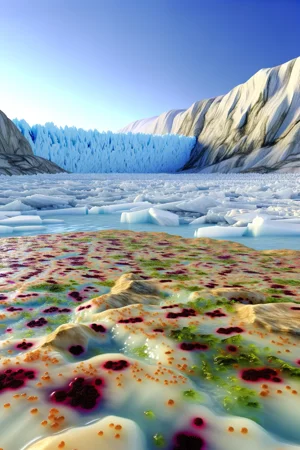
At the crumbling edges of glaciers, where ice meets rock and temperatures hover near lethal extremes, life persists in forms that defy conventional understanding. *Glacier Edge Life* explores this stark frontier, revealing how organisms thrive in one of Earth’s most inhospitable habitats and what their survival means for science, ecology, and a rapidly warming planet. The book anchors its investigation in three core themes: the biochemical adaptations of extremophiles, the fragile interdependence of glacial ecosystems, and the cascading effects of climate-driven ice loss. These topics are critical not only for understanding biodiversity in overlooked regions but also for grasping how micro-scale survival strategies may inform macro-scale environmental challenges. **Context and Background** Glacial margins—dynamic zones where ice sheets retreat and advance—have long been dismissed as biological deserts. However, advances in genomic sequencing and microclimate monitoring have unveiled microbial mats, ice-dwelling algae, and even invertebrates that endure subzero temperatures, nutrient scarcity, and intense UV radiation. The book contextualizes these discoveries within the history of polar and alpine exploration, tracing how early 20th-century expeditions laid the groundwork for modern glaciology and microbial ecology. Readers need no specialized prior knowledge; concepts like cryoconite holes (microbial melt pockets on ice) and psychrophilic (cold-loving) enzymes are clearly defined. **Central Thesis** *Glacier Edge Life* argues that glacial ecosystems are not barren outliers but vital components of Earth’s biosphere. Their study challenges assumptions about the limits of life, offering insights into evolutionary innovation and ecosystem resilience. This perspective gains urgency as rising temperatures accelerate ice melt, threatening to erase these communities before their full ecological significance is understood. **Content Overview** The book opens with a survey of extremophiles, detailing how species like *Ancylonema nordenskiöldii* (a glacier-surface algae) use pigments to absorb heat and shield against radiation. Subsequent chapters analyze symbiotic relationships, such as ice worms reliant on snow algae for nutrition, and probe how microorganisms engineer their environment by darkening ice surfaces, hastening melt. The final sections address the paradox of glacial ecosystems: their resilience to extreme conditions contrasts with vulnerability to climate change, as habitat loss disrupts species interactions and alters nutrient flows into downstream environments. **Evidence and Research** Findings draw from field studies in Greenland, Antarctica, and alpine glaciers, combining microbial genomics, isotopic tracing, and climate modeling. Unique methodologies include laser ablation tomography to map microbial colonies within ice cores and satellite imagery tracking algal blooms across ice sheets over decades. The book also integrates Indigenous knowledge from Arctic communities, documenting observed shifts in ice-dwelling species. **Interdisciplinary Connections** By linking glaciology with astrobiology, the book examines how extremophile survival strategies might inform the search for life on icy moons like Europa. It further intersects with biogeochemistry, illustrating how glacial microbes influence carbon cycling, and with conservation biology, advocating for ice-edge habitats in climate policy. **Unique Approach** Unlike prior works focused solely on climate impacts or extremophile biology, *Glacier Edge Life* bridges these narratives. It frames glaciers as living systems, emphasizing their role in global ecological networks rather than as static indicators of warming. Case studies contrast Arctic and alpine environments, highlighting adaptations specific to each while underscoring universal principles of survival. **Tone and Audience** Written in accessible, narrative-driven prose, the book balances scientific rigor with vivid descriptions of fieldwork. It targets environmentally engaged readers, biology students, and researchers seeking a synthesis of glaciology and ecology. Policy advocates will find actionable data on conserving microbial biodiversity, while educators gain case studies for discussing adaptation and interdependence. **Scope and Limitations** Focusing narrowly on ice-edge zones, the book intentionally excludes polar oceans and permafrost ecosystems. It prioritizes microbial and invertebrate life, with limited discussion of vertebrates like snow birds. **Real-World Applications** Insights into cold-adapted enzymes have already spurred innovations in biotechnology, such as low-temperature detergents. The text urges incorporating microbial processes into climate models to improve predictions of sea-level rise and carbon feedback loops. **Controversies** The book engages debates over “bioalbebo” effects—whether managing glacial algae could slow ice melt—and ethical concerns about manipulating extremophiles for commercial use. It critiques conservation frameworks that prioritize charismatic megafauna over microbial communities. *Glacier Edge Life* redefines glaciers as teeming, evolving ecosystems, urging a paradigm shift in how we value and preserve Earth’s frozen frontiers.
At the crumbling edges of glaciers, where ice meets rock and temperatures hover near lethal extremes, life persists in forms that defy conventional understanding. *Glacier Edge Life* explores this stark frontier, revealing how organisms thrive in one of Earth’s most inhospitable habitats and what their survival means for science, ecology, and a rapidly warming planet. The book anchors its investigation in three core themes: the biochemical adaptations of extremophiles, the fragile interdependence of glacial ecosystems, and the cascading effects of climate-driven ice loss. These topics are critical not only for understanding biodiversity in overlooked regions but also for grasping how micro-scale survival strategies may inform macro-scale environmental challenges. **Context and Background** Glacial margins—dynamic zones where ice sheets retreat and advance—have long been dismissed as biological deserts. However, advances in genomic sequencing and microclimate monitoring have unveiled microbial mats, ice-dwelling algae, and even invertebrates that endure subzero temperatures, nutrient scarcity, and intense UV radiation. The book contextualizes these discoveries within the history of polar and alpine exploration, tracing how early 20th-century expeditions laid the groundwork for modern glaciology and microbial ecology. Readers need no specialized prior knowledge; concepts like cryoconite holes (microbial melt pockets on ice) and psychrophilic (cold-loving) enzymes are clearly defined. **Central Thesis** *Glacier Edge Life* argues that glacial ecosystems are not barren outliers but vital components of Earth’s biosphere. Their study challenges assumptions about the limits of life, offering insights into evolutionary innovation and ecosystem resilience. This perspective gains urgency as rising temperatures accelerate ice melt, threatening to erase these communities before their full ecological significance is understood. **Content Overview** The book opens with a survey of extremophiles, detailing how species like *Ancylonema nordenskiöldii* (a glacier-surface algae) use pigments to absorb heat and shield against radiation. Subsequent chapters analyze symbiotic relationships, such as ice worms reliant on snow algae for nutrition, and probe how microorganisms engineer their environment by darkening ice surfaces, hastening melt. The final sections address the paradox of glacial ecosystems: their resilience to extreme conditions contrasts with vulnerability to climate change, as habitat loss disrupts species interactions and alters nutrient flows into downstream environments. **Evidence and Research** Findings draw from field studies in Greenland, Antarctica, and alpine glaciers, combining microbial genomics, isotopic tracing, and climate modeling. Unique methodologies include laser ablation tomography to map microbial colonies within ice cores and satellite imagery tracking algal blooms across ice sheets over decades. The book also integrates Indigenous knowledge from Arctic communities, documenting observed shifts in ice-dwelling species. **Interdisciplinary Connections** By linking glaciology with astrobiology, the book examines how extremophile survival strategies might inform the search for life on icy moons like Europa. It further intersects with biogeochemistry, illustrating how glacial microbes influence carbon cycling, and with conservation biology, advocating for ice-edge habitats in climate policy. **Unique Approach** Unlike prior works focused solely on climate impacts or extremophile biology, *Glacier Edge Life* bridges these narratives. It frames glaciers as living systems, emphasizing their role in global ecological networks rather than as static indicators of warming. Case studies contrast Arctic and alpine environments, highlighting adaptations specific to each while underscoring universal principles of survival. **Tone and Audience** Written in accessible, narrative-driven prose, the book balances scientific rigor with vivid descriptions of fieldwork. It targets environmentally engaged readers, biology students, and researchers seeking a synthesis of glaciology and ecology. Policy advocates will find actionable data on conserving microbial biodiversity, while educators gain case studies for discussing adaptation and interdependence. **Scope and Limitations** Focusing narrowly on ice-edge zones, the book intentionally excludes polar oceans and permafrost ecosystems. It prioritizes microbial and invertebrate life, with limited discussion of vertebrates like snow birds. **Real-World Applications** Insights into cold-adapted enzymes have already spurred innovations in biotechnology, such as low-temperature detergents. The text urges incorporating microbial processes into climate models to improve predictions of sea-level rise and carbon feedback loops. **Controversies** The book engages debates over “bioalbebo” effects—whether managing glacial algae could slow ice melt—and ethical concerns about manipulating extremophiles for commercial use. It critiques conservation frameworks that prioritize charismatic megafauna over microbial communities. *Glacier Edge Life* redefines glaciers as teeming, evolving ecosystems, urging a paradigm shift in how we value and preserve Earth’s frozen frontiers.
"Glacier Edge Life" unveils the hidden world of organisms thriving where ice meets rock, transforming our understanding of glaciers from barren wastelands to vibrant ecosystems. The book’s central theme explores how extremophiles—microbes, algae, and invertebrates—survive extreme cold, UV radiation, and nutrient scarcity through remarkable biochemical adaptations. For instance, glacier algae like *Ancylonema nordenskiöldii* use dark pigments to melt ice for liquid water, while ice worms depend on symbiotic relationships with snow algae for survival. These discoveries challenge assumptions about life’s limits and highlight glaciers as critical players in global biodiversity and climate regulation. The book merges cutting-edge field research with Indigenous knowledge, examining glacial ecosystems from Greenland to alpine regions. It reveals how microbial activity in cryoconite holes (meltwater pockets) accelerates ice loss—a double-edged sword where survival strategies worsen habitat destruction. By linking glaciology to astrobiology, the text ponders how extremophiles might inform the search for life on icy moons. Chapters progress from micro-scale adaptations to macro-scale climate impacts, emphasizing the paradox of resilience and fragility: these organisms withstand extreme conditions but face extinction as glaciers vanish. Unique in its interdisciplinary approach, *Glacier Edge Life* bridges biology, climate science, and ethics. It advocates for conserving microbial biodiversity while critiquing policies that overlook “invisible” life. Accessible yet rigorous, the book combines vivid fieldwork narratives with urgent calls to rethink humanity’s relationship with Earth’s frozen frontiers before they disappear.
Book Details
ISBN
9788233954192
Publisher
Publifye AS
Your Licenses
You don't own any licenses for this book
Purchase a license below to unlock this book and download the EPUB.
Purchase License
Select a tier to unlock this book
Need bulk licensing?
Contact us for enterprise agreements.