
About This Book
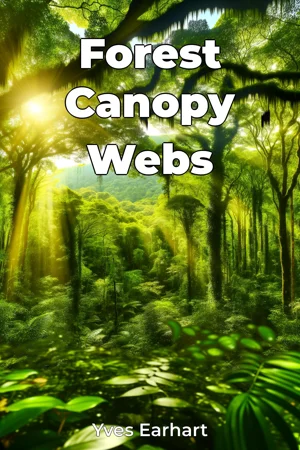
High above the forest floor, where sunlight filters through a labyrinth of leaves, lies a world as complex and interconnected as our own cities—yet one that remains largely unseen. *Forest Canopy Webs* ventures into this enigmatic realm, examining the intricate relationships between species that shape the health and survival of Earth’s most biodiverse ecosystems. Bridging ecology, conservation biology, and environmental science, this book uncovers how interactions in the uppermost forest layers influence everything from carbon cycles to species evolution. The book opens by dismantling the myth of the canopy as a passive “roof” over forests. Instead, it frames this layer as a dynamic network of life, where plants, animals, fungi, and microbes engage in constant competition, cooperation, and coexistence. Central themes include the role of keystone species (such as canopy-dwelling primates and epiphytic plants) in maintaining ecological balance, the flow of nutrients through “canopy webs,” and the vulnerability of these systems to climate change and deforestation. These topics are critical for understanding how forests function as carbon sinks, biodiversity reservoirs, and buffers against environmental degradation—a pressing concern as global forest cover declines. To contextualize its findings, the book traces the history of canopy research, from early 19th-century naturalists who risked perilous climbs to modern scientists using drones, canopy cranes, and DNA metabarcoding. It assumes no prior expertise, introducing foundational concepts like trophic cascades, mutualism, and niche partitioning with clarity. The core thesis argues that canopy interactions are not peripheral to forest ecosystems but central to their resilience: disturbances in the canopy reverberate through entire landscapes, affecting soil health, water cycles, and even human livelihoods. Structured in three parts, the book first maps the canopy’s biological architecture, detailing how stratified microhabitats host specialized species. The second section explores case studies: the symbiotic relationship between fig trees and wasps, the role of arboreal ants in pest control, and the cascading effects of canopy bird declines on seed dispersal. The final chapters address anthropogenic threats, emphasizing how fragmentation and rising temperatures destabilize canopy webs. Practical solutions, such as targeted reforestation and canopy corridor preservation, are presented alongside critiques of current conservation policies. Evidence is drawn from peer-reviewed studies, long-term ecological monitoring data, and field experiments. For instance, isotopic analysis reveals how canopy-dwelling insects contribute to soil nitrogen levels, while camera traps document predator-prey interactions unreachable from the ground. The book also highlights Indigenous knowledge systems, showcasing how traditional practices like agroforestry sustain canopy biodiversity. Interdisciplinary links to climatology, biotechnology, and economics reinforce the canopy’s broader relevance. For example, canopy microbes inspire pharmaceutical breakthroughs, while canopy-atmosphere interactions inform climate models. The book’s unique perspective lies in its “web” metaphor—treating the canopy not as a tiered structure but as a multidimensional network where species and processes intersect unpredictably. Written in a precise yet engaging style, *Forest Canopy Webs* balances scientific rigor with vivid storytelling, avoiding jargon without oversimplification. It targets ecologists, environmental policymakers, and nature enthusiasts seeking a deeper grasp of forest dynamics. By adhering to conventions of scientific non-fiction—empirical evidence, clear citations, and hypothesis-driven analysis—it remains accessible to educated general readers. While focused on tropical and temperate forests, the book acknowledges gaps in data from understudied regions like boreal canopies. It also addresses debates, such as whether protecting flagship canopy species (e.g., orangutans) sufficiently safeguards entire ecosystems. Ultimately, the work urges readers to view forests vertically, not just horizontally, recognizing that conserving the canopy is not a niche concern but a global imperative. Applications range from improving urban green infrastructure to refining carbon credit systems. By illuminating the hidden threads that bind life in the treetops, *Forest Canopy Webs* offers a roadmap for sustaining these vital networks—and through them, the planet itself.
High above the forest floor, where sunlight filters through a labyrinth of leaves, lies a world as complex and interconnected as our own cities—yet one that remains largely unseen. *Forest Canopy Webs* ventures into this enigmatic realm, examining the intricate relationships between species that shape the health and survival of Earth’s most biodiverse ecosystems. Bridging ecology, conservation biology, and environmental science, this book uncovers how interactions in the uppermost forest layers influence everything from carbon cycles to species evolution. The book opens by dismantling the myth of the canopy as a passive “roof” over forests. Instead, it frames this layer as a dynamic network of life, where plants, animals, fungi, and microbes engage in constant competition, cooperation, and coexistence. Central themes include the role of keystone species (such as canopy-dwelling primates and epiphytic plants) in maintaining ecological balance, the flow of nutrients through “canopy webs,” and the vulnerability of these systems to climate change and deforestation. These topics are critical for understanding how forests function as carbon sinks, biodiversity reservoirs, and buffers against environmental degradation—a pressing concern as global forest cover declines. To contextualize its findings, the book traces the history of canopy research, from early 19th-century naturalists who risked perilous climbs to modern scientists using drones, canopy cranes, and DNA metabarcoding. It assumes no prior expertise, introducing foundational concepts like trophic cascades, mutualism, and niche partitioning with clarity. The core thesis argues that canopy interactions are not peripheral to forest ecosystems but central to their resilience: disturbances in the canopy reverberate through entire landscapes, affecting soil health, water cycles, and even human livelihoods. Structured in three parts, the book first maps the canopy’s biological architecture, detailing how stratified microhabitats host specialized species. The second section explores case studies: the symbiotic relationship between fig trees and wasps, the role of arboreal ants in pest control, and the cascading effects of canopy bird declines on seed dispersal. The final chapters address anthropogenic threats, emphasizing how fragmentation and rising temperatures destabilize canopy webs. Practical solutions, such as targeted reforestation and canopy corridor preservation, are presented alongside critiques of current conservation policies. Evidence is drawn from peer-reviewed studies, long-term ecological monitoring data, and field experiments. For instance, isotopic analysis reveals how canopy-dwelling insects contribute to soil nitrogen levels, while camera traps document predator-prey interactions unreachable from the ground. The book also highlights Indigenous knowledge systems, showcasing how traditional practices like agroforestry sustain canopy biodiversity. Interdisciplinary links to climatology, biotechnology, and economics reinforce the canopy’s broader relevance. For example, canopy microbes inspire pharmaceutical breakthroughs, while canopy-atmosphere interactions inform climate models. The book’s unique perspective lies in its “web” metaphor—treating the canopy not as a tiered structure but as a multidimensional network where species and processes intersect unpredictably. Written in a precise yet engaging style, *Forest Canopy Webs* balances scientific rigor with vivid storytelling, avoiding jargon without oversimplification. It targets ecologists, environmental policymakers, and nature enthusiasts seeking a deeper grasp of forest dynamics. By adhering to conventions of scientific non-fiction—empirical evidence, clear citations, and hypothesis-driven analysis—it remains accessible to educated general readers. While focused on tropical and temperate forests, the book acknowledges gaps in data from understudied regions like boreal canopies. It also addresses debates, such as whether protecting flagship canopy species (e.g., orangutans) sufficiently safeguards entire ecosystems. Ultimately, the work urges readers to view forests vertically, not just horizontally, recognizing that conserving the canopy is not a niche concern but a global imperative. Applications range from improving urban green infrastructure to refining carbon credit systems. By illuminating the hidden threads that bind life in the treetops, *Forest Canopy Webs* offers a roadmap for sustaining these vital networks—and through them, the planet itself.
"Forest Canopy Webs" unveils the hidden world of forest treetops, revealing their critical role in sustaining biodiversity, regulating climate, and shaping life on Earth. The book’s central theme challenges the notion of canopies as passive coverings, reframing them as vibrant, interconnected networks where species interactions drive ecological resilience. From keystone primates dispersing seeds to epiphytic plants filtering rainwater, the canopy emerges as a dynamic hub where competition, mutualism, and nutrient cycles intersect. These processes underpin forests’ capacity to store carbon, buffer climate change, and support countless species—functions increasingly threatened by deforestation and rising temperatures. Blending ecology and conservation science, the book traces canopy research from daring 19th-century climbs to modern drone-based studies. Case studies—like fig trees and wasps relying on one another for survival, or ants defending trees from pests—illustrate concepts like mutualism and trophic cascades. It emphasizes how canopy disruptions cascade downward, destabilizing soil health and water cycles. Unique in its "web" metaphor, the work highlights Indigenous agroforestry practices and interdisciplinary solutions, such as canopy corridors linking fragmented habitats. Structured to guide readers from foundational biology to urgent conservation strategies, *Forest Canopy Webs* combines rigorous science with vivid storytelling. By framing treetops as a global imperative rather than a niche interest, it equips policymakers, ecologists, and nature enthusiasts to rethink forest conservation—vertically.
Book Details
ISBN
9788233954161
Publisher
Publifye AS
Your Licenses
You don't own any licenses for this book
Purchase a license below to unlock this book and download the EPUB.
Purchase License
Select a tier to unlock this book
Need bulk licensing?
Contact us for enterprise agreements.