
About This Book
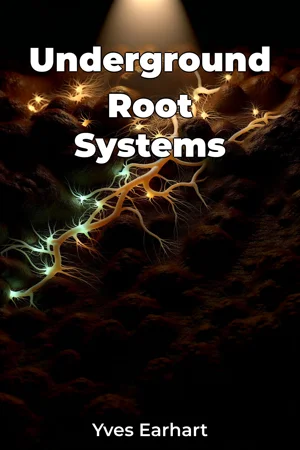
Beneath every forest, grassland, and garden lies a vast, dynamic world that sustains life aboveground yet remains largely unseen. *Underground Root Systems* delves into the intricate relationships between plant roots and mycorrhizal fungi, revealing how these subterranean networks shape ecosystems, influence biodiversity, and offer solutions to pressing environmental challenges. This book synthesizes decades of ecological research to present a groundbreaking perspective on the hidden foundations of terrestrial life. The book begins by dismantling the notion of plants as isolated organisms. Instead, it introduces readers to the concept of the “wood-wide web”—a complex symbiotic network where roots and fungi exchange nutrients, water, and chemical signals. Central topics include the biology of mycorrhizal associations, the role of root exudates in soil communication, and the ecological implications of these networks for forest resilience and carbon sequestration. These themes are critical for understanding how ecosystems adapt to stressors like climate change, deforestation, and soil degradation. Historically, botany emphasized visible plant structures, relegating roots to a secondary focus. However, advances in imaging technology and molecular biology have revolutionized the study of subterranean systems. The book contextualizes this shift, tracing milestones from early 20th-century discoveries of mycorrhizae to contemporary research using isotopic tracing and genomic analysis. It assumes no prior expertise, offering clear explanations of terms like *hyphae* (fungal threads) and *rhizosphere* (the soil layer influenced by roots). At its core, *Underground Root Systems* argues that plant-fungal networks are not merely biological curiosities but foundational to ecosystem stability. Their ability to redistribute resources, transmit warnings about pests, and support seedling growth underscores their role as ecological mediators. This thesis challenges reductionist views of nature, positing that cooperation, as much as competition, drives ecological success. Structured across three sections, the book first outlines the mechanisms of root-fungal interactions, detailing how plants allocate up to 30% of their photosynthates to nourish fungal partners. Subsequent chapters explore the ecological consequences: mycorrhizal networks enhance drought tolerance in forests, enable nutrient-sharing between species, and store vast amounts of carbon—up to 70% of terrestrial carbon passes through soil systems. The final section addresses applications, discussing how agroforestry and mycorrhizal inoculants could revolutionize sustainable agriculture and reforestation efforts. Evidence is drawn from peer-reviewed studies, field experiments, and case studies. For instance, the book cites research demonstrating how Douglas fir trees transfer carbon to seedlings via shared fungi, and how deforestation disrupts these networks, exacerbating soil erosion. Unique methodologies, such as microcosm experiments simulating drought conditions, reveal how networks allocate resources to stressed plants. Interdisciplinary insights bridge ecology, agriculture, and climate science. The book links mycorrhizal research to carbon farming strategies, which aim to combat global warming by enhancing soil organic matter. It also examines parallels between plant networks and human systems, such as decentralized communication models in technology. A standout feature is its integration of microscopic processes with landscape-scale impacts. While many texts isolate root biology or fungal ecology, this book emphasizes their synergy, using accessible analogies—like comparing hyphal networks to neural circuits—to demystify complex interactions. Written in a crisp, engaging style, the book balances scientific rigor with narrative clarity. It avoids jargon, making it suitable for readers ranging from biology students to environmentally conscious policymakers. Charts and diagrams supplement the text, visualizing concepts like nutrient exchange pathways. *Underground Root Systems* does not shy from debates. It addresses controversies, such as whether plant signaling qualifies as a form of “intelligence” or if anthropomorphic terms like “mother trees” risk oversimplification. These discussions invite readers to grapple with the ethics and semantics of ecological research. Practical applications form a key thread. Farmers can adopt no-till practices to protect mycorrhizal networks, while urban planners might integrate fungal-friendly green spaces. The book also highlights unresolved questions, such as how invasive species disrupt these networks, inviting future research. By illuminating the hidden connections beneath our feet, *Underground Root Systems* redefines our understanding of nature’s interconnectedness—and our role in preserving it.
Beneath every forest, grassland, and garden lies a vast, dynamic world that sustains life aboveground yet remains largely unseen. *Underground Root Systems* delves into the intricate relationships between plant roots and mycorrhizal fungi, revealing how these subterranean networks shape ecosystems, influence biodiversity, and offer solutions to pressing environmental challenges. This book synthesizes decades of ecological research to present a groundbreaking perspective on the hidden foundations of terrestrial life. The book begins by dismantling the notion of plants as isolated organisms. Instead, it introduces readers to the concept of the “wood-wide web”—a complex symbiotic network where roots and fungi exchange nutrients, water, and chemical signals. Central topics include the biology of mycorrhizal associations, the role of root exudates in soil communication, and the ecological implications of these networks for forest resilience and carbon sequestration. These themes are critical for understanding how ecosystems adapt to stressors like climate change, deforestation, and soil degradation. Historically, botany emphasized visible plant structures, relegating roots to a secondary focus. However, advances in imaging technology and molecular biology have revolutionized the study of subterranean systems. The book contextualizes this shift, tracing milestones from early 20th-century discoveries of mycorrhizae to contemporary research using isotopic tracing and genomic analysis. It assumes no prior expertise, offering clear explanations of terms like *hyphae* (fungal threads) and *rhizosphere* (the soil layer influenced by roots). At its core, *Underground Root Systems* argues that plant-fungal networks are not merely biological curiosities but foundational to ecosystem stability. Their ability to redistribute resources, transmit warnings about pests, and support seedling growth underscores their role as ecological mediators. This thesis challenges reductionist views of nature, positing that cooperation, as much as competition, drives ecological success. Structured across three sections, the book first outlines the mechanisms of root-fungal interactions, detailing how plants allocate up to 30% of their photosynthates to nourish fungal partners. Subsequent chapters explore the ecological consequences: mycorrhizal networks enhance drought tolerance in forests, enable nutrient-sharing between species, and store vast amounts of carbon—up to 70% of terrestrial carbon passes through soil systems. The final section addresses applications, discussing how agroforestry and mycorrhizal inoculants could revolutionize sustainable agriculture and reforestation efforts. Evidence is drawn from peer-reviewed studies, field experiments, and case studies. For instance, the book cites research demonstrating how Douglas fir trees transfer carbon to seedlings via shared fungi, and how deforestation disrupts these networks, exacerbating soil erosion. Unique methodologies, such as microcosm experiments simulating drought conditions, reveal how networks allocate resources to stressed plants. Interdisciplinary insights bridge ecology, agriculture, and climate science. The book links mycorrhizal research to carbon farming strategies, which aim to combat global warming by enhancing soil organic matter. It also examines parallels between plant networks and human systems, such as decentralized communication models in technology. A standout feature is its integration of microscopic processes with landscape-scale impacts. While many texts isolate root biology or fungal ecology, this book emphasizes their synergy, using accessible analogies—like comparing hyphal networks to neural circuits—to demystify complex interactions. Written in a crisp, engaging style, the book balances scientific rigor with narrative clarity. It avoids jargon, making it suitable for readers ranging from biology students to environmentally conscious policymakers. Charts and diagrams supplement the text, visualizing concepts like nutrient exchange pathways. *Underground Root Systems* does not shy from debates. It addresses controversies, such as whether plant signaling qualifies as a form of “intelligence” or if anthropomorphic terms like “mother trees” risk oversimplification. These discussions invite readers to grapple with the ethics and semantics of ecological research. Practical applications form a key thread. Farmers can adopt no-till practices to protect mycorrhizal networks, while urban planners might integrate fungal-friendly green spaces. The book also highlights unresolved questions, such as how invasive species disrupt these networks, inviting future research. By illuminating the hidden connections beneath our feet, *Underground Root Systems* redefines our understanding of nature’s interconnectedness—and our role in preserving it.
*Underground Root Systems* uncovers the hidden world beneath our feet, where plant roots and mycorrhizal fungi form intricate partnerships that sustain ecosystems. The book’s central theme—the “wood-wide web”—reveals how these subterranean networks exchange nutrients, transmit warnings, and even nurture seedlings, reshaping our understanding of forests and grasslands as collaborative communities rather than collections of isolated plants. By synthesizing decades of research, the author challenges traditional views of nature, emphasizing cooperation over competition as a driver of ecological resilience. The book blends vivid scientific insights with real-world relevance. For instance, plants devote up to 30% of their energy to feed fungal partners, while soil systems store staggering amounts of carbon—a key factor in combating climate change. Case studies, like Douglas firs sharing carbon with struggling seedlings through fungal networks, illustrate how these relationships buffer forests against droughts and deforestation. The text also explores practical applications, such as using mycorrhizal inoculants to revive degraded farmland or designing cities with fungal-friendly green spaces. Structured in three sections, it progresses from root-fungal mechanics to landscape-scale impacts, bridging ecology, agriculture, and climate science. What sets *Underground Root Systems* apart is its ability to translate complex interactions into accessible concepts, comparing hyphal networks to neural circuits or decentralized communication systems. It balances cutting-edge research with debates, like whether plants exhibit “intelligence,” while avoiding anthropomorphic pitfalls. Crisp explanations, diagrams, and real-world examples make it equally valuable for students, farmers, and policymakers. By revealing how life aboveground depends on these unseen partnerships, the book invites readers to rethink stewardship of the planet—starting with the soil beneath their feet.
Book Details
ISBN
9788233954109
Publisher
Publifye AS
Your Licenses
You don't own any licenses for this book
Purchase a license below to unlock this book and download the EPUB.
Purchase License
Select a tier to unlock this book
Need bulk licensing?
Contact us for enterprise agreements.