
About This Book
**Title:** *Salt Lake Ecosystems: Life in the World’s Hypersaline Frontiers* **Opening Hook:** What if the key to understanding life’s resilience lies not in lush rainforests or coral reefs, but in the stark, salt-crusted shores of hypersaline lakes? This book plunges into these overlooked ecosystems, where life thrives under conditions lethal to most species, challenging our assumptions about adaptability and survival. **Main Topics & Significance:** 1. **Microbial Diversity in Extreme Conditions**: The book explores specialized bacteria, archaea, and algae that dominate hypersaline lakes, detailing their survival strategies. 2. **Ecological and Evolutionary Adaptations**: It investigates how species evolve unique traits, such as salt-shedding cellular mechanisms, to persist in high-salinity waters. 3. **Ecosystem Services and Threats**: These environments act as carbon sinks and nutrient cyclers, yet face existential risks from climate change and industrial exploitation. These topics underscore the urgency of studying hypersaline lakes as models for ecological resilience and as indicators of environmental health. **Context & Background:** Hypersaline lakes—defined by salinity levels exceeding 50 grams per liter—occur on every continent, from the Dead Sea to Australia’s pink lakes. Once considered biological deserts, advances in genomics and microscopy have revealed their hidden biodiversity. The book assumes a basic familiarity with cellular biology and ecology but clarifies technical terms for broader accessibility. **Central Thesis:** Hypersaline ecosystems are not merely curiosities but critical laboratories for understanding life’s adaptability. Their study offers insights into evolutionary innovation, ecosystem stability, and responses to environmental stress—an urgent concern in an era of rapid global change. **Content Overview:** 1. **Introduction**: Defines hypersalinity, global distribution of salt lakes, and historical scientific misconceptions. 2. **Chapters 2–4**: - *Microbial Architects*: Profiles halophiles and their metabolic innovations. - *Evolution Under Pressure*: Analyzes genetic and physiological adaptations to salinity. - *Ecosystem Dynamics*: Examines food webs and abiotic interactions (e.g., salt gradients, temperature extremes). 3. **Culmination**: Synthesizes how these ecosystems model resilience, bridging microbial biology to planetary-scale processes. 4. **Applications**: Discusses bioremediation, enzyme harvesting for industry, and conservation strategies. **Evidence & Research:** The book draws on metagenomic studies of Chile’s Salar de Atacama, sediment cores from Iran’s shrinking Lake Urmia, and lab experiments replicating extreme conditions. Fieldwork from lesser-known systems, like Ethiopia’s Dallol hydrothermal pools, provides novel data on speciation. **Interdisciplinary Connections:** 1. **Astrobiology**: Analogues for extraterrestrial life on Mars or Europa. 2. **Biotechnology**: Industrial applications of salt-tolerant enzymes. 3. **Climate Science**: Salt lakes as sentinels of aridification and hydrological shifts. These links position the book at the intersection of pure research and applied innovation. **Unique Approach:** Unlike prior works focused on individual lakes, this text adopts a comparative framework, highlighting patterns across geographies and species. It integrates molecular biology with ecosystem ecology, emphasizing scale-dependent interactions. **Tone & Style:** Academic rigor is balanced with narrative storytelling, using case studies to illustrate concepts. Technical discussions are punctuated with diagrams and field photographs, maintaining accessibility without oversimplification. **Target Audience:** Students and researchers in extremophile biology, environmental policymakers, and science enthusiasts seeking a holistic view of ecosystem adaptability. Its applied focus appeals to professionals in conservation and biotechnology. **Genre-Specific Elements:** Aligns with science and environmental genres by prioritizing empirical evidence, citing peer-reviewed studies, and addressing contemporary issues like habitat loss. Complex processes are unpacked through real-world examples. **Scope & Limitations:** Focuses on microbial and small invertebrate life; larger vertebrates (e.g., flamingos) are mentioned briefly as part of food webs. Geographically, it emphasizes inland lakes over coastal salt pans. **Real-World Applications:** - Using salt-tolerant algae for biofuel production. - Leveraging microbial mats to detoxify brine wastewater from desalination plants. - Informing policies to balance mineral extraction with ecosystem preservation. **Controversies & Debates:** The book addresses tensions between commercial salt harvesting and habitat protection, alongside scientific disputes over whether extremophiles’ adaptations are evolutionary “leaps” or gradual processes. Ethical questions about patenting genetic material from these ecosystems are also explored. *Salt Lake Ecosystems* redefines hypersaline environments as vital, dynamic worlds, urging a reevaluation of their scientific and ecological value. By merging discovery with practicality, it invites readers to reconsider where life’s most profound lessons might be hidden.
**Title:** *Salt Lake Ecosystems: Life in the World’s Hypersaline Frontiers* **Opening Hook:** What if the key to understanding life’s resilience lies not in lush rainforests or coral reefs, but in the stark, salt-crusted shores of hypersaline lakes? This book plunges into these overlooked ecosystems, where life thrives under conditions lethal to most species, challenging our assumptions about adaptability and survival. **Main Topics & Significance:** 1. **Microbial Diversity in Extreme Conditions**: The book explores specialized bacteria, archaea, and algae that dominate hypersaline lakes, detailing their survival strategies. 2. **Ecological and Evolutionary Adaptations**: It investigates how species evolve unique traits, such as salt-shedding cellular mechanisms, to persist in high-salinity waters. 3. **Ecosystem Services and Threats**: These environments act as carbon sinks and nutrient cyclers, yet face existential risks from climate change and industrial exploitation. These topics underscore the urgency of studying hypersaline lakes as models for ecological resilience and as indicators of environmental health. **Context & Background:** Hypersaline lakes—defined by salinity levels exceeding 50 grams per liter—occur on every continent, from the Dead Sea to Australia’s pink lakes. Once considered biological deserts, advances in genomics and microscopy have revealed their hidden biodiversity. The book assumes a basic familiarity with cellular biology and ecology but clarifies technical terms for broader accessibility. **Central Thesis:** Hypersaline ecosystems are not merely curiosities but critical laboratories for understanding life’s adaptability. Their study offers insights into evolutionary innovation, ecosystem stability, and responses to environmental stress—an urgent concern in an era of rapid global change. **Content Overview:** 1. **Introduction**: Defines hypersalinity, global distribution of salt lakes, and historical scientific misconceptions. 2. **Chapters 2–4**: - *Microbial Architects*: Profiles halophiles and their metabolic innovations. - *Evolution Under Pressure*: Analyzes genetic and physiological adaptations to salinity. - *Ecosystem Dynamics*: Examines food webs and abiotic interactions (e.g., salt gradients, temperature extremes). 3. **Culmination**: Synthesizes how these ecosystems model resilience, bridging microbial biology to planetary-scale processes. 4. **Applications**: Discusses bioremediation, enzyme harvesting for industry, and conservation strategies. **Evidence & Research:** The book draws on metagenomic studies of Chile’s Salar de Atacama, sediment cores from Iran’s shrinking Lake Urmia, and lab experiments replicating extreme conditions. Fieldwork from lesser-known systems, like Ethiopia’s Dallol hydrothermal pools, provides novel data on speciation. **Interdisciplinary Connections:** 1. **Astrobiology**: Analogues for extraterrestrial life on Mars or Europa. 2. **Biotechnology**: Industrial applications of salt-tolerant enzymes. 3. **Climate Science**: Salt lakes as sentinels of aridification and hydrological shifts. These links position the book at the intersection of pure research and applied innovation. **Unique Approach:** Unlike prior works focused on individual lakes, this text adopts a comparative framework, highlighting patterns across geographies and species. It integrates molecular biology with ecosystem ecology, emphasizing scale-dependent interactions. **Tone & Style:** Academic rigor is balanced with narrative storytelling, using case studies to illustrate concepts. Technical discussions are punctuated with diagrams and field photographs, maintaining accessibility without oversimplification. **Target Audience:** Students and researchers in extremophile biology, environmental policymakers, and science enthusiasts seeking a holistic view of ecosystem adaptability. Its applied focus appeals to professionals in conservation and biotechnology. **Genre-Specific Elements:** Aligns with science and environmental genres by prioritizing empirical evidence, citing peer-reviewed studies, and addressing contemporary issues like habitat loss. Complex processes are unpacked through real-world examples. **Scope & Limitations:** Focuses on microbial and small invertebrate life; larger vertebrates (e.g., flamingos) are mentioned briefly as part of food webs. Geographically, it emphasizes inland lakes over coastal salt pans. **Real-World Applications:** - Using salt-tolerant algae for biofuel production. - Leveraging microbial mats to detoxify brine wastewater from desalination plants. - Informing policies to balance mineral extraction with ecosystem preservation. **Controversies & Debates:** The book addresses tensions between commercial salt harvesting and habitat protection, alongside scientific disputes over whether extremophiles’ adaptations are evolutionary “leaps” or gradual processes. Ethical questions about patenting genetic material from these ecosystems are also explored. *Salt Lake Ecosystems* redefines hypersaline environments as vital, dynamic worlds, urging a reevaluation of their scientific and ecological value. By merging discovery with practicality, it invites readers to reconsider where life’s most profound lessons might be hidden.
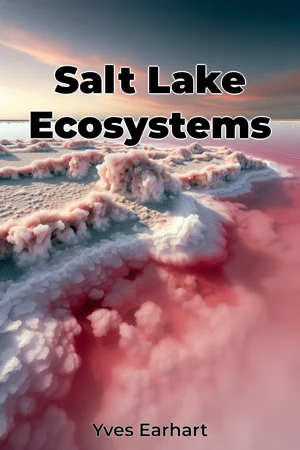
*Salt Lake Ecosystems: Life in the World’s Hypersaline Frontiers* explores Earth’s salt-saturated lakes as unexpected hubs of biological innovation. These extreme environments—home to pink-hued waters and salt-crusted shores—challenge life to adapt or perish, offering profound insights into resilience. The book reveals how microbes like halophiles survive using strategies such as pumping out excess salt or building protective proteins, while algae create vibrant microbial mats that sustain entire ecosystems. Far from barren, these lakes act as carbon sinks and nutrient cyclers, yet face collapse from climate change and industrial overuse, underscoring their fragile importance. Blending genomics, ecology, and fieldwork, the book journeys from Chile’s Salar de Atacama to Iran’s shrinking Lake Urmia, showing how salt lakes model evolutionary creativity. Chapters dissect microbial diversity, genetic adaptations, and cascading impacts of salinity shifts, bridging tiny organisms to global processes. Practical applications—like algae-based biofuels or microbes that detoxify wastewater—highlight their biotech potential, while parallels to Mars’ briny pools tie these ecosystems to astrobiology. Unlike previous works, the text compares lakes worldwide, weaving molecular details into ecosystem-scale stories without sacrificing accessibility. By framing hypersaline lakes as both laboratories and sentinels, the book appeals to scientists, conservationists, and curious readers. Its balance of gritty fieldwork, vivid examples, and urgent conservation messaging transforms salty backwaters into frontlines for understanding life’s limits—and possibilities.
Book Details
ISBN
9788233953881
Publisher
Publifye AS
Your Licenses
You don't own any licenses for this book
Purchase a license below to unlock this book and download the EPUB.
Purchase License
Select a tier to unlock this book
Need bulk licensing?
Contact us for enterprise agreements.