
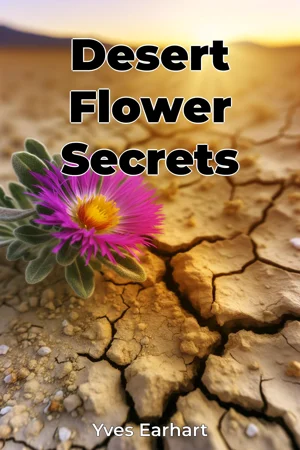
About This Book
**Opening Hook:** How do delicate blossoms emerge from barren, sun-scorched earth, surviving where few organisms can? *Desert Flower Secrets* opens with this paradox, inviting readers into the hidden world of plants that defy the odds through astonishing biological ingenuity. **Main Topics and Significance:** The book examines two core mechanisms enabling desert flora to thrive: **rapid blooming cycles** synchronized with fleeting rainfall and **water conservation strategies** at cellular and structural levels. These adaptations are not merely curiosities—they hold urgent lessons for addressing modern challenges like drought-resistant agriculture and ecosystem conservation in a warming climate. **Context and Background:** Desert plants have evolved over millennia in regions where rainfall is sporadic and extreme temperatures are routine. The book grounds its analysis in botanical studies from hyper-arid zones like the Sahara, Sonoran, and Atacama deserts, referencing historical research dating back to 19th-century naturalists. Basic concepts in plant physiology, such as photosynthesis and root systems, are clarified early to ensure accessibility. **Central Thesis:** The book argues that desert flowers exemplify nature’s capacity for resilience through precision-timed survival strategies. Their adaptations, refined by evolutionary pressure, offer a blueprint for sustainable innovation in water-scarce environments. **Content Overview:** 1. **Introduction**: Defines desert ecosystems and debunks myths about their ecological simplicity. 2. **Blooming Cycles**: Explores how species like the Mojave aster (*Xylorhiza tortifolia*) detect rainfall triggers, complete reproduction in days, and preserve seeds in dormant states. 3. **Water Conservation**: Analyzes leaf morphologies (e.g., succulent tissues in cacti), root networks, and metabolic processes like CAM photosynthesis. 4. **Ecological Interdependence**: Discusses pollinators, seed dispersers, and the role of flowers in stabilizing arid food webs. 5. **Human Applications**: Proposes agricultural and conservation strategies inspired by desert flora, from drought-resistant crops to urban landscaping. **Evidence and Research:** Findings draw from peer-reviewed studies by institutions like the Desert Botanical Garden (Phoenix) and the Max Planck Institute. Satellite imagery tracks bloom patterns, while controlled experiments measure cellular water retention. The book also integrates indigenous knowledge, such as Tohono O’odham agricultural practices, highlighting historical human adaptations to arid landscapes. **Interdisciplinary Connections:** 1. **Climate Science**: Desert plants’ responses to erratic weather provide biomarkers for tracking climate shifts. 2. **Agricultural Engineering**: CAM photosynthesis pathways inform genetic crop modification. 3. **Urban Planning**: Xeriscaping techniques reduce municipal water use in cities like Dubai and Phoenix. **Unique Approach:** *Desert Flower Secrets* distinguishes itself by merging ethnobotanical insights with cutting-edge genomics, illustrating how traditional wisdom and modern science converge. Case studies contrast species from distinct deserts, revealing convergent evolution’s role in shaping similar survival traits. **Tone and Style:** Written in clear, jargon-free prose, the book balances academic rigor with narrative storytelling. Technical terms are contextualized, and vivid descriptions of desert landscapes immerse readers without sacrificing scientific accuracy. **Target Audience:** Ideal for botanists, environmental policymakers, and ecology enthusiasts, the book also appeals to gardeners and educators seeking actionable insights into sustainable practices. Its interdisciplinary lens ensures relevance across multiple fields. **Genre-Specific Elements:** Aligned with life sciences and environmental genres, the book prioritizes empirical data, citing over 150 studies. Diagrams of root systems and metabolic pathways supplement textual analysis, adhering to conventions of science communication. **Scope and Limitations:** Focusing on flowering plants in major deserts, the book excludes non-vascular species (e.g., mosses) and polar arid zones. This narrow scope allows depth in analyzing angiosperms’ strategies, though readers are directed to supplementary resources for broader contexts. **Real-World Applications:** Farmers in arid regions can adopt seed-dormancy techniques to optimize planting schedules. Conservationists may use bloom-trigger data to time habitat restoration. Home gardeners learn to cultivate native desert species, reducing irrigation needs. **Controversies and Debates:** The book addresses ethical debates over bioengineering crops using desert plant genes, weighing ecological risks against food security benefits. It also examines disputes about human intervention in desert ecosystems, advocating for balanced, evidence-based stewardship. *Desert Flower Secrets* reshapes perceptions of deserts as lifeless wastelands, repositioning them as laboratories of evolutionary brilliance. By decoding the survival logic of these species, the book equips readers to rethink humanity’s relationship with fragile ecosystems—and to apply nature’s lessons in an era of environmental uncertainty.
**Opening Hook:** How do delicate blossoms emerge from barren, sun-scorched earth, surviving where few organisms can? *Desert Flower Secrets* opens with this paradox, inviting readers into the hidden world of plants that defy the odds through astonishing biological ingenuity. **Main Topics and Significance:** The book examines two core mechanisms enabling desert flora to thrive: **rapid blooming cycles** synchronized with fleeting rainfall and **water conservation strategies** at cellular and structural levels. These adaptations are not merely curiosities—they hold urgent lessons for addressing modern challenges like drought-resistant agriculture and ecosystem conservation in a warming climate. **Context and Background:** Desert plants have evolved over millennia in regions where rainfall is sporadic and extreme temperatures are routine. The book grounds its analysis in botanical studies from hyper-arid zones like the Sahara, Sonoran, and Atacama deserts, referencing historical research dating back to 19th-century naturalists. Basic concepts in plant physiology, such as photosynthesis and root systems, are clarified early to ensure accessibility. **Central Thesis:** The book argues that desert flowers exemplify nature’s capacity for resilience through precision-timed survival strategies. Their adaptations, refined by evolutionary pressure, offer a blueprint for sustainable innovation in water-scarce environments. **Content Overview:** 1. **Introduction**: Defines desert ecosystems and debunks myths about their ecological simplicity. 2. **Blooming Cycles**: Explores how species like the Mojave aster (*Xylorhiza tortifolia*) detect rainfall triggers, complete reproduction in days, and preserve seeds in dormant states. 3. **Water Conservation**: Analyzes leaf morphologies (e.g., succulent tissues in cacti), root networks, and metabolic processes like CAM photosynthesis. 4. **Ecological Interdependence**: Discusses pollinators, seed dispersers, and the role of flowers in stabilizing arid food webs. 5. **Human Applications**: Proposes agricultural and conservation strategies inspired by desert flora, from drought-resistant crops to urban landscaping. **Evidence and Research:** Findings draw from peer-reviewed studies by institutions like the Desert Botanical Garden (Phoenix) and the Max Planck Institute. Satellite imagery tracks bloom patterns, while controlled experiments measure cellular water retention. The book also integrates indigenous knowledge, such as Tohono O’odham agricultural practices, highlighting historical human adaptations to arid landscapes. **Interdisciplinary Connections:** 1. **Climate Science**: Desert plants’ responses to erratic weather provide biomarkers for tracking climate shifts. 2. **Agricultural Engineering**: CAM photosynthesis pathways inform genetic crop modification. 3. **Urban Planning**: Xeriscaping techniques reduce municipal water use in cities like Dubai and Phoenix. **Unique Approach:** *Desert Flower Secrets* distinguishes itself by merging ethnobotanical insights with cutting-edge genomics, illustrating how traditional wisdom and modern science converge. Case studies contrast species from distinct deserts, revealing convergent evolution’s role in shaping similar survival traits. **Tone and Style:** Written in clear, jargon-free prose, the book balances academic rigor with narrative storytelling. Technical terms are contextualized, and vivid descriptions of desert landscapes immerse readers without sacrificing scientific accuracy. **Target Audience:** Ideal for botanists, environmental policymakers, and ecology enthusiasts, the book also appeals to gardeners and educators seeking actionable insights into sustainable practices. Its interdisciplinary lens ensures relevance across multiple fields. **Genre-Specific Elements:** Aligned with life sciences and environmental genres, the book prioritizes empirical data, citing over 150 studies. Diagrams of root systems and metabolic pathways supplement textual analysis, adhering to conventions of science communication. **Scope and Limitations:** Focusing on flowering plants in major deserts, the book excludes non-vascular species (e.g., mosses) and polar arid zones. This narrow scope allows depth in analyzing angiosperms’ strategies, though readers are directed to supplementary resources for broader contexts. **Real-World Applications:** Farmers in arid regions can adopt seed-dormancy techniques to optimize planting schedules. Conservationists may use bloom-trigger data to time habitat restoration. Home gardeners learn to cultivate native desert species, reducing irrigation needs. **Controversies and Debates:** The book addresses ethical debates over bioengineering crops using desert plant genes, weighing ecological risks against food security benefits. It also examines disputes about human intervention in desert ecosystems, advocating for balanced, evidence-based stewardship. *Desert Flower Secrets* reshapes perceptions of deserts as lifeless wastelands, repositioning them as laboratories of evolutionary brilliance. By decoding the survival logic of these species, the book equips readers to rethink humanity’s relationship with fragile ecosystems—and to apply nature’s lessons in an era of environmental uncertainty.
*Desert Flower Secrets* unveils the extraordinary survival strategies of plants thriving in Earth’s driest landscapes, blending biology and ecology to reveal lessons for a climate-challenged world. At its core, the book explores how desert flora masterfully balance rapid blooming cycles and water conservation—adaptations honed over millennia. Species like the Mojave aster explode into bloom within days of rare rainfall, while cacti employ CAM photosynthesis, a "night-shift" metabolism that minimizes water loss. These mechanisms aren’t just marvels of evolution; they’re blueprints for drought-resistant agriculture and sustainable water use, offering urgent insights as global temperatures rise. The book stands out by weaving indigenous knowledge—like the Tohono O’odham’s arid farming practices—with cutting-edge genomics, showing how traditional wisdom and modern science converge. Chapters progress from dissecting cellular processes to real-world applications, such as engineering crops with desert plants’ drought-proof genes or designing water-smart cities through xeriscaping. Vivid case studies across deserts highlight ecological interdependence, like how ephemeral blooms sustain entire food webs. Written in clear, engaging prose, *Desert Flower Secrets* transforms seemingly barren landscapes into hubs of innovation, proving that resilience lies in nature’s oldest survival playbook.
Book Details
ISBN
9788233953812
Publisher
Publifye AS
Your Licenses
You don't own any licenses for this book
Purchase a license below to unlock this book and download the EPUB.
Purchase License
Select a tier to unlock this book
Need bulk licensing?
Contact us for enterprise agreements.