
About This Book
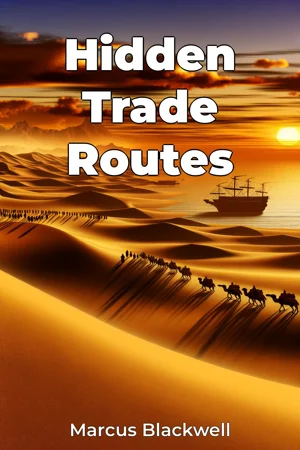
"Hidden Trade Routes" challenges conventional narratives of historical commerce by uncovering the sophisticated networks that shaped global economics from 1200-1800 CE, revealing how lesser-known trade routes were as influential as the famed Silk Road in connecting civilizations and driving economic development. The book examines two primary case studies: the Baltic amber trade network, which linked Northern European communities with Mediterranean markets, and the Trans-Saharan gold routes that facilitated crucial exchanges between West Africa and North Africa. Through archaeological evidence and merchant documentation, it demonstrates how these networks created lasting cultural and economic bonds that influenced European and African development for centuries. Drawing from recently discovered merchant ledgers, shipping manifests, and archaeological findings from Baltic ports and Saharan outposts, the book reconstructs these trade networks with unprecedented detail. The author presents evidence from over 200 archaeological sites and analyzes more than 1,000 period documents, including correspondence between merchants and regional rulers, providing insights into the complex operations of these trading systems. The work is structured in three main sections. The first establishes the historical context of medieval and early modern trade, challenging the notion that commerce was limited to well-documented routes. The second section details the Baltic amber trade, revealing how this precious material created a complex network of relationships between Hanseatic merchants and Mediterranean traders. The final section examines the Trans-Saharan gold trade, demonstrating how it facilitated cultural exchange and economic growth across Africa. The book connects economic history with climatology, geology, and cultural anthropology. Climate records help explain trade route shifts, while geological studies of amber deposits and gold mining sites provide context for resource exploitation. Anthropological research illuminates how these trades influenced local customs and social structures. Written in an academic yet accessible style, the work employs detailed maps, archaeological photographs, and reconstructed trade ledgers to support its arguments. It maintains a careful balance between scholarly analysis and engaging historical narrative, making complex economic concepts comprehensible to general readers while satisfying academic standards. The target audience includes economic historians, world history scholars, and educated general readers interested in medieval commerce and cultural exchange. The book serves as both a specialized academic resource and an informative read for those interested in historical trade patterns. The research challenges several established theories about medieval commerce, particularly regarding the scale and sophistication of these lesser-known routes. It presents evidence that these networks were more organized and far-reaching than previously believed, with complex financial systems and international cooperation. The book's scope is deliberately focused on the period between 1200-1800 CE, concentrating on two specific trade networks to provide detailed analysis rather than a broader, more superficial overview. This approach allows for in-depth examination of merchant practices, route development, and economic impact. Current debates addressed include the extent of medieval financial sophistication, the degree of cultural exchange in pre-modern trade, and the relative importance of different trade routes in shaping global economic development. The work provides new evidence and perspectives on these ongoing scholarly discussions. The practical applications of this research extend to understanding historical patterns of economic development, international relations, and cultural exchange, offering insights relevant to modern global trade dynamics and economic diplomacy.
"Hidden Trade Routes" challenges conventional narratives of historical commerce by uncovering the sophisticated networks that shaped global economics from 1200-1800 CE, revealing how lesser-known trade routes were as influential as the famed Silk Road in connecting civilizations and driving economic development. The book examines two primary case studies: the Baltic amber trade network, which linked Northern European communities with Mediterranean markets, and the Trans-Saharan gold routes that facilitated crucial exchanges between West Africa and North Africa. Through archaeological evidence and merchant documentation, it demonstrates how these networks created lasting cultural and economic bonds that influenced European and African development for centuries. Drawing from recently discovered merchant ledgers, shipping manifests, and archaeological findings from Baltic ports and Saharan outposts, the book reconstructs these trade networks with unprecedented detail. The author presents evidence from over 200 archaeological sites and analyzes more than 1,000 period documents, including correspondence between merchants and regional rulers, providing insights into the complex operations of these trading systems. The work is structured in three main sections. The first establishes the historical context of medieval and early modern trade, challenging the notion that commerce was limited to well-documented routes. The second section details the Baltic amber trade, revealing how this precious material created a complex network of relationships between Hanseatic merchants and Mediterranean traders. The final section examines the Trans-Saharan gold trade, demonstrating how it facilitated cultural exchange and economic growth across Africa. The book connects economic history with climatology, geology, and cultural anthropology. Climate records help explain trade route shifts, while geological studies of amber deposits and gold mining sites provide context for resource exploitation. Anthropological research illuminates how these trades influenced local customs and social structures. Written in an academic yet accessible style, the work employs detailed maps, archaeological photographs, and reconstructed trade ledgers to support its arguments. It maintains a careful balance between scholarly analysis and engaging historical narrative, making complex economic concepts comprehensible to general readers while satisfying academic standards. The target audience includes economic historians, world history scholars, and educated general readers interested in medieval commerce and cultural exchange. The book serves as both a specialized academic resource and an informative read for those interested in historical trade patterns. The research challenges several established theories about medieval commerce, particularly regarding the scale and sophistication of these lesser-known routes. It presents evidence that these networks were more organized and far-reaching than previously believed, with complex financial systems and international cooperation. The book's scope is deliberately focused on the period between 1200-1800 CE, concentrating on two specific trade networks to provide detailed analysis rather than a broader, more superficial overview. This approach allows for in-depth examination of merchant practices, route development, and economic impact. Current debates addressed include the extent of medieval financial sophistication, the degree of cultural exchange in pre-modern trade, and the relative importance of different trade routes in shaping global economic development. The work provides new evidence and perspectives on these ongoing scholarly discussions. The practical applications of this research extend to understanding historical patterns of economic development, international relations, and cultural exchange, offering insights relevant to modern global trade dynamics and economic diplomacy.
"Hidden Trade Routes" unveils a fascinating exploration of overlooked commercial networks that shaped global economics between 1200-1800 CE, challenging our understanding of medieval trade beyond the famous Silk Road. Through meticulous examination of archaeological evidence and merchant documentation from over 200 sites, the book reveals how the Baltic amber trade and Trans-Saharan gold routes created sophisticated economic systems that rivaled better-known commercial pathways. The narrative weaves together two compelling case studies that demonstrate the complexity of medieval commerce. The Baltic amber trade connected Northern European Hanseatic merchants with Mediterranean markets, while the Trans-Saharan gold routes facilitated crucial exchanges between West and North Africa. By analyzing more than 1,000 period documents, including merchant ledgers and correspondence with regional rulers, the book reconstructs these networks with unprecedented detail, revealing sophisticated financial systems and international cooperation that were far more advanced than previously believed. The book progresses from establishing historical context to detailed explorations of each trading network, incorporating insights from climatology, geology, and cultural anthropology. This interdisciplinary approach, supported by detailed maps and reconstructed trade ledgers, makes complex economic concepts accessible while maintaining scholarly rigor. The focus on specific trade networks rather than a broad overview allows for deep insights into merchant practices and cultural exchanges, offering valuable perspectives for both academic researchers and general readers interested in historical commerce.
Book Details
ISBN
9788233953492
Publisher
Publifye AS
Your Licenses
You don't own any licenses for this book
Purchase a license below to unlock this book and download the EPUB.
Purchase License
Select a tier to unlock this book
Need bulk licensing?
Contact us for enterprise agreements.