
About This Book
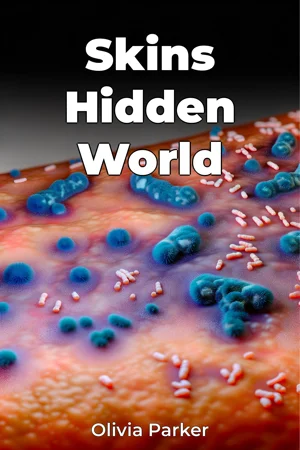
"Skins Hidden World" unveils the complex universe that exists within and upon the body's largest organ, challenging our understanding of this seemingly simple barrier between our internal systems and the external environment. The book presents three interconnected themes: the skin's microbiome as a dynamic ecosystem, its role as a sophisticated biological barrier, and its influence on human health and social identity. These topics reveal how recent scientific discoveries have transformed our understanding of skin from a mere protective covering to a complex organ system that influences everything from immune response to mental health. Drawing from cutting-edge research in microbiology, immunology, and dermatology, the text examines the trillion-member microbial community inhabiting human skin. It explores how these organisms interact with human cells to maintain health, prevent disease, and influence bodily functions. The book provides detailed analyses of recent studies using advanced genetic sequencing techniques that have mapped the skin's bacterial diversity across different body regions. The central argument posits that skin health requires a holistic understanding of its multiple functions and the delicate balance between its physical, chemical, and biological components. This perspective challenges traditional skincare approaches and suggests new directions for medical treatments and personal care practices. The content progresses through four major sections: First, it establishes the fundamental biology of skin structure and function. Second, it explores the intricate relationship between human cells and microbial communities. Third, it examines how environmental factors influence skin health. Finally, it discusses practical applications of this knowledge in medicine and daily life. Supporting evidence comes from diverse sources, including longitudinal clinical studies, microbiome research, immunological investigations, and evolutionary biology. The book incorporates data from international research institutions and includes findings from both established and emerging scientific methodologies. The work connects multiple disciplines, linking dermatology with evolutionary biology, psychology, and environmental science. These connections demonstrate how skin health reflects broader ecological and social contexts, including climate change impacts and modern lifestyle effects on skin conditions. Written in an accessible scientific style, the text balances technical accuracy with clear explanations suitable for readers with a basic science background. It uses analogies and case studies to illustrate complex concepts while maintaining scientific rigor. The target audience includes healthcare professionals, biology students, and informed general readers interested in human health and biology. The book serves as both a comprehensive reference and an engaging exploration of cutting-edge skin science. Practical applications include evidence-based recommendations for skincare, disease prevention, and environmental protection. The text addresses current debates in dermatology, including the role of commercial skincare products, the impact of modern hygiene practices on skin health, and emerging treatments for chronic skin conditions. The scope encompasses both molecular-level processes and broader public health implications, though it primarily focuses on human skin rather than comparative biology. It presents current scientific consensus while acknowledging areas of ongoing research and uncertainty in the field. This work stands out by integrating traditional dermatological knowledge with recent microbiome discoveries, offering a comprehensive view of skin as a complex ecosystem rather than a simple barrier. It provides readers with both theoretical understanding and practical knowledge for maintaining skin health in the context of modern environmental challenges.
"Skins Hidden World" unveils the complex universe that exists within and upon the body's largest organ, challenging our understanding of this seemingly simple barrier between our internal systems and the external environment. The book presents three interconnected themes: the skin's microbiome as a dynamic ecosystem, its role as a sophisticated biological barrier, and its influence on human health and social identity. These topics reveal how recent scientific discoveries have transformed our understanding of skin from a mere protective covering to a complex organ system that influences everything from immune response to mental health. Drawing from cutting-edge research in microbiology, immunology, and dermatology, the text examines the trillion-member microbial community inhabiting human skin. It explores how these organisms interact with human cells to maintain health, prevent disease, and influence bodily functions. The book provides detailed analyses of recent studies using advanced genetic sequencing techniques that have mapped the skin's bacterial diversity across different body regions. The central argument posits that skin health requires a holistic understanding of its multiple functions and the delicate balance between its physical, chemical, and biological components. This perspective challenges traditional skincare approaches and suggests new directions for medical treatments and personal care practices. The content progresses through four major sections: First, it establishes the fundamental biology of skin structure and function. Second, it explores the intricate relationship between human cells and microbial communities. Third, it examines how environmental factors influence skin health. Finally, it discusses practical applications of this knowledge in medicine and daily life. Supporting evidence comes from diverse sources, including longitudinal clinical studies, microbiome research, immunological investigations, and evolutionary biology. The book incorporates data from international research institutions and includes findings from both established and emerging scientific methodologies. The work connects multiple disciplines, linking dermatology with evolutionary biology, psychology, and environmental science. These connections demonstrate how skin health reflects broader ecological and social contexts, including climate change impacts and modern lifestyle effects on skin conditions. Written in an accessible scientific style, the text balances technical accuracy with clear explanations suitable for readers with a basic science background. It uses analogies and case studies to illustrate complex concepts while maintaining scientific rigor. The target audience includes healthcare professionals, biology students, and informed general readers interested in human health and biology. The book serves as both a comprehensive reference and an engaging exploration of cutting-edge skin science. Practical applications include evidence-based recommendations for skincare, disease prevention, and environmental protection. The text addresses current debates in dermatology, including the role of commercial skincare products, the impact of modern hygiene practices on skin health, and emerging treatments for chronic skin conditions. The scope encompasses both molecular-level processes and broader public health implications, though it primarily focuses on human skin rather than comparative biology. It presents current scientific consensus while acknowledging areas of ongoing research and uncertainty in the field. This work stands out by integrating traditional dermatological knowledge with recent microbiome discoveries, offering a comprehensive view of skin as a complex ecosystem rather than a simple barrier. It provides readers with both theoretical understanding and practical knowledge for maintaining skin health in the context of modern environmental challenges.
"Skin's Hidden World" reveals the fascinating complexity of our body's largest organ, transforming our understanding of skin from a simple protective barrier into a sophisticated ecosystem teeming with life. This comprehensive exploration delves into the trillion-strong microbial community inhabiting our skin and its crucial role in maintaining health, preventing disease, and influencing everything from immune responses to mental well-being. The book masterfully weaves together three interconnected themes: the dynamic skin microbiome, the intricate biological barrier function, and skin's influence on human health and identity. Through cutting-edge research in microbiology, immunology, and dermatology, readers discover how advanced genetic sequencing has mapped bacterial diversity across different body regions, challenging traditional approaches to skincare and medical treatments. The text presents compelling evidence from longitudinal clinical studies and microbiome research, making complex scientific concepts accessible through clear explanations and relevant case studies. Progressing from fundamental skin biology through to practical applications, the book connects multiple disciplines including evolutionary biology, psychology, and environmental science. It offers evidence-based recommendations for skincare while addressing current debates in dermatology, such as the impact of modern hygiene practices and commercial skincare products. This unique integration of traditional dermatological knowledge with recent microbiome discoveries provides healthcare professionals, biology students, and informed readers with both theoretical insights and practical guidance for maintaining skin health in today's challenging environment.
Book Details
ISBN
9788233953270
Publisher
Publifye AS
Your Licenses
You don't own any licenses for this book
Purchase a license below to unlock this book and download the EPUB.
Purchase License
Select a tier to unlock this book
Need bulk licensing?
Contact us for enterprise agreements.