
About This Book
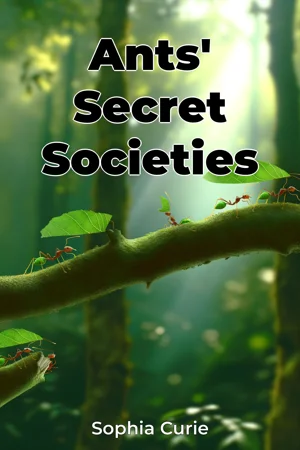
"Ants' Secret Societies" delves into the intricate world of ant colonies, where millions of individuals operate in precise coordination through sophisticated social networks that rival human organizational systems in their complexity. The book examines three fundamental aspects of ant colony behavior: their hierarchical social structure, collective decision-making processes, and advanced problem-solving capabilities. These elements reveal how ants have evolved solutions to complex logistical and social challenges over millions of years, offering insights relevant to fields ranging from organizational management to artificial intelligence. Drawing from fifty years of entomological research, including recent studies using advanced imaging technologies and chemical analysis, the work presents a comprehensive examination of ant societies. The text explores how colonies coordinate labor distribution, maintain complex agricultural systems, and engineer elaborate architectural structures without centralized control. The central thesis demonstrates that ant colonies represent a prime example of emergent intelligence, where simple interactions between individuals create complex, adaptive systems. This understanding has significant implications for human organizational behavior and the development of decentralized problem-solving algorithms. The book's structure progresses from microscopic to macroscopic perspectives. It begins with individual ant biology and communication methods, advances through colony organization and decision-making processes, and culminates in examining colony-level adaptations to environmental challenges. Each chapter integrates direct observational data from field studies with laboratory experiments and computational models. Research evidence includes long-term field studies from multiple continents, chemical analyses of pheromone communication, and new findings from radioisotope tracking of ant movement patterns. The work incorporates data from collaborative studies across twenty research institutions, providing a global perspective on ant behavior. The interdisciplinary approach connects entomology with computer science, examining how ant decision-making algorithms inform swarm robotics development. It also explores parallels with human sociology and organizational psychology, demonstrating how ant colonies mirror and sometimes surpass human social structures in efficiency. The book employs a systematic, research-based approach while maintaining accessibility through clear explanations and relevant examples. Technical concepts are carefully introduced with supporting diagrams and case studies, making complex ideas comprehensible to readers with basic scientific literacy. Written for both professional scientists and informed general readers, the book serves as a comprehensive reference for researchers while remaining engaging for nature enthusiasts and those interested in organizational behavior. The material is particularly relevant for students and professionals in biology, computer science, and organizational management. The scope encompasses both tropical and temperate ant species, focusing on social structure variations across different environments. While primarily examining social behavior, the book acknowledges but does not deeply explore genetic and molecular aspects of ant biology. Practical applications include insights for artificial intelligence development, organizational management strategies, and urban planning. The research presents valuable models for developing efficient transportation networks and optimizing resource distribution systems. The work addresses ongoing debates in the field, including discussions about the evolution of altruistic behavior and the nature of collective intelligence. It presents current evidence while acknowledging areas where scientific consensus remains unresolved. The book maintains an objective, evidence-based tone throughout, focusing on verified research findings rather than speculation. This approach ensures reliability while highlighting the genuine fascination of ant social behavior without resorting to sensationalism.
"Ants' Secret Societies" delves into the intricate world of ant colonies, where millions of individuals operate in precise coordination through sophisticated social networks that rival human organizational systems in their complexity. The book examines three fundamental aspects of ant colony behavior: their hierarchical social structure, collective decision-making processes, and advanced problem-solving capabilities. These elements reveal how ants have evolved solutions to complex logistical and social challenges over millions of years, offering insights relevant to fields ranging from organizational management to artificial intelligence. Drawing from fifty years of entomological research, including recent studies using advanced imaging technologies and chemical analysis, the work presents a comprehensive examination of ant societies. The text explores how colonies coordinate labor distribution, maintain complex agricultural systems, and engineer elaborate architectural structures without centralized control. The central thesis demonstrates that ant colonies represent a prime example of emergent intelligence, where simple interactions between individuals create complex, adaptive systems. This understanding has significant implications for human organizational behavior and the development of decentralized problem-solving algorithms. The book's structure progresses from microscopic to macroscopic perspectives. It begins with individual ant biology and communication methods, advances through colony organization and decision-making processes, and culminates in examining colony-level adaptations to environmental challenges. Each chapter integrates direct observational data from field studies with laboratory experiments and computational models. Research evidence includes long-term field studies from multiple continents, chemical analyses of pheromone communication, and new findings from radioisotope tracking of ant movement patterns. The work incorporates data from collaborative studies across twenty research institutions, providing a global perspective on ant behavior. The interdisciplinary approach connects entomology with computer science, examining how ant decision-making algorithms inform swarm robotics development. It also explores parallels with human sociology and organizational psychology, demonstrating how ant colonies mirror and sometimes surpass human social structures in efficiency. The book employs a systematic, research-based approach while maintaining accessibility through clear explanations and relevant examples. Technical concepts are carefully introduced with supporting diagrams and case studies, making complex ideas comprehensible to readers with basic scientific literacy. Written for both professional scientists and informed general readers, the book serves as a comprehensive reference for researchers while remaining engaging for nature enthusiasts and those interested in organizational behavior. The material is particularly relevant for students and professionals in biology, computer science, and organizational management. The scope encompasses both tropical and temperate ant species, focusing on social structure variations across different environments. While primarily examining social behavior, the book acknowledges but does not deeply explore genetic and molecular aspects of ant biology. Practical applications include insights for artificial intelligence development, organizational management strategies, and urban planning. The research presents valuable models for developing efficient transportation networks and optimizing resource distribution systems. The work addresses ongoing debates in the field, including discussions about the evolution of altruistic behavior and the nature of collective intelligence. It presents current evidence while acknowledging areas where scientific consensus remains unresolved. The book maintains an objective, evidence-based tone throughout, focusing on verified research findings rather than speculation. This approach ensures reliability while highlighting the genuine fascination of ant social behavior without resorting to sensationalism.
"Ants' Secret Societies" unveils the fascinating world of ant colonies, where millions of individuals work together in remarkably sophisticated social networks that rival human organizations. Through extensive research spanning fifty years, including cutting-edge imaging technologies and chemical analysis, the book reveals how these tiny insects have evolved solutions to complex challenges that offer valuable insights for fields ranging from artificial intelligence to urban planning. The narrative progresses systematically from individual ant biology to colony-level dynamics, exploring three key aspects: hierarchical social structure, collective decision-making, and advanced problem-solving capabilities. Readers discover how ant colonies coordinate labor distribution and maintain intricate agricultural systems without centralized control, demonstrating a prime example of emergent intelligence. The book draws from global research across twenty institutions, incorporating field studies from multiple continents and groundbreaking findings from radioisotope tracking of ant movement patterns. What sets this work apart is its interdisciplinary approach, connecting entomology with computer science and organizational psychology while maintaining accessibility through clear explanations and relevant examples. The book balances technical precision with engaging content, making complex concepts comprehensible for both professional scientists and nature enthusiasts. By examining how ant colonies mirror and sometimes surpass human social structures in efficiency, it provides practical applications for developing efficient transportation networks and optimizing resource distribution systems.
Book Details
ISBN
9788233953218
Publisher
Publifye AS
Your Licenses
You don't own any licenses for this book
Purchase a license below to unlock this book and download the EPUB.
Purchase License
Select a tier to unlock this book
Need bulk licensing?
Contact us for enterprise agreements.