
About This Book
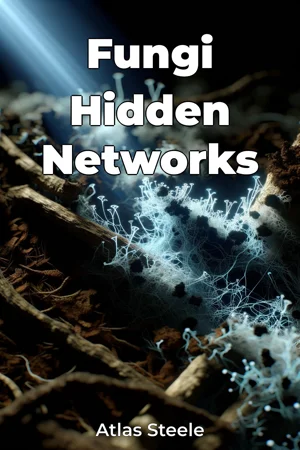
"Fungi Hidden Networks" reveals how mycelial networks form a complex communication and resource-sharing system beneath our feet, fundamentally challenging our understanding of forest ecosystems. This comprehensive exploration examines the intricate relationships between fungi, plants, and other organisms that sustain forest life through underground connections. The book presents three core topics: the structural architecture of mycelial networks, their role in forest communication systems, and their impact on ecosystem resilience. Recent research using advanced imaging technologies has revealed that these networks connect hundreds of trees across acres of forest floor, creating what scientists now refer to as the "Wood Wide Web." Beginning with the basic biology of fungi, the text establishes fundamental concepts necessary for understanding mycelial behavior. Readers learn how fungi evolved from single-celled organisms to become crucial mediators of forest health over 450 million years ago. This historical context helps explain current forest ecosystem dynamics and their evolutionary significance. The central thesis demonstrates that forests function as superorganisms, with mycelial networks serving as their neural system. Through detailed analysis of field studies and laboratory research, the book shows how these fungal networks facilitate resource distribution, warn of incoming threats, and support forest regeneration. Structured in three main sections, the book first examines the physical structure and biochemistry of mycelial networks. The second section explores their role in forest communication, including chemical signaling and resource allocation. The final section investigates how these networks influence forest resilience and adaptation to environmental changes. The text incorporates research from leading mycologists and ecologists, featuring data from long-term forest studies, isotope tracking experiments, and molecular analysis. Advanced microscopy and genetic sequencing techniques provide new insights into network formation and function. This work connects multiple scientific disciplines, including mycology, plant biology, soil science, and systems ecology. These intersections help explain how fungal networks influence climate change adaptation, forest management practices, and agricultural systems. The book employs a methodical, evidence-based approach, presenting complex scientific concepts through clear explanations and detailed illustrations. Technical information is balanced with practical applications, making the content accessible to both researchers and informed general readers. Written in scientific narrative style, the text maintains academic rigor while engaging readers through real-world examples and case studies. The target audience includes ecologists, foresters, environmental scientists, and educated readers interested in natural systems. The scope encompasses temperate and boreal forest ecosystems, with particular focus on areas where extensive mycelial network research has been conducted. While primarily examining forest systems, the book acknowledges applications to agriculture and urban forestry. Practical applications include forest management strategies, soil conservation techniques, and methods for promoting ecosystem resilience. The text addresses ongoing debates about the extent of plant communication through fungal networks and the implications for forest conservation. Current research challenges traditional views of forests as collections of competing individuals, presenting evidence for cooperative networks that influence species survival and adaptation. The book examines competing hypotheses about network formation and function, presenting evidence for various theoretical frameworks. This work fills a crucial gap in ecological literature by synthesizing recent research on underground forest networks and their ecological significance. It provides essential insights for understanding forest ecosystem management and conservation in an era of rapid environmental change.
"Fungi Hidden Networks" reveals how mycelial networks form a complex communication and resource-sharing system beneath our feet, fundamentally challenging our understanding of forest ecosystems. This comprehensive exploration examines the intricate relationships between fungi, plants, and other organisms that sustain forest life through underground connections. The book presents three core topics: the structural architecture of mycelial networks, their role in forest communication systems, and their impact on ecosystem resilience. Recent research using advanced imaging technologies has revealed that these networks connect hundreds of trees across acres of forest floor, creating what scientists now refer to as the "Wood Wide Web." Beginning with the basic biology of fungi, the text establishes fundamental concepts necessary for understanding mycelial behavior. Readers learn how fungi evolved from single-celled organisms to become crucial mediators of forest health over 450 million years ago. This historical context helps explain current forest ecosystem dynamics and their evolutionary significance. The central thesis demonstrates that forests function as superorganisms, with mycelial networks serving as their neural system. Through detailed analysis of field studies and laboratory research, the book shows how these fungal networks facilitate resource distribution, warn of incoming threats, and support forest regeneration. Structured in three main sections, the book first examines the physical structure and biochemistry of mycelial networks. The second section explores their role in forest communication, including chemical signaling and resource allocation. The final section investigates how these networks influence forest resilience and adaptation to environmental changes. The text incorporates research from leading mycologists and ecologists, featuring data from long-term forest studies, isotope tracking experiments, and molecular analysis. Advanced microscopy and genetic sequencing techniques provide new insights into network formation and function. This work connects multiple scientific disciplines, including mycology, plant biology, soil science, and systems ecology. These intersections help explain how fungal networks influence climate change adaptation, forest management practices, and agricultural systems. The book employs a methodical, evidence-based approach, presenting complex scientific concepts through clear explanations and detailed illustrations. Technical information is balanced with practical applications, making the content accessible to both researchers and informed general readers. Written in scientific narrative style, the text maintains academic rigor while engaging readers through real-world examples and case studies. The target audience includes ecologists, foresters, environmental scientists, and educated readers interested in natural systems. The scope encompasses temperate and boreal forest ecosystems, with particular focus on areas where extensive mycelial network research has been conducted. While primarily examining forest systems, the book acknowledges applications to agriculture and urban forestry. Practical applications include forest management strategies, soil conservation techniques, and methods for promoting ecosystem resilience. The text addresses ongoing debates about the extent of plant communication through fungal networks and the implications for forest conservation. Current research challenges traditional views of forests as collections of competing individuals, presenting evidence for cooperative networks that influence species survival and adaptation. The book examines competing hypotheses about network formation and function, presenting evidence for various theoretical frameworks. This work fills a crucial gap in ecological literature by synthesizing recent research on underground forest networks and their ecological significance. It provides essential insights for understanding forest ecosystem management and conservation in an era of rapid environmental change.
"Fungi Hidden Networks" unveils the fascinating world of underground fungal connections that form nature's most sophisticated communication system. This groundbreaking exploration reveals how mycelial networks, often called the "Wood Wide Web," create intricate pathways connecting hundreds of trees across forest floors, fundamentally challenging our traditional understanding of forest ecosystems. The book traces the remarkable 450-million-year evolution of fungi from single-celled organisms to become the crucial mediators of forest health we know today. Through detailed analysis of cutting-edge research, including advanced imaging technologies and molecular studies, readers discover how these fungal networks facilitate resource sharing, transmit warning signals about incoming threats, and support forest regeneration. The text masterfully explains how forests function as superorganisms, with mycelial networks serving as their neural system. Structured in three comprehensive sections, the book progresses from examining the physical structure and biochemistry of mycelial networks to exploring their role in forest communication and finally investigating their influence on ecosystem resilience. By integrating research from leading mycologists and ecologists, this accessible yet scientifically rigorous work bridges multiple disciplines, offering practical insights for forest management while maintaining scholarly depth. The book's evidence-based approach, enriched with real-world examples and case studies, makes complex ecological concepts accessible to both researchers and informed general readers interested in natural systems.
Book Details
ISBN
9788233953201
Publisher
Publifye AS
Your Licenses
You don't own any licenses for this book
Purchase a license below to unlock this book and download the EPUB.
Purchase License
Select a tier to unlock this book
Need bulk licensing?
Contact us for enterprise agreements.