
About This Book
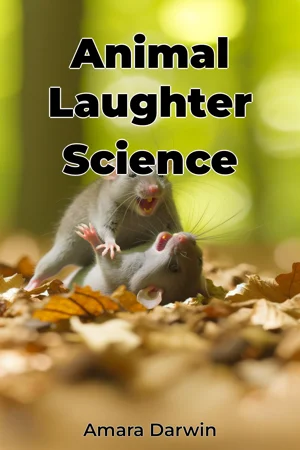
"Animal Laughter Science" challenges our understanding of emotional expressions in non-human species by examining documented evidence of play-associated vocalizations and behaviors across the animal kingdom. This research-based exploration delves into the evolutionary origins and neurological basis of laughter-like responses in various species, from mammals to marine life. The book presents three core themes: the neurobiological mechanisms behind animal play vocalizations, the evolutionary development of these behaviors, and their social functions across species. Through detailed case studies of rats, dolphins, primates, and other social animals, readers discover how play sounds serve as emotional signals and social bonding tools. Building on Charles Darwin's early observations of emotional expressions in animals, the text synthesizes decades of field research and laboratory studies. Modern tracking technologies, acoustic analysis, and neuroscience methods reveal how play vocalizations emerge from specific brain circuits shared across vertebrate species. This scientific foundation helps readers understand the biological basis of animal expressions previously dismissed as anthropomorphic projections. The central thesis argues that laughter-like vocalizations evolved independently in multiple species as social coordination signals, serving crucial developmental and bonding functions. Supporting evidence includes detailed acoustic analyses of rat ultrasonic chirps during play, dolphins' play-specific click patterns, and comparative studies of facial expressions in great apes. The book's structure progresses from foundational concepts to specific case studies. Early chapters establish the neuroscience of play circuits and vocalization. Middle sections present detailed species-specific research, while later chapters explore evolutionary implications and cross-species comparisons. The conclusion examines what these findings reveal about the nature of emotions and social bonding. Research methodologies described include laboratory studies using sophisticated recording equipment, field observations with advanced acoustic monitoring, and comparative analyses across species. The work integrates findings from neuroscience, evolutionary biology, ethology, and behavioral ecology. The text connects to cognitive science through discussions of emotional processing, to psychology via social bonding mechanisms, and to anthropology through evolutionary perspectives on human laughter. These interdisciplinary links provide broader context for understanding animal behavior. Written in clear, technical language appropriate for both specialists and informed general readers, the book maintains scientific rigor while remaining accessible. Each chapter includes detailed citations, methodological explanations, and relevant data visualizations. The primary audience includes animal behavior researchers, evolutionary biologists, and students in related fields, though the content remains accessible to interested general readers with basic science background. The book serves as both a comprehensive reference and an introduction to this emerging field. The scope encompasses vertebrate species with documented play vocalizations, focusing primarily on mammals while acknowledging similar behaviors in other taxa. The text addresses current debates about animal consciousness and emotional experiences, presenting evidence without making unfounded claims about animal subjective experiences. Practical applications extend to animal welfare, veterinary care, and wildlife conservation, offering insights into behavioral indicators of positive emotional states in captive and wild animals. The research also informs human-animal interaction protocols and enrichment programs. The book acknowledges ongoing scientific discussions about the interpretation of animal behaviors and the challenges of studying emotional expressions across species. It presents competing hypotheses where evidence remains inconclusive, maintaining scientific objectivity throughout. This comprehensive analysis provides a solid foundation for understanding the biological basis of play vocalizations while advancing our knowledge of emotional expression in the animal kingdom.
"Animal Laughter Science" challenges our understanding of emotional expressions in non-human species by examining documented evidence of play-associated vocalizations and behaviors across the animal kingdom. This research-based exploration delves into the evolutionary origins and neurological basis of laughter-like responses in various species, from mammals to marine life. The book presents three core themes: the neurobiological mechanisms behind animal play vocalizations, the evolutionary development of these behaviors, and their social functions across species. Through detailed case studies of rats, dolphins, primates, and other social animals, readers discover how play sounds serve as emotional signals and social bonding tools. Building on Charles Darwin's early observations of emotional expressions in animals, the text synthesizes decades of field research and laboratory studies. Modern tracking technologies, acoustic analysis, and neuroscience methods reveal how play vocalizations emerge from specific brain circuits shared across vertebrate species. This scientific foundation helps readers understand the biological basis of animal expressions previously dismissed as anthropomorphic projections. The central thesis argues that laughter-like vocalizations evolved independently in multiple species as social coordination signals, serving crucial developmental and bonding functions. Supporting evidence includes detailed acoustic analyses of rat ultrasonic chirps during play, dolphins' play-specific click patterns, and comparative studies of facial expressions in great apes. The book's structure progresses from foundational concepts to specific case studies. Early chapters establish the neuroscience of play circuits and vocalization. Middle sections present detailed species-specific research, while later chapters explore evolutionary implications and cross-species comparisons. The conclusion examines what these findings reveal about the nature of emotions and social bonding. Research methodologies described include laboratory studies using sophisticated recording equipment, field observations with advanced acoustic monitoring, and comparative analyses across species. The work integrates findings from neuroscience, evolutionary biology, ethology, and behavioral ecology. The text connects to cognitive science through discussions of emotional processing, to psychology via social bonding mechanisms, and to anthropology through evolutionary perspectives on human laughter. These interdisciplinary links provide broader context for understanding animal behavior. Written in clear, technical language appropriate for both specialists and informed general readers, the book maintains scientific rigor while remaining accessible. Each chapter includes detailed citations, methodological explanations, and relevant data visualizations. The primary audience includes animal behavior researchers, evolutionary biologists, and students in related fields, though the content remains accessible to interested general readers with basic science background. The book serves as both a comprehensive reference and an introduction to this emerging field. The scope encompasses vertebrate species with documented play vocalizations, focusing primarily on mammals while acknowledging similar behaviors in other taxa. The text addresses current debates about animal consciousness and emotional experiences, presenting evidence without making unfounded claims about animal subjective experiences. Practical applications extend to animal welfare, veterinary care, and wildlife conservation, offering insights into behavioral indicators of positive emotional states in captive and wild animals. The research also informs human-animal interaction protocols and enrichment programs. The book acknowledges ongoing scientific discussions about the interpretation of animal behaviors and the challenges of studying emotional expressions across species. It presents competing hypotheses where evidence remains inconclusive, maintaining scientific objectivity throughout. This comprehensive analysis provides a solid foundation for understanding the biological basis of play vocalizations while advancing our knowledge of emotional expression in the animal kingdom.
"Animal Laughter Science" presents a groundbreaking exploration of play-associated vocalizations and emotional expressions across the animal kingdom, challenging traditional views about non-human emotional behaviors. The book weaves together decades of research to demonstrate how laughter-like responses serve crucial social bonding and developmental functions in various species, from rats and dolphins to primates. Through a carefully structured progression, the text first establishes the neurobiological foundations of play circuits and vocalizations before diving into fascinating case studies. Readers discover how rat ultrasonic chirps, dolphin click patterns, and great ape facial expressions all represent evolved forms of social coordination signals. The research draws upon cutting-edge technologies, including sophisticated acoustic monitoring and advanced recording equipment, to provide concrete evidence of these shared behavioral patterns. What makes this work particularly valuable is its interdisciplinary approach, connecting findings from neuroscience, evolutionary biology, and behavioral ecology. While maintaining scientific rigor, the book remains accessible to both specialists and informed general readers, carefully avoiding unfounded claims about animal consciousness while presenting compelling evidence for shared emotional expression mechanisms across species. The practical applications extend into animal welfare and conservation, offering insights that can improve how we understand and interact with various animal species.
Book Details
ISBN
9788233953133
Publisher
Publifye AS
Your Licenses
You don't own any licenses for this book
Purchase a license below to unlock this book and download the EPUB.
Purchase License
Select a tier to unlock this book
Need bulk licensing?
Contact us for enterprise agreements.