
About This Book
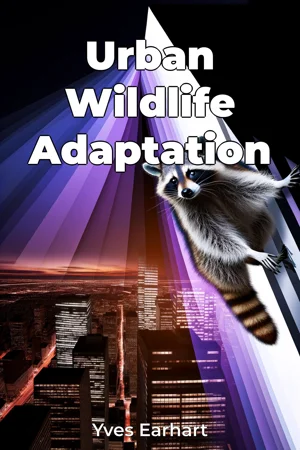
"Urban Wildlife Adaptation" reveals how animals and plants actively reshape their behaviors and life cycles to thrive in human-dominated landscapes, supported by extensive ecological research across global cities. The book examines three critical aspects of urban wildlife adaptation: behavioral modifications, genetic changes over generations, and the emergence of novel ecosystems within city environments. Through detailed field studies and long-term research programs, it demonstrates how urban pressures create unique evolutionary challenges that drive species to develop sophisticated survival strategies. The work builds on decades of urban ecology research, tracing the shift from viewing cities as biological deserts to recognizing them as dynamic ecosystems. Drawing from studies across six continents, the book presents evidence of rapid adaptations, including birds adjusting their song frequencies to overcome city noise, raccoons developing enhanced problem-solving abilities, and plants modifying their seed dispersal mechanisms in response to artificial surfaces. Central to the book's thesis is the concept that urban environments act as accelerated evolutionary laboratories, where species must adapt rapidly or disappear. This process creates measurable changes in wildlife populations, documented through methodical field observations, GPS tracking data, and genetic sampling spanning multiple generations of urban-dwelling species. The content progresses through systematic analysis of adaptation patterns, beginning with immediate behavioral responses, moving to physiological changes, and culminating in documented genetic shifts. Each chapter incorporates case studies from different global cities, supported by data from motion-sensor cameras, bioacoustic monitoring, and citizen science initiatives. The research methodology combines traditional ecological fieldwork with innovative urban-specific techniques, including thermal imaging for nocturnal species studies and artificial intelligence-driven pattern recognition for behavioral analysis. This approach provides robust evidence for adaptation patterns while acknowledging the challenges of conducting research in urban settings. The book connects urban wildlife studies with city planning, public health, and conservation biology. It demonstrates how understanding urban wildlife adaptation influences urban design decisions, public health policies regarding zoonotic diseases, and broader conservation strategies for endangered species. The writing maintains an academic foundation while incorporating narrative elements that make complex ecological concepts accessible to educated general readers. Technical terms are clearly defined, and scientific concepts are illustrated through specific examples and case studies. This work serves multiple audiences, including urban ecologists, city planners, conservation biologists, and informed citizens interested in human-wildlife coexistence. It provides practical insights for urban wildlife management while advancing theoretical understanding of rapid evolution in anthropogenic environments. The scope encompasses both well-studied urban adapters like pigeons and rats, and lesser-known examples of adaptation among insects, plants, and soil microorganisms. While focused primarily on contemporary adaptations, it acknowledges the limitations of current research in predicting long-term evolutionary outcomes. Readers can apply the insights to enhance urban biodiversity, reduce human-wildlife conflicts, and contribute to citizen science initiatives. The book addresses ongoing debates about whether urban adaptations represent true evolution or merely behavioral plasticity, and discusses the implications for species conservation in an increasingly urbanized world. This comprehensive examination of urban wildlife adaptation provides a foundation for understanding and supporting biodiversity in human-dominated landscapes, while contributing to the broader scientific understanding of evolutionary processes in rapidly changing environments.
"Urban Wildlife Adaptation" reveals how animals and plants actively reshape their behaviors and life cycles to thrive in human-dominated landscapes, supported by extensive ecological research across global cities. The book examines three critical aspects of urban wildlife adaptation: behavioral modifications, genetic changes over generations, and the emergence of novel ecosystems within city environments. Through detailed field studies and long-term research programs, it demonstrates how urban pressures create unique evolutionary challenges that drive species to develop sophisticated survival strategies. The work builds on decades of urban ecology research, tracing the shift from viewing cities as biological deserts to recognizing them as dynamic ecosystems. Drawing from studies across six continents, the book presents evidence of rapid adaptations, including birds adjusting their song frequencies to overcome city noise, raccoons developing enhanced problem-solving abilities, and plants modifying their seed dispersal mechanisms in response to artificial surfaces. Central to the book's thesis is the concept that urban environments act as accelerated evolutionary laboratories, where species must adapt rapidly or disappear. This process creates measurable changes in wildlife populations, documented through methodical field observations, GPS tracking data, and genetic sampling spanning multiple generations of urban-dwelling species. The content progresses through systematic analysis of adaptation patterns, beginning with immediate behavioral responses, moving to physiological changes, and culminating in documented genetic shifts. Each chapter incorporates case studies from different global cities, supported by data from motion-sensor cameras, bioacoustic monitoring, and citizen science initiatives. The research methodology combines traditional ecological fieldwork with innovative urban-specific techniques, including thermal imaging for nocturnal species studies and artificial intelligence-driven pattern recognition for behavioral analysis. This approach provides robust evidence for adaptation patterns while acknowledging the challenges of conducting research in urban settings. The book connects urban wildlife studies with city planning, public health, and conservation biology. It demonstrates how understanding urban wildlife adaptation influences urban design decisions, public health policies regarding zoonotic diseases, and broader conservation strategies for endangered species. The writing maintains an academic foundation while incorporating narrative elements that make complex ecological concepts accessible to educated general readers. Technical terms are clearly defined, and scientific concepts are illustrated through specific examples and case studies. This work serves multiple audiences, including urban ecologists, city planners, conservation biologists, and informed citizens interested in human-wildlife coexistence. It provides practical insights for urban wildlife management while advancing theoretical understanding of rapid evolution in anthropogenic environments. The scope encompasses both well-studied urban adapters like pigeons and rats, and lesser-known examples of adaptation among insects, plants, and soil microorganisms. While focused primarily on contemporary adaptations, it acknowledges the limitations of current research in predicting long-term evolutionary outcomes. Readers can apply the insights to enhance urban biodiversity, reduce human-wildlife conflicts, and contribute to citizen science initiatives. The book addresses ongoing debates about whether urban adaptations represent true evolution or merely behavioral plasticity, and discusses the implications for species conservation in an increasingly urbanized world. This comprehensive examination of urban wildlife adaptation provides a foundation for understanding and supporting biodiversity in human-dominated landscapes, while contributing to the broader scientific understanding of evolutionary processes in rapidly changing environments.
"Urban Wildlife Adaptation" presents a fascinating exploration of how animals and plants actively evolve and adapt to survive in human-dominated urban environments. The book challenges the outdated notion of cities as biological wastelands, instead revealing them as dynamic ecosystems where wildlife develops sophisticated survival strategies through behavioral, physiological, and genetic adaptations. Through compelling case studies spanning six continents, the book showcases remarkable examples of urban adaptation, including birds modifying their songs to overcome city noise and raccoons developing enhanced problem-solving abilities. The research combines traditional ecological fieldwork with cutting-edge technology, using tools like thermal imaging, GPS tracking, and AI-driven analysis to document these evolutionary changes. Each chapter builds systematically from immediate behavioral responses to long-term genetic modifications, supported by extensive field observations and citizen science initiatives. What sets this work apart is its comprehensive approach to understanding urban ecosystems, bridging the gap between academic research and practical applications. While maintaining scientific rigor, the book presents complex ecological concepts in an accessible manner, making it valuable for both professionals and educated general readers. The insights offered are particularly relevant for urban planners, conservationists, and anyone interested in promoting biodiversity in increasingly urbanized landscapes, providing practical solutions for human-wildlife coexistence while advancing our understanding of rapid evolution in anthropogenic environments.
Book Details
ISBN
9788233953102
Publisher
Publifye AS
Your Licenses
You don't own any licenses for this book
Purchase a license below to unlock this book and download the EPUB.
Purchase License
Select a tier to unlock this book
Need bulk licensing?
Contact us for enterprise agreements.