
About This Book
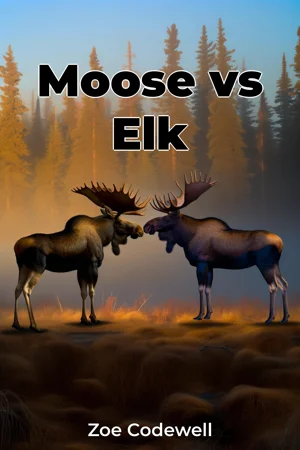
"Moose vs Elk" presents a detailed examination of North America's largest cervids, addressing common misconceptions and providing scientific insights into these often-confused species. Through systematic comparison and analysis, this book illuminates the distinct characteristics that separate these magnificent mammals. The text begins by establishing the evolutionary history of both species, tracing their divergence within the deer family (Cervidae) and their adaptation to different ecological niches. This foundation helps readers understand why these animals, despite their superficial similarities, have developed distinct traits and behaviors. Three primary sections form the core of the book. The first explores physical characteristics, comparing the moose's distinctive shoulder hump and bell with the elk's more compact build and lighter coloration. The second section examines habitat preferences, from the moose's affinity for boreal forests and wetlands to the elk's adaptation to various environments, including mountains, grasslands, and woodlands. The third section analyzes dietary patterns, detailing the moose's browsing habits versus the elk's grazing tendencies. The book incorporates current research from wildlife biologists, including GPS tracking data, population studies, and behavioral observations. These scientific findings are supported by high-resolution photography and detailed anatomical illustrations that highlight key differences between the species. Field studies from various regions across North America provide comprehensive data on migration patterns, social structures, and reproductive behaviors. Interdisciplinary connections link the main content to climate science, showing how environmental changes affect both species' ranges and behaviors. The text also explores these animals' roles in indigenous cultures and modern wildlife management practices, providing cultural and ecological context. The writing maintains an academic foundation while remaining accessible to general readers interested in wildlife biology. Technical terms are clearly defined, and complex concepts are explained through practical examples and real-world observations. Each chapter builds upon previous information, creating a cohesive understanding of both species. The target audience includes wildlife enthusiasts, biology students, and outdoor professionals who need to distinguish between these species accurately. The book serves as both a reference guide and an educational resource, offering practical identification tips for field observation. Conservation biology features prominently in the latter chapters, examining how habitat loss, human encroachment, and climate change affect both species differently. The book addresses current debates in wildlife management, including hunting regulations and habitat preservation strategies. The scope encompasses both species' full geographic ranges across North America, though it acknowledges regional variations and subspecies. While focused primarily on biological and ecological aspects, the book includes relevant information about human-wildlife interactions and management practices. Practical applications include species identification guidelines for wildlife photographers, hunters, and naturalists, along with protocols for safe wildlife viewing. The text also provides insights for land managers and conservation professionals working to protect these species' habitats. This comprehensive comparison fills a gap in wildlife literature by providing a detailed, science-based examination of two often-confused species, offering readers the tools and knowledge to understand their distinct roles in North American ecosystems.
"Moose vs Elk" presents a detailed examination of North America's largest cervids, addressing common misconceptions and providing scientific insights into these often-confused species. Through systematic comparison and analysis, this book illuminates the distinct characteristics that separate these magnificent mammals. The text begins by establishing the evolutionary history of both species, tracing their divergence within the deer family (Cervidae) and their adaptation to different ecological niches. This foundation helps readers understand why these animals, despite their superficial similarities, have developed distinct traits and behaviors. Three primary sections form the core of the book. The first explores physical characteristics, comparing the moose's distinctive shoulder hump and bell with the elk's more compact build and lighter coloration. The second section examines habitat preferences, from the moose's affinity for boreal forests and wetlands to the elk's adaptation to various environments, including mountains, grasslands, and woodlands. The third section analyzes dietary patterns, detailing the moose's browsing habits versus the elk's grazing tendencies. The book incorporates current research from wildlife biologists, including GPS tracking data, population studies, and behavioral observations. These scientific findings are supported by high-resolution photography and detailed anatomical illustrations that highlight key differences between the species. Field studies from various regions across North America provide comprehensive data on migration patterns, social structures, and reproductive behaviors. Interdisciplinary connections link the main content to climate science, showing how environmental changes affect both species' ranges and behaviors. The text also explores these animals' roles in indigenous cultures and modern wildlife management practices, providing cultural and ecological context. The writing maintains an academic foundation while remaining accessible to general readers interested in wildlife biology. Technical terms are clearly defined, and complex concepts are explained through practical examples and real-world observations. Each chapter builds upon previous information, creating a cohesive understanding of both species. The target audience includes wildlife enthusiasts, biology students, and outdoor professionals who need to distinguish between these species accurately. The book serves as both a reference guide and an educational resource, offering practical identification tips for field observation. Conservation biology features prominently in the latter chapters, examining how habitat loss, human encroachment, and climate change affect both species differently. The book addresses current debates in wildlife management, including hunting regulations and habitat preservation strategies. The scope encompasses both species' full geographic ranges across North America, though it acknowledges regional variations and subspecies. While focused primarily on biological and ecological aspects, the book includes relevant information about human-wildlife interactions and management practices. Practical applications include species identification guidelines for wildlife photographers, hunters, and naturalists, along with protocols for safe wildlife viewing. The text also provides insights for land managers and conservation professionals working to protect these species' habitats. This comprehensive comparison fills a gap in wildlife literature by providing a detailed, science-based examination of two often-confused species, offering readers the tools and knowledge to understand their distinct roles in North American ecosystems.
"Moose vs Elk" offers a comprehensive scientific exploration of North America's largest members of the deer family, delving into the distinct characteristics that set these frequently confused species apart. Through a systematic approach combining current research, GPS tracking data, and field studies, the book illuminates the fascinating differences between these magnificent mammals, from their physical attributes to their behavioral patterns. The book progresses logically through three main sections, beginning with evolutionary history before examining physical characteristics, habitat preferences, and dietary patterns. Readers learn how moose, with their distinctive shoulder humps and preference for boreal forests, differ fundamentally from elk, which sport a more compact build and adapt to diverse environments from mountains to grasslands. Particularly intriguing is the contrast between moose's browsing habits in wetland environments and elk's grazing tendencies across varied terrains. While maintaining scientific accuracy, the text remains accessible to general readers, incorporating practical applications for wildlife enthusiasts, photographers, and outdoor professionals. The book extends beyond pure biology to explore these animals' roles in indigenous cultures and modern conservation challenges, making it a valuable resource for understanding both species' places in North American ecosystems. Current research on climate change impacts and habitat conservation adds contemporary relevance to this thorough species comparison.
Book Details
ISBN
9788233952938
Publisher
Publifye AS
Your Licenses
You don't own any licenses for this book
Purchase a license below to unlock this book and download the EPUB.
Purchase License
Select a tier to unlock this book
Need bulk licensing?
Contact us for enterprise agreements.