
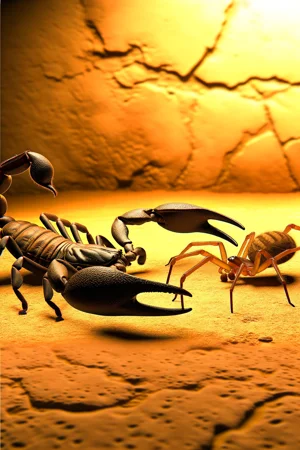
About This Book
"Spider vs Scorpion" delves into the complex world of two of Earth's most successful arachnid groups, examining how their evolutionary paths have led to distinct survival strategies despite sharing common ancestors. Through detailed scientific analysis and field observations, this book uncovers the biological mechanisms and behavioral patterns that have enabled these creatures to thrive for over 400 million years. The text systematically compares the hunting abilities, defensive mechanisms, and sensory systems of spiders and scorpions, revealing how these adaptations influence their ecological roles. Readers discover how spiders' web-building capabilities and scorpions' venomous stingers represent different solutions to similar survival challenges, demonstrating the diversity of evolutionary responses to environmental pressures. The book is structured in three main sections: First, it explores the shared ancestry and divergent evolution of these arachnids, supported by fossil records and genetic studies. The second section examines their distinct hunting strategies, from the mechanical engineering of spider silk to the sophisticated neurotoxins of scorpion venom. The final section investigates their roles in various ecosystems and their relationships with other species. Supporting evidence comes from recent scientific studies, including electron microscopy of silk structures, chemical analysis of venom compounds, and behavioral research from field stations worldwide. The text incorporates findings from genetics, biochemistry, and ecology to present a comprehensive understanding of these organisms. The book connects multiple scientific disciplines, linking molecular biology to ecosystem dynamics, and engineering to evolutionary biology. These connections demonstrate how studying arachnids has contributed to developments in biomaterials, pharmaceutical research, and robotics design. Written in a clear, methodical style, the text balances technical accuracy with accessibility, making complex concepts understandable to both biology students and informed general readers. Each chapter includes detailed diagrams, microscopy images, and field photographs that illustrate key concepts. The target audience includes undergraduate biology students, natural history enthusiasts, and professionals in related fields. The book serves as both a scholarly reference and an informative guide for those seeking to understand arachnid biology and evolution. Practical applications discussed include the development of new materials inspired by spider silk, potential medical applications of venom compounds, and ecological conservation strategies. The text addresses ongoing debates in arachnid classification and the evolution of venom systems, presenting current evidence and competing hypotheses. The scope encompasses both broad evolutionary patterns and specific mechanical and chemical processes, though it focuses primarily on species that have been well-studied in laboratory conditions. This approach provides reliable, verifiable information while acknowledging areas where research is still ongoing. The book maintains scientific objectivity while examining human-arachnid interactions, addressing common misconceptions and providing evidence-based insights into the behavior of these often-misunderstood creatures. It concludes by examining the conservation status of various spider and scorpion species, discussing their importance in maintaining ecosystem balance and their potential benefits to human society through biomimicry and pharmaceutical applications.
"Spider vs Scorpion" delves into the complex world of two of Earth's most successful arachnid groups, examining how their evolutionary paths have led to distinct survival strategies despite sharing common ancestors. Through detailed scientific analysis and field observations, this book uncovers the biological mechanisms and behavioral patterns that have enabled these creatures to thrive for over 400 million years. The text systematically compares the hunting abilities, defensive mechanisms, and sensory systems of spiders and scorpions, revealing how these adaptations influence their ecological roles. Readers discover how spiders' web-building capabilities and scorpions' venomous stingers represent different solutions to similar survival challenges, demonstrating the diversity of evolutionary responses to environmental pressures. The book is structured in three main sections: First, it explores the shared ancestry and divergent evolution of these arachnids, supported by fossil records and genetic studies. The second section examines their distinct hunting strategies, from the mechanical engineering of spider silk to the sophisticated neurotoxins of scorpion venom. The final section investigates their roles in various ecosystems and their relationships with other species. Supporting evidence comes from recent scientific studies, including electron microscopy of silk structures, chemical analysis of venom compounds, and behavioral research from field stations worldwide. The text incorporates findings from genetics, biochemistry, and ecology to present a comprehensive understanding of these organisms. The book connects multiple scientific disciplines, linking molecular biology to ecosystem dynamics, and engineering to evolutionary biology. These connections demonstrate how studying arachnids has contributed to developments in biomaterials, pharmaceutical research, and robotics design. Written in a clear, methodical style, the text balances technical accuracy with accessibility, making complex concepts understandable to both biology students and informed general readers. Each chapter includes detailed diagrams, microscopy images, and field photographs that illustrate key concepts. The target audience includes undergraduate biology students, natural history enthusiasts, and professionals in related fields. The book serves as both a scholarly reference and an informative guide for those seeking to understand arachnid biology and evolution. Practical applications discussed include the development of new materials inspired by spider silk, potential medical applications of venom compounds, and ecological conservation strategies. The text addresses ongoing debates in arachnid classification and the evolution of venom systems, presenting current evidence and competing hypotheses. The scope encompasses both broad evolutionary patterns and specific mechanical and chemical processes, though it focuses primarily on species that have been well-studied in laboratory conditions. This approach provides reliable, verifiable information while acknowledging areas where research is still ongoing. The book maintains scientific objectivity while examining human-arachnid interactions, addressing common misconceptions and providing evidence-based insights into the behavior of these often-misunderstood creatures. It concludes by examining the conservation status of various spider and scorpion species, discussing their importance in maintaining ecosystem balance and their potential benefits to human society through biomimicry and pharmaceutical applications.
"Spider vs Scorpion" offers a fascinating exploration of two remarkable arachnid groups, unraveling their 400-million-year evolutionary journey and the distinct survival strategies they've developed from common origins. The book masterfully compares these creatures through multiple scientific lenses, from their hunting abilities to their sophisticated defensive mechanisms, revealing how spider silk and scorpion venom represent divergent solutions to similar survival challenges. The narrative progresses through three comprehensive sections, beginning with their shared ancestry and evolutionary divergence, supported by fossil evidence and genetic studies. Moving through detailed examinations of their hunting strategies and defensive mechanisms, the book culminates in an analysis of their ecological roles and relationships with other species. Cutting-edge research, including electron microscopy of silk structures and chemical analysis of venom compounds, provides readers with the latest scientific understanding of these remarkable creatures. What sets this book apart is its interdisciplinary approach, connecting molecular biology, ecosystem dynamics, and engineering principles to demonstrate how arachnid research contributes to developments in biomaterials and pharmaceutical research. Written in clear, accessible language while maintaining scientific rigor, it serves both as a scholarly reference and an engaging guide for biology students and nature enthusiasts. The inclusion of detailed diagrams, microscopy images, and field photographs helps readers visualize complex concepts, making the material more accessible and memorable.
Book Details
ISBN
9788233952846
Publisher
Publifye AS
Your Licenses
You don't own any licenses for this book
Purchase a license below to unlock this book and download the EPUB.
Purchase License
Select a tier to unlock this book
Need bulk licensing?
Contact us for enterprise agreements.