
About This Book
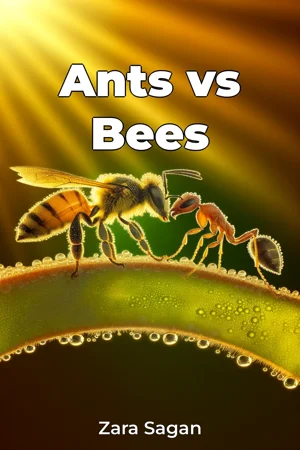
"Ants vs Bees" delves into the sophisticated social systems of two of Earth's most successful insect societies, revealing how their organizational structures have enabled their species to thrive for over 100 million years. Through detailed scientific analysis and field research, this book examines the parallel evolution of these insects' complex communities while highlighting their distinct approaches to survival. The book presents three core themes: collective decision-making processes, division of labor systems, and communication networks. Each theme is explored through comparative analysis, demonstrating how ants and bees have developed different solutions to similar ecological challenges. The research draws from decades of myrmecological and apiological studies, including recent discoveries in chemical communication and behavioral patterns. Starting with an evolutionary context, the text traces the development of eusocial behavior from solitary insects to the complex colonies we observe today. This foundation helps readers understand how these insects' current social structures emerged and why they proved so effective for species survival. The book's central argument posits that while ants and bees share fundamental social principles, they have evolved distinct organizational approaches that optimize their survival in different environmental niches. This thesis is supported through examination of colony structure, reproductive strategies, and resource management systems. The content progresses through systematic comparison of both species. Chapter one explores colony architecture and organization, from ant tunnels to honeycomb construction. Chapter two examines communication methods, contrasting ant pheromone trails with bee waggle dances. Chapter three analyzes decision-making processes, including nest-site selection and foraging strategies. Evidence is drawn from multiple sources, including laboratory studies, field observations, and advanced imaging techniques. The book incorporates recent research using RFID tracking of individual insects and computer modeling of colony behaviors, providing precise data on movement patterns and social interactions. The work connects to various scientific disciplines, including chemistry (through analysis of pheromones), physics (in studying structural engineering of nests), and mathematics (in examining decision-making algorithms). These interdisciplinary connections demonstrate how social insects have inspired innovations in fields from robotics to urban planning. The book's unique approach lies in its direct comparative analysis, moving beyond traditional single-species studies to reveal patterns in social evolution. The writing maintains an analytical tone while remaining accessible to non-specialists, using clear analogies and detailed illustrations to explain complex concepts. Written for both biology enthusiasts and professional researchers, the book serves as a comprehensive reference while engaging general readers interested in natural history. It adheres to scientific rigor while presenting information in a structured, comprehensible format. The scope encompasses both laboratory findings and field observations, though it primarily focuses on species found in temperate and tropical regions. The book addresses current debates in the field, including questions about individual vs. collective intelligence and the role of genetic predisposition in social behavior. Practical applications include insights for human organizational systems, sustainable agriculture practices, and biomimicry in engineering. The text provides readers with tools to observe and understand social insect behavior in their local environment, promoting citizen science and environmental awareness. The work maintains scientific objectivity while acknowledging areas where further research is needed, particularly regarding the neurological basis of social behavior and the impact of environmental changes on colony dynamics.
"Ants vs Bees" delves into the sophisticated social systems of two of Earth's most successful insect societies, revealing how their organizational structures have enabled their species to thrive for over 100 million years. Through detailed scientific analysis and field research, this book examines the parallel evolution of these insects' complex communities while highlighting their distinct approaches to survival. The book presents three core themes: collective decision-making processes, division of labor systems, and communication networks. Each theme is explored through comparative analysis, demonstrating how ants and bees have developed different solutions to similar ecological challenges. The research draws from decades of myrmecological and apiological studies, including recent discoveries in chemical communication and behavioral patterns. Starting with an evolutionary context, the text traces the development of eusocial behavior from solitary insects to the complex colonies we observe today. This foundation helps readers understand how these insects' current social structures emerged and why they proved so effective for species survival. The book's central argument posits that while ants and bees share fundamental social principles, they have evolved distinct organizational approaches that optimize their survival in different environmental niches. This thesis is supported through examination of colony structure, reproductive strategies, and resource management systems. The content progresses through systematic comparison of both species. Chapter one explores colony architecture and organization, from ant tunnels to honeycomb construction. Chapter two examines communication methods, contrasting ant pheromone trails with bee waggle dances. Chapter three analyzes decision-making processes, including nest-site selection and foraging strategies. Evidence is drawn from multiple sources, including laboratory studies, field observations, and advanced imaging techniques. The book incorporates recent research using RFID tracking of individual insects and computer modeling of colony behaviors, providing precise data on movement patterns and social interactions. The work connects to various scientific disciplines, including chemistry (through analysis of pheromones), physics (in studying structural engineering of nests), and mathematics (in examining decision-making algorithms). These interdisciplinary connections demonstrate how social insects have inspired innovations in fields from robotics to urban planning. The book's unique approach lies in its direct comparative analysis, moving beyond traditional single-species studies to reveal patterns in social evolution. The writing maintains an analytical tone while remaining accessible to non-specialists, using clear analogies and detailed illustrations to explain complex concepts. Written for both biology enthusiasts and professional researchers, the book serves as a comprehensive reference while engaging general readers interested in natural history. It adheres to scientific rigor while presenting information in a structured, comprehensible format. The scope encompasses both laboratory findings and field observations, though it primarily focuses on species found in temperate and tropical regions. The book addresses current debates in the field, including questions about individual vs. collective intelligence and the role of genetic predisposition in social behavior. Practical applications include insights for human organizational systems, sustainable agriculture practices, and biomimicry in engineering. The text provides readers with tools to observe and understand social insect behavior in their local environment, promoting citizen science and environmental awareness. The work maintains scientific objectivity while acknowledging areas where further research is needed, particularly regarding the neurological basis of social behavior and the impact of environmental changes on colony dynamics.
"Ants vs Bees" offers a fascinating exploration of Earth's most successful insect societies, comparing how these remarkable creatures have developed distinct approaches to social living over 100 million years of evolution. This comprehensive examination reveals the sophisticated organizational structures that enable both species to thrive, while highlighting their unique adaptations to different environmental challenges. The book masterfully weaves together three core themes: collective decision-making, labor division, and communication networks. Through detailed scientific analysis, readers discover how ant colonies rely primarily on pheromone trails for communication, while bees have evolved their famous waggle dance to share information. The systematic comparison progresses from colony architecture and organization to communication methods and complex decision-making processes, incorporating cutting-edge research using RFID tracking and computer modeling. What sets this work apart is its interdisciplinary approach, connecting insights from chemistry, physics, and mathematics to explain how these social insects have inspired innovations in various fields. The accessible writing style makes complex concepts understandable through clear analogies and examples, while maintaining scientific rigor. Whether examining ant tunnel networks or honeycomb construction, the book demonstrates how these parallel but distinct evolutionary paths have led to remarkably successful survival strategies, offering valuable insights for both scientific researchers and nature enthusiasts.
Book Details
ISBN
9788233952730
Publisher
Publifye AS
Your Licenses
You don't own any licenses for this book
Purchase a license below to unlock this book and download the EPUB.
Purchase License
Select a tier to unlock this book
Need bulk licensing?
Contact us for enterprise agreements.