
About This Book
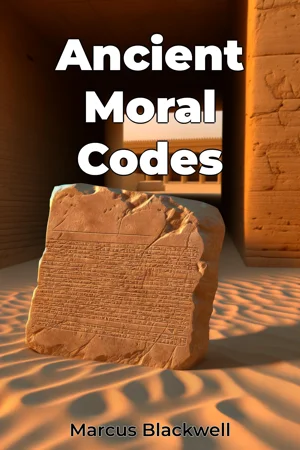
"Ancient Moral Codes" examines how early civilizations developed ethical frameworks that continue to influence modern moral philosophy and societal values. From the Code of Hammurabi to Confucian principles, this comprehensive analysis reveals the intricate connections between ancient wisdom and contemporary ethical challenges. The book presents three primary themes: the universal patterns in moral development across civilizations, the role of religious and secular authorities in codifying ethical behavior, and the transmission of moral principles through cultural exchange. These interconnected topics demonstrate how early societies established foundational concepts of justice, fairness, and social responsibility that remain relevant today. Drawing from archaeological evidence, preserved texts, and scholarly interpretations, the work examines moral codes from Mesopotamia, Egypt, Greece, India, and China, spanning from 3000 BCE to 500 CE. The analysis reveals how geographic, economic, and social factors shaped these ethical systems, while identifying surprising commonalities in their core principles. The central thesis argues that modern moral frameworks are built upon recurring ethical patterns established by ancient civilizations, demonstrating both the universality of certain moral concepts and their cultural adaptability. This understanding provides crucial context for contemporary ethical debates and policy-making decisions. The book's structure progresses chronologically and geographically, beginning with early Mesopotamian codes and expanding outward. Each chapter examines specific civilizations' moral systems, supported by primary source translations, archaeological findings, and current academic research. The work concludes by tracing these ancient principles' evolution into modern ethical frameworks. Research methodology combines archaeological evidence, linguistic analysis of ancient texts, and comparative historical studies. The book features recent findings from excavations in the Middle East and Asia, along with updated translations of key moral texts and treaties. The interdisciplinary approach integrates anthropology, sociology, and political science, demonstrating how ancient moral codes influenced legal systems, social structures, and governance models. These connections help readers understand how ethical principles shaped civilizations' development and continue to influence modern institutions. Written in an academic yet accessible style, the book provides clear explanations of complex concepts while maintaining scholarly rigor. Technical terms are carefully defined, and historical context is provided to ensure readers can follow the development of moral thinking across different cultures and periods. The work serves scholars, students, and general readers interested in ethics, history, and social development. It provides valuable insights for those studying law, philosophy, religious studies, or cultural anthropology, while remaining accessible to non-specialists interested in understanding the historical roots of modern moral thinking. The scope encompasses major civilizations of the ancient world, focusing on documented ethical systems with verifiable historical evidence. While acknowledging gaps in historical records, the book uses comparative analysis to develop well-supported conclusions about moral development patterns. Practical applications include insights for modern ethical decision-making, policy development, and cross-cultural understanding. The work addresses current debates about universal values versus cultural relativism, providing historical context for contemporary moral discussions. The book maintains an objective stance while examining competing interpretations of historical evidence. It addresses scholarly disagreements about the interpretation of ancient texts and the relative influence of different moral systems on modern thought. This systematic examination of ancient moral codes provides readers with a deeper understanding of how early ethical systems continue to shape modern moral frameworks and social structures.
"Ancient Moral Codes" examines how early civilizations developed ethical frameworks that continue to influence modern moral philosophy and societal values. From the Code of Hammurabi to Confucian principles, this comprehensive analysis reveals the intricate connections between ancient wisdom and contemporary ethical challenges. The book presents three primary themes: the universal patterns in moral development across civilizations, the role of religious and secular authorities in codifying ethical behavior, and the transmission of moral principles through cultural exchange. These interconnected topics demonstrate how early societies established foundational concepts of justice, fairness, and social responsibility that remain relevant today. Drawing from archaeological evidence, preserved texts, and scholarly interpretations, the work examines moral codes from Mesopotamia, Egypt, Greece, India, and China, spanning from 3000 BCE to 500 CE. The analysis reveals how geographic, economic, and social factors shaped these ethical systems, while identifying surprising commonalities in their core principles. The central thesis argues that modern moral frameworks are built upon recurring ethical patterns established by ancient civilizations, demonstrating both the universality of certain moral concepts and their cultural adaptability. This understanding provides crucial context for contemporary ethical debates and policy-making decisions. The book's structure progresses chronologically and geographically, beginning with early Mesopotamian codes and expanding outward. Each chapter examines specific civilizations' moral systems, supported by primary source translations, archaeological findings, and current academic research. The work concludes by tracing these ancient principles' evolution into modern ethical frameworks. Research methodology combines archaeological evidence, linguistic analysis of ancient texts, and comparative historical studies. The book features recent findings from excavations in the Middle East and Asia, along with updated translations of key moral texts and treaties. The interdisciplinary approach integrates anthropology, sociology, and political science, demonstrating how ancient moral codes influenced legal systems, social structures, and governance models. These connections help readers understand how ethical principles shaped civilizations' development and continue to influence modern institutions. Written in an academic yet accessible style, the book provides clear explanations of complex concepts while maintaining scholarly rigor. Technical terms are carefully defined, and historical context is provided to ensure readers can follow the development of moral thinking across different cultures and periods. The work serves scholars, students, and general readers interested in ethics, history, and social development. It provides valuable insights for those studying law, philosophy, religious studies, or cultural anthropology, while remaining accessible to non-specialists interested in understanding the historical roots of modern moral thinking. The scope encompasses major civilizations of the ancient world, focusing on documented ethical systems with verifiable historical evidence. While acknowledging gaps in historical records, the book uses comparative analysis to develop well-supported conclusions about moral development patterns. Practical applications include insights for modern ethical decision-making, policy development, and cross-cultural understanding. The work addresses current debates about universal values versus cultural relativism, providing historical context for contemporary moral discussions. The book maintains an objective stance while examining competing interpretations of historical evidence. It addresses scholarly disagreements about the interpretation of ancient texts and the relative influence of different moral systems on modern thought. This systematic examination of ancient moral codes provides readers with a deeper understanding of how early ethical systems continue to shape modern moral frameworks and social structures.
"Ancient Moral Codes" offers a fascinating exploration of how early civilizations developed ethical frameworks that continue to shape our modern moral understanding. This comprehensive analysis spans from 3000 BCE to 500 CE, examining the intricate moral systems developed across Mesopotamia, Egypt, Greece, India, and China. Through careful examination of archaeological evidence and preserved texts, the book reveals how these ancient societies established fundamental concepts of justice, fairness, and social responsibility that remain surprisingly relevant in today's world. The book's journey through ancient ethical systems unveils three crucial themes: universal patterns in moral development, the influence of religious and secular authorities in establishing ethical codes, and the transmission of moral principles through cultural exchange. By examining iconic examples like the Code of Hammurabi alongside lesser-known moral frameworks, readers discover how geographic, economic, and social factors shaped these ethical systems while maintaining certain universal principles. What makes this work particularly valuable is its ability to connect ancient wisdom with contemporary challenges, demonstrating how ancient moral codes continue to influence modern policy-making and ethical debates. Moving chronologically and geographically, the book combines archaeological findings, linguistic analysis, and comparative historical studies to present a clear picture of moral development across civilizations. Its interdisciplinary approach makes complex philosophical concepts accessible while maintaining scholarly rigor, offering valuable insights for both academics and general readers interested in understanding the historical roots of modern moral thinking. The work effectively bridges the gap between ancient wisdom and contemporary ethical challenges, providing a unique perspective on how early moral codes continue to resonate in today's global society.
Book Details
ISBN
9788233951238
Publisher
Publifye AS
Your Licenses
You don't own any licenses for this book
Purchase a license below to unlock this book and download the EPUB.
Purchase License
Select a tier to unlock this book
Need bulk licensing?
Contact us for enterprise agreements.