
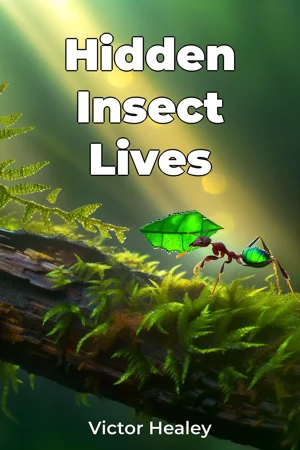
About This Book
"Hidden Insect Lives" unveils the intricate networks of insect behavior that shape Earth's ecosystems, challenging common perceptions of these small but influential organisms. From underground colonies to forest canopies, this comprehensive exploration examines how insects maintain ecological balance through their diverse roles as pollinators, decomposers, and vital food chain components. The book presents three central themes: the complex social structures of insect communities, their ecological functions across different habitats, and their adaptive behaviors in response to environmental changes. These topics are particularly relevant as global ecosystems face unprecedented pressures, making understanding insect roles crucial for conservation and agricultural planning. Drawing from decades of entomological research, the text builds upon foundational studies from pioneers like E.O. Wilson while incorporating recent discoveries in chemical ecology and behavioral science. Readers receive essential background in insect morphology and classification, creating a framework for understanding more complex concepts. The central argument demonstrates that insects serve as key indicators of ecosystem health while performing vital functions that maintain biological systems. This thesis is developed through systematic examination of various insect groups and their ecological contributions, supported by field studies, laboratory research, and long-term population data. The book's structure progresses from individual insect behaviors to broader ecosystem impacts. Early chapters examine social organization in species like ants and termites, followed by sections on insect-plant relationships and predator-prey dynamics. The final portion addresses conservation implications and future research directions. Research evidence includes data from multi-year field studies, advanced imaging techniques revealing previously unknown behaviors, and genetic analyses explaining evolutionary adaptations. The work incorporates findings from international research teams across various climates and habitats. Interdisciplinary connections link entomology with climate science, agriculture, and urban planning. The text explores how insect behavior studies inform sustainable farming practices and help predict ecosystem responses to environmental change. The book's unique approach lies in its integration of traditional observational methods with cutting-edge technology, revealing previously hidden aspects of insect life. Time-lapse photography and micro-sensors provide new insights into nocturnal behaviors and underground activities. Written in an accessible academic style, the text balances scientific rigor with engaging narratives of field research and discovery. Technical concepts are explained through clear examples and detailed illustrations, making complex information digestible for both students and general readers. The primary audience includes biology students, environmental scientists, and informed general readers interested in natural history. The content serves as both an academic reference and a source of practical knowledge for conservation work and habitat management. While covering major insect orders and their ecological roles, the book focuses specifically on behavioral aspects rather than attempting comprehensive taxonomic coverage. This targeted approach allows for deeper exploration of key behavioral patterns and their environmental implications. Practical applications include guidance for habitat conservation, agricultural pest management, and urban planning that considers insect ecology. The text provides frameworks for monitoring ecosystem health through insect population indicators. The work addresses ongoing debates about insect population decline, the impact of pesticides on beneficial species, and the role of insects in future food security. These discussions are presented with current research data and multiple scientific perspectives.
"Hidden Insect Lives" unveils the intricate networks of insect behavior that shape Earth's ecosystems, challenging common perceptions of these small but influential organisms. From underground colonies to forest canopies, this comprehensive exploration examines how insects maintain ecological balance through their diverse roles as pollinators, decomposers, and vital food chain components. The book presents three central themes: the complex social structures of insect communities, their ecological functions across different habitats, and their adaptive behaviors in response to environmental changes. These topics are particularly relevant as global ecosystems face unprecedented pressures, making understanding insect roles crucial for conservation and agricultural planning. Drawing from decades of entomological research, the text builds upon foundational studies from pioneers like E.O. Wilson while incorporating recent discoveries in chemical ecology and behavioral science. Readers receive essential background in insect morphology and classification, creating a framework for understanding more complex concepts. The central argument demonstrates that insects serve as key indicators of ecosystem health while performing vital functions that maintain biological systems. This thesis is developed through systematic examination of various insect groups and their ecological contributions, supported by field studies, laboratory research, and long-term population data. The book's structure progresses from individual insect behaviors to broader ecosystem impacts. Early chapters examine social organization in species like ants and termites, followed by sections on insect-plant relationships and predator-prey dynamics. The final portion addresses conservation implications and future research directions. Research evidence includes data from multi-year field studies, advanced imaging techniques revealing previously unknown behaviors, and genetic analyses explaining evolutionary adaptations. The work incorporates findings from international research teams across various climates and habitats. Interdisciplinary connections link entomology with climate science, agriculture, and urban planning. The text explores how insect behavior studies inform sustainable farming practices and help predict ecosystem responses to environmental change. The book's unique approach lies in its integration of traditional observational methods with cutting-edge technology, revealing previously hidden aspects of insect life. Time-lapse photography and micro-sensors provide new insights into nocturnal behaviors and underground activities. Written in an accessible academic style, the text balances scientific rigor with engaging narratives of field research and discovery. Technical concepts are explained through clear examples and detailed illustrations, making complex information digestible for both students and general readers. The primary audience includes biology students, environmental scientists, and informed general readers interested in natural history. The content serves as both an academic reference and a source of practical knowledge for conservation work and habitat management. While covering major insect orders and their ecological roles, the book focuses specifically on behavioral aspects rather than attempting comprehensive taxonomic coverage. This targeted approach allows for deeper exploration of key behavioral patterns and their environmental implications. Practical applications include guidance for habitat conservation, agricultural pest management, and urban planning that considers insect ecology. The text provides frameworks for monitoring ecosystem health through insect population indicators. The work addresses ongoing debates about insect population decline, the impact of pesticides on beneficial species, and the role of insects in future food security. These discussions are presented with current research data and multiple scientific perspectives.
"Hidden Insect Lives" offers a fascinating journey into the intricate world of insect behavior and its profound impact on Earth's ecosystems. This comprehensive exploration reveals how these small creatures maintain ecological balance through their roles as pollinators, decomposers, and vital links in the food chain, while challenging common misconceptions about their importance in our world. The book masterfully progresses from examining individual insect behaviors to their broader ecosystem effects, incorporating both traditional research methods and cutting-edge technology. Through detailed studies of social insects like ants and termites, readers discover complex community structures that rival human societies in their sophistication. Particularly compelling are the revelations about underground colonies and forest canopy communities, where advanced imaging techniques have uncovered previously unknown behavioral patterns and survival strategies. Building on classic entomological studies while incorporating recent discoveries in chemical ecology and behavioral science, the text bridges the gap between academic research and practical applications. This approach makes it invaluable for both students and conservation practitioners, offering insights into how insect behavior studies inform sustainable farming practices and ecosystem management. The book's unique strength lies in its ability to present complex scientific concepts through engaging narratives and clear examples, making it accessible to anyone interested in natural history while maintaining its scientific rigor.
Book Details
ISBN
9788233950880
Publisher
Publifye AS
Your Licenses
You don't own any licenses for this book
Purchase a license below to unlock this book and download the EPUB.
Purchase License
Select a tier to unlock this book
Need bulk licensing?
Contact us for enterprise agreements.