
About This Book
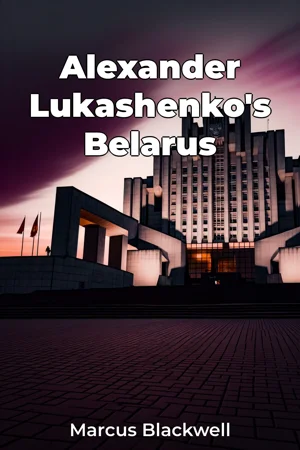
"Alexander Lukashenko's Belarus" examines the transformation of Eastern Europe's last authoritarian state through the lens of its controversial leader's 27-year rule. This comprehensive analysis delves into how a former collective farm director rose to become Belarus's first and only president, maintaining power through a combination of Soviet-style governance and strategic relationships with both Russia and the West. The book systematically explores three primary themes: Lukashenko's consolidation of power during the 1990s, his economic model of state-controlled markets, and Belarus's precarious position between Russia and the European Union. Through detailed examination of government documents, diplomatic communications, and first-hand accounts from former officials, the text illuminates the mechanisms that have sustained Europe's longest-serving head of state. The central argument posits that Lukashenko's longevity stems from his ability to maintain a delicate balance between preserving Soviet-era stability and selectively implementing market reforms, while expertly manipulating external powers for domestic advantage. The book presents evidence from economic data, policy analysis, and diplomatic archives to demonstrate how this approach has created a unique hybrid system that defies conventional political categorization. Structured chronologically, the narrative begins with Belarus's transition from Soviet republic to independent state, followed by Lukashenko's rise to power in 1994. Subsequent chapters examine key periods: the constitutional reforms of 1996, the implementation of the "Belarusian economic model" in the early 2000s, and the increasing tensions with both Western democracies and Russia from 2008 onward. The final section addresses the contested 2020 election and its aftermath, analyzing the most significant challenge to Lukashenko's authority to date. The research draws from previously unavailable government archives, interviews with former officials, and economic data from both Belarusian and international sources. This methodology provides readers with unprecedented insight into the decision-making processes within Lukashenko's administration. The book connects political science, economics, and international relations, demonstrating how domestic policy choices intersect with geopolitical pressures in post-Soviet spaces. It particularly emphasizes the role of state institutions in maintaining political control and economic stability. Written in an academic yet accessible style, the text targets political analysts, scholars of post-Soviet studies, and informed readers interested in contemporary European affairs. The analysis maintains objectivity while addressing controversial aspects of Lukashenko's leadership, including election manipulation, media control, and human rights concerns. The book's scope encompasses the entire period of Lukashenko's rule while focusing particularly on pivotal moments that shaped modern Belarus. It examines both domestic policies and international relations, though it necessarily excludes certain classified information still held by various governments. For policymakers and analysts, the book offers practical insights into dealing with authoritarian regimes in the post-Soviet space. It provides valuable context for understanding similar political dynamics in other former Soviet republics and the challenges of democratic transition in Eastern Europe. The work addresses ongoing debates about the sustainability of authoritarian governance in the 21st century, the effectiveness of Western sanctions policies, and the future of Russian influence in its near abroad. It presents multiple perspectives on these issues while maintaining analytical rigor and factual accuracy. Human rights organizations, democracy advocates, and foreign policy professionals will find particular value in understanding the internal mechanisms that have allowed Lukashenko's system to persist, despite international pressure and domestic opposition.
"Alexander Lukashenko's Belarus" examines the transformation of Eastern Europe's last authoritarian state through the lens of its controversial leader's 27-year rule. This comprehensive analysis delves into how a former collective farm director rose to become Belarus's first and only president, maintaining power through a combination of Soviet-style governance and strategic relationships with both Russia and the West. The book systematically explores three primary themes: Lukashenko's consolidation of power during the 1990s, his economic model of state-controlled markets, and Belarus's precarious position between Russia and the European Union. Through detailed examination of government documents, diplomatic communications, and first-hand accounts from former officials, the text illuminates the mechanisms that have sustained Europe's longest-serving head of state. The central argument posits that Lukashenko's longevity stems from his ability to maintain a delicate balance between preserving Soviet-era stability and selectively implementing market reforms, while expertly manipulating external powers for domestic advantage. The book presents evidence from economic data, policy analysis, and diplomatic archives to demonstrate how this approach has created a unique hybrid system that defies conventional political categorization. Structured chronologically, the narrative begins with Belarus's transition from Soviet republic to independent state, followed by Lukashenko's rise to power in 1994. Subsequent chapters examine key periods: the constitutional reforms of 1996, the implementation of the "Belarusian economic model" in the early 2000s, and the increasing tensions with both Western democracies and Russia from 2008 onward. The final section addresses the contested 2020 election and its aftermath, analyzing the most significant challenge to Lukashenko's authority to date. The research draws from previously unavailable government archives, interviews with former officials, and economic data from both Belarusian and international sources. This methodology provides readers with unprecedented insight into the decision-making processes within Lukashenko's administration. The book connects political science, economics, and international relations, demonstrating how domestic policy choices intersect with geopolitical pressures in post-Soviet spaces. It particularly emphasizes the role of state institutions in maintaining political control and economic stability. Written in an academic yet accessible style, the text targets political analysts, scholars of post-Soviet studies, and informed readers interested in contemporary European affairs. The analysis maintains objectivity while addressing controversial aspects of Lukashenko's leadership, including election manipulation, media control, and human rights concerns. The book's scope encompasses the entire period of Lukashenko's rule while focusing particularly on pivotal moments that shaped modern Belarus. It examines both domestic policies and international relations, though it necessarily excludes certain classified information still held by various governments. For policymakers and analysts, the book offers practical insights into dealing with authoritarian regimes in the post-Soviet space. It provides valuable context for understanding similar political dynamics in other former Soviet republics and the challenges of democratic transition in Eastern Europe. The work addresses ongoing debates about the sustainability of authoritarian governance in the 21st century, the effectiveness of Western sanctions policies, and the future of Russian influence in its near abroad. It presents multiple perspectives on these issues while maintaining analytical rigor and factual accuracy. Human rights organizations, democracy advocates, and foreign policy professionals will find particular value in understanding the internal mechanisms that have allowed Lukashenko's system to persist, despite international pressure and domestic opposition.
"Alexander Lukashenko's Belarus" offers a compelling examination of Eastern Europe's longest-serving head of state and his unprecedented 27-year grip on power. The book meticulously traces how a former collective farm director transformed Belarus into a unique hybrid state, maintaining authority through a delicate balance of Soviet-style governance and selective market reforms, while skillfully navigating relationships with both Russia and the West. Through extensive research drawing from previously unavailable government archives and firsthand accounts, the book chronicles Lukashenko's journey from his rise to power in 1994 through the watershed 2020 election. The narrative explores three crucial elements of his regime: power consolidation in the 1990s, the development of a state-controlled economic model, and Belarus's careful positioning between Russian influence and European interests. Particularly fascinating is how Lukashenko's administration has managed to maintain stability by preserving Soviet-era structures while selectively adopting modern reforms. The book progresses chronologically, examining pivotal moments such as the 1996 constitutional reforms and the implementation of the distinctive "Belarusian economic model" in the early 2000s. What makes this analysis particularly valuable is its comprehensive approach to understanding authoritarian governance in the post-Soviet space, combining insights from political science, economics, and international relations. For scholars, policymakers, and readers interested in contemporary European affairs, it provides crucial context for understanding both Belarus's unique political landscape and broader regional dynamics.
Book Details
ISBN
9788233950576
Publisher
Publifye AS
Your Licenses
You don't own any licenses for this book
Purchase a license below to unlock this book and download the EPUB.
Purchase License
Select a tier to unlock this book
Need bulk licensing?
Contact us for enterprise agreements.