
About This Book
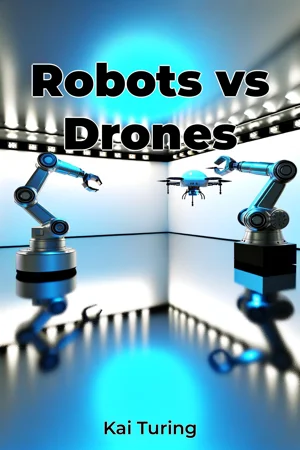
"Robots vs Drones" presents a systematic analysis of two transformative technologies that are reshaping industries, commerce, and daily life in the 21st century. The book examines how these distinct technologies serve different yet complementary roles in automation and remote operations, providing readers with a comprehensive understanding of their capabilities, limitations, and future potential. The work begins by establishing clear technical definitions of robots and drones, addressing common misconceptions and highlighting their fundamental differences in design, function, and application. Through detailed case studies and industry data, the book demonstrates how robots excel in structured, repetitive tasks requiring precision and physical manipulation, while drones offer unparalleled mobility and aerial perspectives for tasks ranging from surveillance to delivery services. The first section explores industrial robotics, examining how manufacturing facilities utilize robotic systems for assembly, welding, and quality control. It presents data from major automotive and electronics manufacturers, showing productivity gains and error reduction rates achieved through robotic implementation. The analysis extends to collaborative robots (cobots) and their integration with human workers, addressing safety protocols and workplace dynamics. The drone technology section investigates both commercial and consumer applications, from agricultural monitoring to cinematography. The book provides technical specifications, regulatory frameworks, and operational guidelines that govern drone usage across different sectors. It includes recent developments in autonomous flight systems, obstacle avoidance, and artificial intelligence integration that enhance drone capabilities. A significant portion of the content focuses on the convergence of robotics and drone technologies, presenting emerging hybrid systems that combine ground-based mobility with aerial capabilities. The book draws from research conducted at leading robotics laboratories and drone manufacturers, incorporating interviews with engineers, industry leaders, and end-users to provide multiple perspectives on technological advancement. The work maintains an objective, technical tone while remaining accessible to readers with basic technology literacy. It addresses critical considerations including ethical implications, privacy concerns, and economic impact, supported by current market analysis and employment data. The text includes detailed diagrams, technical specifications, and real-world implementation examples, making it valuable for both industry professionals and technology enthusiasts. Interdisciplinary connections are drawn to computer science, mechanical engineering, and logistics management, demonstrating how advances in these fields contribute to robotic and drone development. The book examines regulatory frameworks across different countries, providing context for international deployment and operation of these technologies. The target audience includes technology professionals, business decision-makers, and students in engineering or computer science fields. The content is structured to provide both theoretical understanding and practical implementation guidance, with each chapter including technical specifications, application examples, and future development trajectories. While maintaining focus on current technologies, the book addresses emerging trends such as swarm robotics, autonomous systems, and artificial intelligence integration. It examines how these developments may influence future applications while acknowledging current technological limitations and challenges. The work concludes by presenting a balanced view of how robots and drones will continue to evolve and complement each other, rather than compete, in various applications. It provides readers with frameworks for evaluating which technology best suits specific operational needs, supported by decision matrices and case studies from diverse industries.
"Robots vs Drones" presents a systematic analysis of two transformative technologies that are reshaping industries, commerce, and daily life in the 21st century. The book examines how these distinct technologies serve different yet complementary roles in automation and remote operations, providing readers with a comprehensive understanding of their capabilities, limitations, and future potential. The work begins by establishing clear technical definitions of robots and drones, addressing common misconceptions and highlighting their fundamental differences in design, function, and application. Through detailed case studies and industry data, the book demonstrates how robots excel in structured, repetitive tasks requiring precision and physical manipulation, while drones offer unparalleled mobility and aerial perspectives for tasks ranging from surveillance to delivery services. The first section explores industrial robotics, examining how manufacturing facilities utilize robotic systems for assembly, welding, and quality control. It presents data from major automotive and electronics manufacturers, showing productivity gains and error reduction rates achieved through robotic implementation. The analysis extends to collaborative robots (cobots) and their integration with human workers, addressing safety protocols and workplace dynamics. The drone technology section investigates both commercial and consumer applications, from agricultural monitoring to cinematography. The book provides technical specifications, regulatory frameworks, and operational guidelines that govern drone usage across different sectors. It includes recent developments in autonomous flight systems, obstacle avoidance, and artificial intelligence integration that enhance drone capabilities. A significant portion of the content focuses on the convergence of robotics and drone technologies, presenting emerging hybrid systems that combine ground-based mobility with aerial capabilities. The book draws from research conducted at leading robotics laboratories and drone manufacturers, incorporating interviews with engineers, industry leaders, and end-users to provide multiple perspectives on technological advancement. The work maintains an objective, technical tone while remaining accessible to readers with basic technology literacy. It addresses critical considerations including ethical implications, privacy concerns, and economic impact, supported by current market analysis and employment data. The text includes detailed diagrams, technical specifications, and real-world implementation examples, making it valuable for both industry professionals and technology enthusiasts. Interdisciplinary connections are drawn to computer science, mechanical engineering, and logistics management, demonstrating how advances in these fields contribute to robotic and drone development. The book examines regulatory frameworks across different countries, providing context for international deployment and operation of these technologies. The target audience includes technology professionals, business decision-makers, and students in engineering or computer science fields. The content is structured to provide both theoretical understanding and practical implementation guidance, with each chapter including technical specifications, application examples, and future development trajectories. While maintaining focus on current technologies, the book addresses emerging trends such as swarm robotics, autonomous systems, and artificial intelligence integration. It examines how these developments may influence future applications while acknowledging current technological limitations and challenges. The work concludes by presenting a balanced view of how robots and drones will continue to evolve and complement each other, rather than compete, in various applications. It provides readers with frameworks for evaluating which technology best suits specific operational needs, supported by decision matrices and case studies from diverse industries.
"Robots vs Drones" offers a comprehensive exploration of two revolutionary technologies reshaping our modern world, presenting a detailed comparison of their distinct capabilities and applications. The book systematically breaks down how robots excel in structured, repetitive tasks requiring precise physical manipulation, while drones offer unprecedented aerial mobility and perspective. Through real-world case studies and industry data, readers gain insight into how these technologies are transforming manufacturing, agriculture, surveillance, and delivery services. The narrative progresses from fundamental definitions to advanced applications, examining industrial robotics in manufacturing settings and the integration of collaborative robots with human workers. The drone technology section delves into commercial and consumer applications, covering essential aspects like regulatory frameworks and autonomous flight systems. Particularly fascinating is the book's analysis of hybrid systems that combine ground-based robotics with aerial capabilities, showcasing the potential for technological convergence. What sets this work apart is its balanced, technical approach that remains accessible to readers with basic technology literacy. The book incorporates insights from industry leaders, engineers, and end-users, while addressing crucial considerations such as ethical implications and economic impact. For professionals, decision-makers, and students in technology-related fields, the inclusion of technical specifications, implementation examples, and decision matrices makes this an invaluable resource for understanding the complementary roles of robots and drones in shaping our technological future.
Book Details
ISBN
9788233950118
Publisher
Publifye AS
Your Licenses
You don't own any licenses for this book
Purchase a license below to unlock this book and download the EPUB.
Purchase License
Select a tier to unlock this book
Need bulk licensing?
Contact us for enterprise agreements.