
About This Book
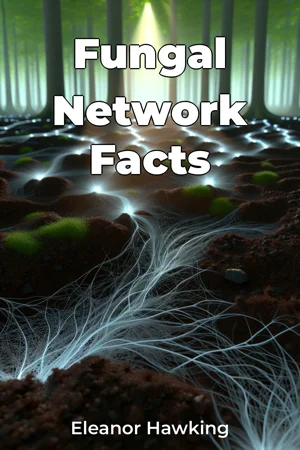
"Fungal Network Facts" reveals the hidden world of mycorrhizal networks, the complex underground systems through which plants communicate and share resources. By examining the microscopic fungal threads that connect root systems, this book presents research-based evidence of nature's sophisticated nutrient exchange mechanisms. The text explores three primary areas: the structural composition of fungal networks, their role in ecosystem health, and the biochemical processes that enable inter-plant communication. These topics help readers understand how forests and plant communities function as integrated systems rather than collections of individual organisms. Building on decades of mycological research, the book presents both historical and contemporary scientific findings. From the initial discovery of mycorrhizal relationships in the late 19th century to current research using isotope tracking and molecular analysis, readers gain insight into how scientific understanding has evolved. The central thesis demonstrates that fungal networks serve as critical infrastructure in terrestrial ecosystems, facilitating resource distribution and information sharing among plants. This understanding challenges traditional views of plant communities and suggests new approaches to forest management and agricultural practices. The book's structure progresses from fundamental concepts to practical applications. It begins with an examination of fungal morphology and taxonomy, advances through detailed analysis of nutrient transfer mechanisms, and culminates in exploring the implications for ecosystem management. Each chapter incorporates recent research findings, including data from field studies and laboratory experiments. Evidence presented includes microscopy studies, chemical analysis of nutrient transfer, and long-term forest monitoring data. The research draws from multiple laboratories worldwide, providing a comprehensive view of current scientific understanding. The work connects biology with ecology, chemistry, and environmental science, demonstrating how fungal networks influence soil health, climate resilience, and biodiversity. These interdisciplinary links provide context for understanding ecosystem dynamics and environmental protection. The book employs a systematic approach to presenting complex biological processes, using clear diagrams and detailed explanations to make technical concepts accessible. It maintains scientific accuracy while ensuring readability for both academic and general audiences. Written in a clear, methodical style, the text balances technical detail with practical examples. It serves advanced students, researchers, and professionals in biology and environmental sciences, while remaining accessible to interested general readers with basic scientific knowledge. The scope encompasses both temperate and tropical ecosystems, though it focuses primarily on forest systems where fungal networks are most extensively studied. It addresses current debates about the extent of plant communication and the implications for evolutionary biology. Practical applications include guidelines for forest conservation, agricultural planning, and ecosystem restoration. The book provides specific protocols for measuring and monitoring fungal network health in various environments. The text acknowledges ongoing scientific discussions about the degree of coordination in plant-fungal networks and the evolutionary development of these systems. It presents multiple viewpoints on these debates while maintaining focus on verified scientific findings. Target readers include biology students, environmental scientists, forest managers, and naturalists seeking to understand underground ecological processes. The book provides both theoretical knowledge and practical tools for working with natural systems. By adhering to established biological principles while incorporating recent research developments, the book offers a reliable and current resource for understanding the crucial role of fungal networks in ecosystem function and plant community dynamics.
"Fungal Network Facts" reveals the hidden world of mycorrhizal networks, the complex underground systems through which plants communicate and share resources. By examining the microscopic fungal threads that connect root systems, this book presents research-based evidence of nature's sophisticated nutrient exchange mechanisms. The text explores three primary areas: the structural composition of fungal networks, their role in ecosystem health, and the biochemical processes that enable inter-plant communication. These topics help readers understand how forests and plant communities function as integrated systems rather than collections of individual organisms. Building on decades of mycological research, the book presents both historical and contemporary scientific findings. From the initial discovery of mycorrhizal relationships in the late 19th century to current research using isotope tracking and molecular analysis, readers gain insight into how scientific understanding has evolved. The central thesis demonstrates that fungal networks serve as critical infrastructure in terrestrial ecosystems, facilitating resource distribution and information sharing among plants. This understanding challenges traditional views of plant communities and suggests new approaches to forest management and agricultural practices. The book's structure progresses from fundamental concepts to practical applications. It begins with an examination of fungal morphology and taxonomy, advances through detailed analysis of nutrient transfer mechanisms, and culminates in exploring the implications for ecosystem management. Each chapter incorporates recent research findings, including data from field studies and laboratory experiments. Evidence presented includes microscopy studies, chemical analysis of nutrient transfer, and long-term forest monitoring data. The research draws from multiple laboratories worldwide, providing a comprehensive view of current scientific understanding. The work connects biology with ecology, chemistry, and environmental science, demonstrating how fungal networks influence soil health, climate resilience, and biodiversity. These interdisciplinary links provide context for understanding ecosystem dynamics and environmental protection. The book employs a systematic approach to presenting complex biological processes, using clear diagrams and detailed explanations to make technical concepts accessible. It maintains scientific accuracy while ensuring readability for both academic and general audiences. Written in a clear, methodical style, the text balances technical detail with practical examples. It serves advanced students, researchers, and professionals in biology and environmental sciences, while remaining accessible to interested general readers with basic scientific knowledge. The scope encompasses both temperate and tropical ecosystems, though it focuses primarily on forest systems where fungal networks are most extensively studied. It addresses current debates about the extent of plant communication and the implications for evolutionary biology. Practical applications include guidelines for forest conservation, agricultural planning, and ecosystem restoration. The book provides specific protocols for measuring and monitoring fungal network health in various environments. The text acknowledges ongoing scientific discussions about the degree of coordination in plant-fungal networks and the evolutionary development of these systems. It presents multiple viewpoints on these debates while maintaining focus on verified scientific findings. Target readers include biology students, environmental scientists, forest managers, and naturalists seeking to understand underground ecological processes. The book provides both theoretical knowledge and practical tools for working with natural systems. By adhering to established biological principles while incorporating recent research developments, the book offers a reliable and current resource for understanding the crucial role of fungal networks in ecosystem function and plant community dynamics.
"Fungal Network Facts" unveils the fascinating world of mycorrhizal networks, revealing how these underground fungal systems serve as nature's internet, enabling plants to communicate and share resources. This comprehensive exploration challenges traditional views of plant communities by demonstrating how forests function as integrated systems rather than isolated organisms. Through careful examination of microscopic fungal threads connecting root systems, the book illuminates how these networks facilitate essential nutrient exchange and information sharing among plants. The book presents a logical progression from basic fungal morphology to complex ecosystem dynamics, incorporating both historical perspectives and cutting-edge research. Readers discover how these networks influence everything from soil health to climate resilience, supported by evidence from microscopy studies, chemical analyses, and long-term forest monitoring data. Particularly intriguing is the revelation of how plants use these fungal highways to transfer resources to their neighbors and even send warning signals about environmental threats. Written with both scientific precision and accessibility in mind, the text bridges the gap between technical research and practical application. It synthesizes findings from laboratories worldwide, offering insights into ecosystem management, forest conservation, and agricultural practices. The book's interdisciplinary approach makes it valuable for audiences ranging from biology students and environmental scientists to forest managers and naturalists, providing both theoretical understanding and practical tools for working with these remarkable natural systems.
Book Details
ISBN
9788233946234
Publisher
Publifye AS
Your Licenses
You don't own any licenses for this book
Purchase a license below to unlock this book and download the EPUB.
Purchase License
Select a tier to unlock this book
Need bulk licensing?
Contact us for enterprise agreements.