
About This Book
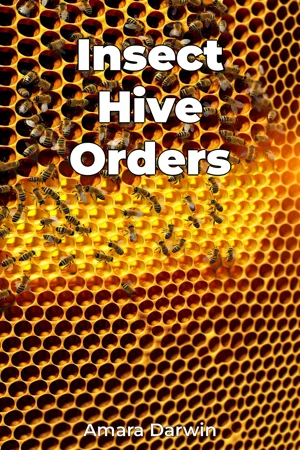
"Insect Hive Orders" delves into the intricate social structures that have enabled certain insect species to become some of Earth's most successful organisms, occupying nearly every terrestrial environment through their sophisticated collective behaviors. The book examines three primary social insect orders—Hymenoptera (bees and ants) and Isoptera (termites)—through the lens of modern entomological research, revealing how their complex social systems enable survival, reproduction, and territorial expansion. These insects have developed sophisticated methods of communication, labor division, and resource management that rival human social structures in their complexity. The text builds upon foundational research dating back to Karl von Frisch's groundbreaking studies of bee communication in the 1940s, advancing through contemporary findings in chemical ecology, behavioral genetics, and swarm intelligence. Readers will gain essential background in insect biology and social behavior theory while exploring cutting-edge research in these fields. Central to the book's thesis is the concept that social insects represent a pinnacle of evolutionary achievement, where individual organisms function as components of a larger, cohesive superorganism. This perspective illuminates how collective decision-making and coordinated actions emerge from seemingly simple individual behaviors. The content progresses through three major sections: First, it examines the physical and chemical mechanisms of insect communication, including pheromone signaling and tactile interactions. Second, it analyzes the organization of labor systems, from nest construction to brood care. Third, it explores how these societies respond to environmental challenges and maintain homeostasis. Research evidence is drawn from field studies, laboratory experiments, and genetic analyses, incorporating data from long-term colony observations and advanced imaging techniques. The book features detailed case studies of specific colonies and their responses to various environmental pressures. The work connects with multiple scientific disciplines, including chemistry (through pheromone analysis), architecture (through nest design studies), and computer science (through swarm intelligence applications). These interdisciplinary links demonstrate how insights from social insects inform technological innovations and organizational theory. The writing maintains a clear, systematic approach, utilizing technical terminology while providing accessible explanations for complex concepts. Each chapter builds upon previous information, creating a comprehensive understanding of social insect systems. This book serves researchers, students, and professionals in biology and related fields, offering both theoretical frameworks and practical applications. It particularly appeals to those interested in organizational behavior, collective intelligence, and evolutionary biology. The scope encompasses both macro-level colony organization and micro-level individual behaviors, though it primarily focuses on species with true social structures rather than semi-social or solitary insects. Practical applications include insights for artificial intelligence development, architectural design, and organizational management. The research presented has implications for understanding complex systems in various fields, from logistics to urban planning. The text addresses ongoing debates in the field, such as the evolution of altruistic behavior and the role of individual selection versus group selection in social evolution. It presents current evidence and competing theories while maintaining objective analysis of different viewpoints.
"Insect Hive Orders" delves into the intricate social structures that have enabled certain insect species to become some of Earth's most successful organisms, occupying nearly every terrestrial environment through their sophisticated collective behaviors. The book examines three primary social insect orders—Hymenoptera (bees and ants) and Isoptera (termites)—through the lens of modern entomological research, revealing how their complex social systems enable survival, reproduction, and territorial expansion. These insects have developed sophisticated methods of communication, labor division, and resource management that rival human social structures in their complexity. The text builds upon foundational research dating back to Karl von Frisch's groundbreaking studies of bee communication in the 1940s, advancing through contemporary findings in chemical ecology, behavioral genetics, and swarm intelligence. Readers will gain essential background in insect biology and social behavior theory while exploring cutting-edge research in these fields. Central to the book's thesis is the concept that social insects represent a pinnacle of evolutionary achievement, where individual organisms function as components of a larger, cohesive superorganism. This perspective illuminates how collective decision-making and coordinated actions emerge from seemingly simple individual behaviors. The content progresses through three major sections: First, it examines the physical and chemical mechanisms of insect communication, including pheromone signaling and tactile interactions. Second, it analyzes the organization of labor systems, from nest construction to brood care. Third, it explores how these societies respond to environmental challenges and maintain homeostasis. Research evidence is drawn from field studies, laboratory experiments, and genetic analyses, incorporating data from long-term colony observations and advanced imaging techniques. The book features detailed case studies of specific colonies and their responses to various environmental pressures. The work connects with multiple scientific disciplines, including chemistry (through pheromone analysis), architecture (through nest design studies), and computer science (through swarm intelligence applications). These interdisciplinary links demonstrate how insights from social insects inform technological innovations and organizational theory. The writing maintains a clear, systematic approach, utilizing technical terminology while providing accessible explanations for complex concepts. Each chapter builds upon previous information, creating a comprehensive understanding of social insect systems. This book serves researchers, students, and professionals in biology and related fields, offering both theoretical frameworks and practical applications. It particularly appeals to those interested in organizational behavior, collective intelligence, and evolutionary biology. The scope encompasses both macro-level colony organization and micro-level individual behaviors, though it primarily focuses on species with true social structures rather than semi-social or solitary insects. Practical applications include insights for artificial intelligence development, architectural design, and organizational management. The research presented has implications for understanding complex systems in various fields, from logistics to urban planning. The text addresses ongoing debates in the field, such as the evolution of altruistic behavior and the role of individual selection versus group selection in social evolution. It presents current evidence and competing theories while maintaining objective analysis of different viewpoints.
"Insect Hive Orders" explores the fascinating world of social insects, revealing how bees, ants, and termites have evolved into some of Earth's most successful organisms through their remarkable collective behaviors. The book examines how these tiny creatures develop sophisticated social structures that rival human societies in complexity, focusing on their intricate methods of communication, labor division, and resource management. Through a systematic progression from basic communication mechanisms to complex colony organization, the text illuminates how individual insects work together as components of a larger superorganism. Readers discover how pheromone signaling and tactile interactions enable thousands of insects to coordinate their activities seamlessly, from constructing elaborate nests to caring for their brood. The book builds upon foundational research while incorporating cutting-edge findings in chemical ecology and behavioral genetics, making complex concepts accessible to both scientists and enthusiasts. The book's unique value lies in its comprehensive approach to understanding social insect colonies as integrated systems, connecting their behaviors to broader applications in fields like artificial intelligence and organizational management. By examining both macro-level colony structures and micro-level individual behaviors, it demonstrates how collective intelligence emerges from simple actions, supported by evidence from field studies, laboratory experiments, and long-term colony observations. This interdisciplinary perspective makes it an invaluable resource for anyone interested in evolutionary biology, collective behavior, or complex systems.
Book Details
ISBN
9788233946203
Publisher
Publifye AS
Your Licenses
You don't own any licenses for this book
Purchase a license below to unlock this book and download the EPUB.
Purchase License
Select a tier to unlock this book
Need bulk licensing?
Contact us for enterprise agreements.